Coaching tools › Guides › Playing through the lines
Tactics guide · in possession · the tenPlaying through the lines:
how to find the ten
Every team has a player who is supposed to live between the other team's midfield and their back four. Most of them never get the ball there. This guide shows where that space is, how the ten hides in it and shows late, the pass that gets there, what the striker and wingers have to do so it stays open, what to do when the ten is marked, and the phase of play that trains all of it.
 Playing Through the Lines: How to Find the Ten
The picture: two lines and the strip between them
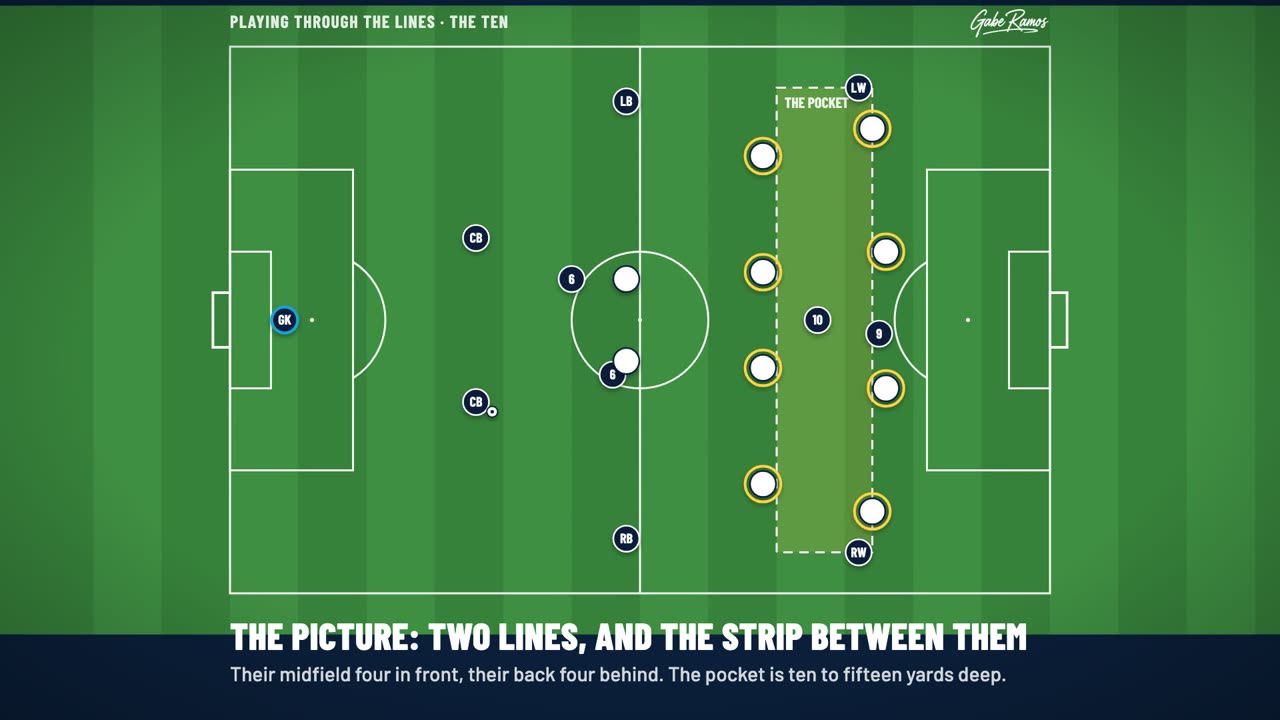
Their team defends in two lines: a midfield four in front, a back four behind. Between those two lines there is a strip of grass, ten to fifteen yards deep. That strip is the pocket. A player who receives in it is behind their midfield and in front of their defense, and nobody is sure whose job they are.
Show the players the strip before you show them anything else. On the training field, mark it with flat cones between a passive midfield four and a passive back four, and let the ten stand in it for a minute. Once they have seen that nobody is looking at them, the rest of this guide makes sense.
Why it works: a defender can only look one way
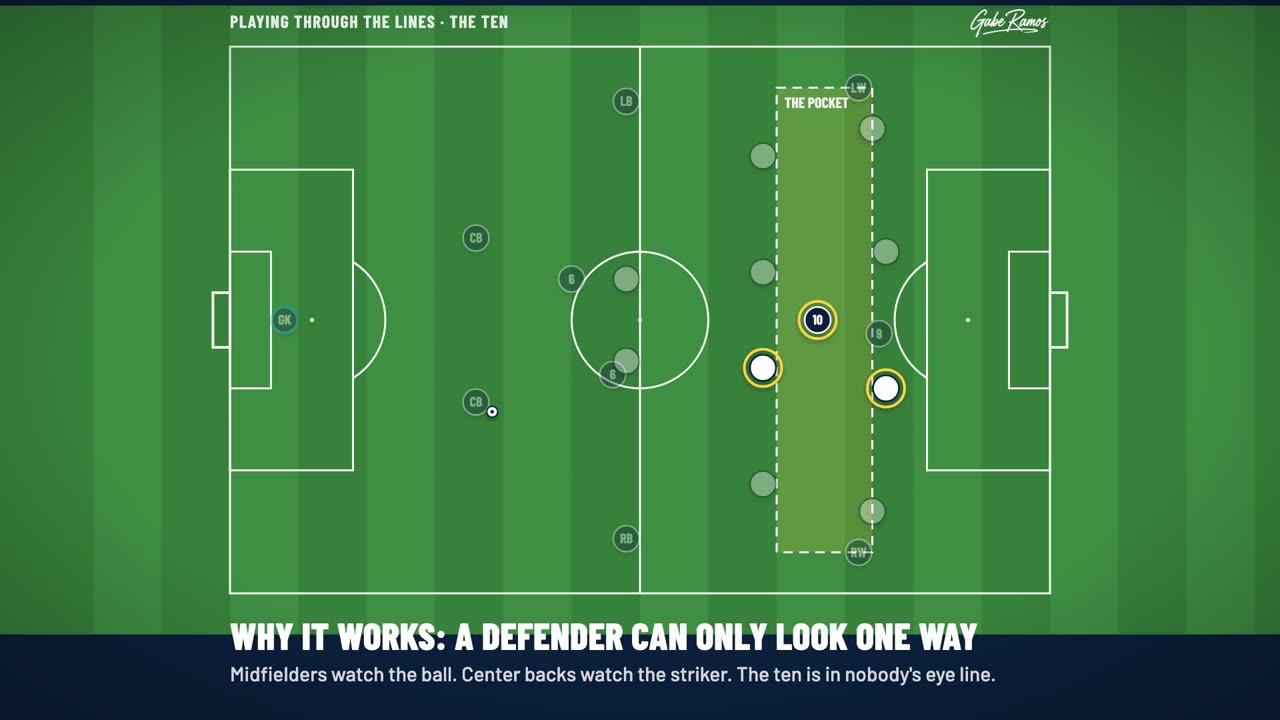
Their midfielders are watching the ball. Their center backs are watching our striker. A ten standing between them is in nobody's eye line, and the moment the ball arrives, one of those two lines has to break to deal with it. Break the midfield line and we are through. Break the back line and the striker is in.
That is the whole value of the position. The ten does not need to beat anyone; the ten needs to make two lines argue about who is responsible, and then play the pass that punishes whichever one moves.
Rule one: hide, then show late
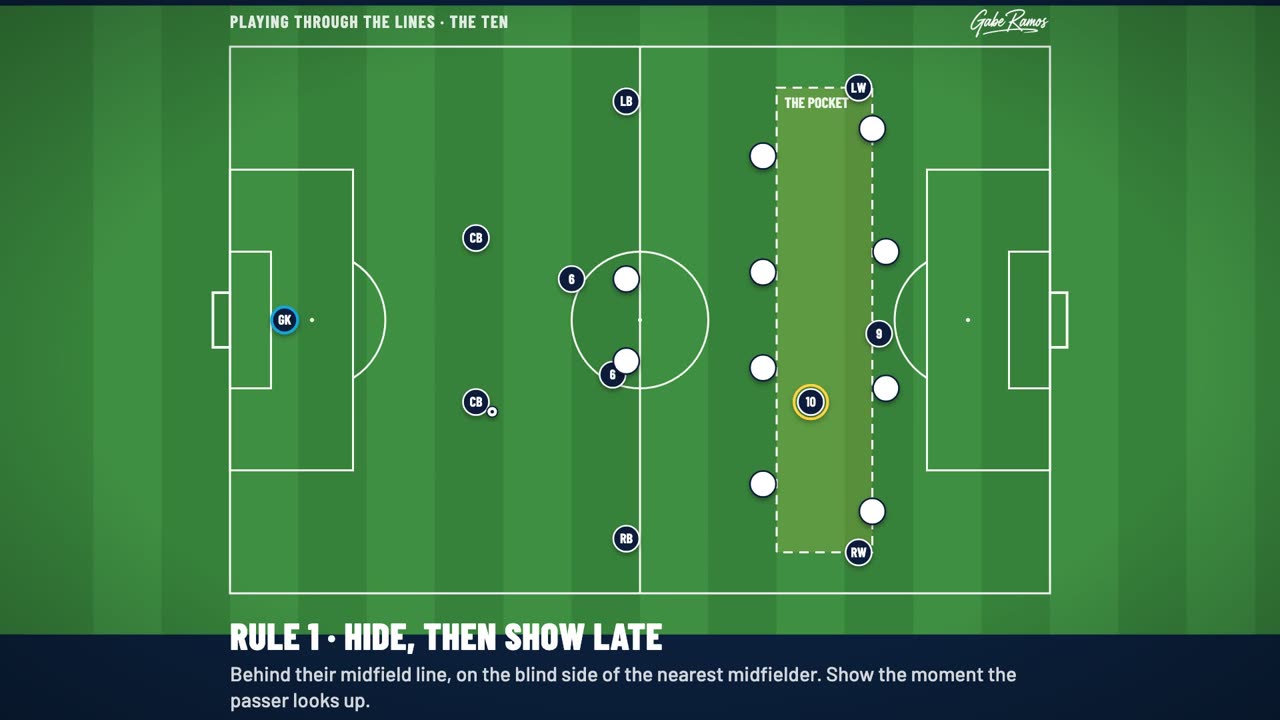
The ten starts behind their midfield line, on the blind side of the nearest midfielder. Not in front of them, where they can see you, and not deep, where the pivots already are. Stand still, stay hidden, and show the moment the passer looks up. A ten who shows early is marked. A ten who shows late is free.
Young tens hate this rule because it means doing nothing for long stretches. Tell them the truth: the hardest part of the job is standing still, and the reward is receiving in a space where nobody can tackle you.
Rule two: the pass through the gate
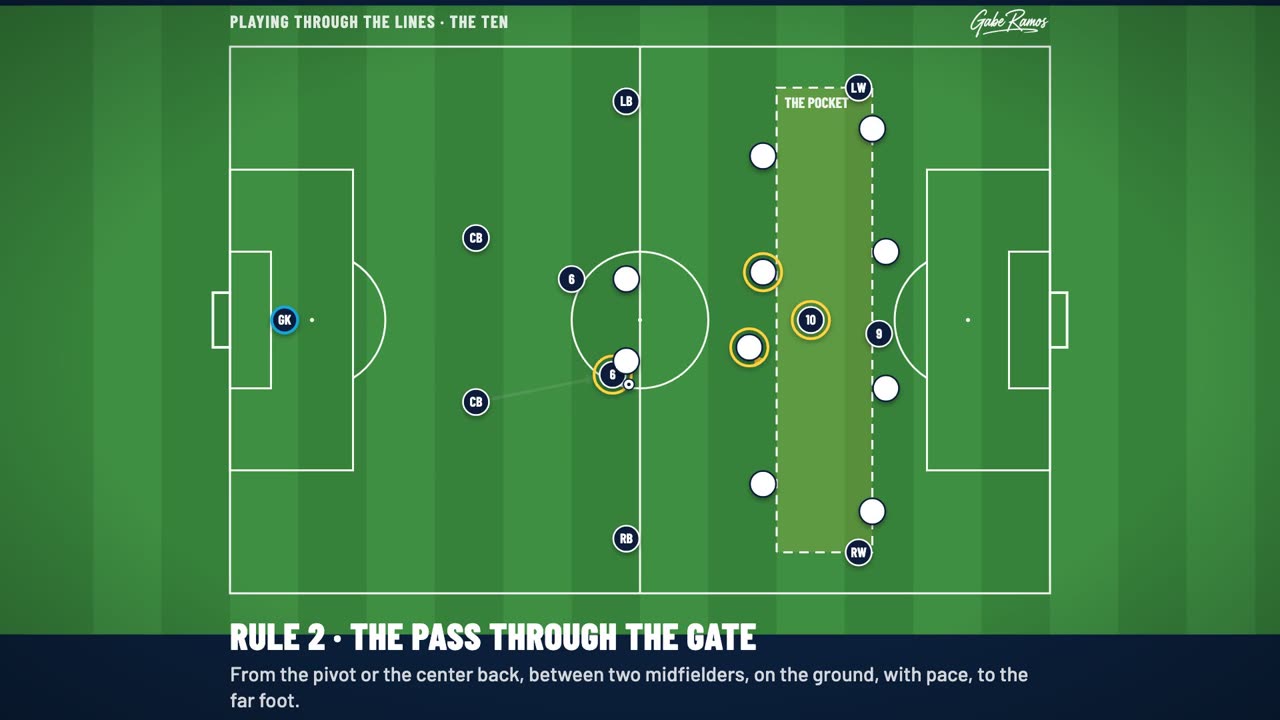
The pass comes from the pivot or the center back, and it goes through the gate between two of their midfielders. Along the ground, with pace, to the far foot. Play it when their midfielder's head turns toward the ball, because that is the second they cannot see the ten. The pass through the lines is a timing pass, not a power pass.
The far foot matters. A pass to the near foot means the ten has to turn across their body with the defender arriving; a pass to the far foot means the first touch already goes forward. Coach the passer to see the ten's body shape, not just the ten.
- Through the gate between two midfielders, never around them.
- On the ground, with pace, to the far foot.
- Played when the midfielder's head turns toward the ball.
Rule three: receive on the half turn
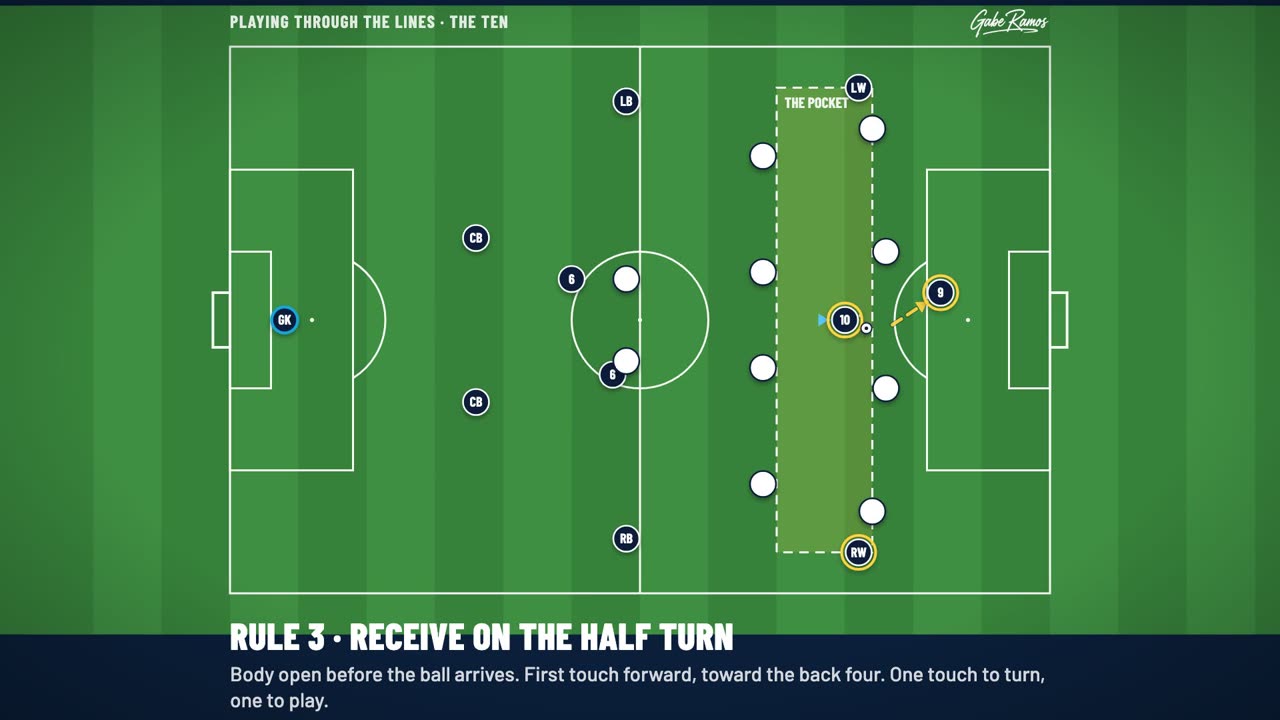
The ten's body is open to the field before the ball arrives, so the first touch takes them forward, toward the back four, not back toward the pivots. One touch to turn, one to play. A ten who receives with their back to goal has to turn in traffic, and that is where the ball gets lost.
The look comes before the half turn. A shoulder check as the pass is played tells the ten whether the center back has stepped, which decides whether the first touch is a drive at the back line or a pass to the striker who is now free.
Rule four: pin the back line
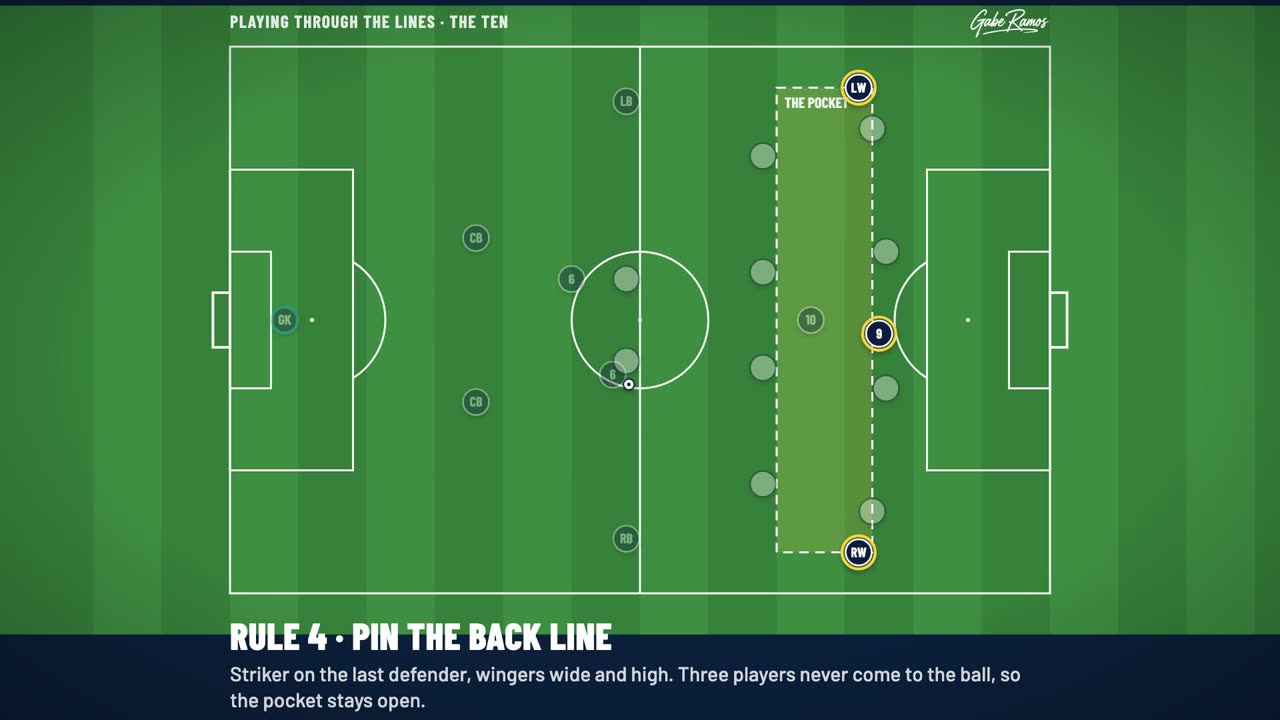
Somebody has to pin the back line, or the pocket closes. The striker stands on the last defender, and stays there. The wingers stay wide and high. Now the center backs cannot step up to the ten without leaving the striker, and the full-backs cannot tuck in without leaving the wingers. The pocket stays open because three players never come to the ball.
This is the rule the ten cannot enforce alone, which is why it belongs to the whole team. A striker who drops to help is closing the space the ten needs. Tell the striker before the game: your job is to stand on their last defender and be boring.
Rule five: marked? Use the ten anyway
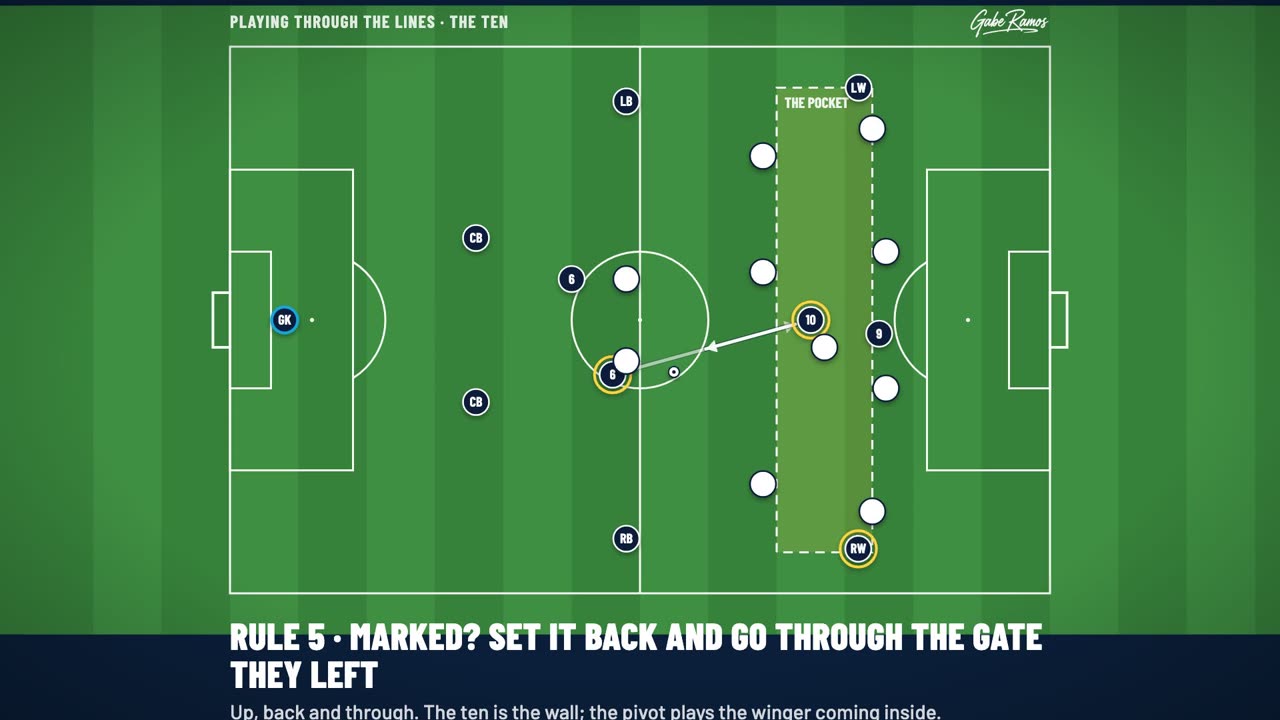
When the ten is marked, play the ball in anyway, and the ten sets it back first time to the pivot. Their midfielder has followed the ten, so the gate they left is open, and the pivot plays through it to the winger coming inside. Up, back and through. The ten does not have to turn to be useful. Sometimes the ten is the wall.
The set has to be first time and firm. A ten who takes a touch gives the marker time to recover into the gate. Up, back and through is the oldest pattern in the game, and it works because the second pass is played before the defense has finished reacting to the first.
In a 4-3-3: the two eights share the job
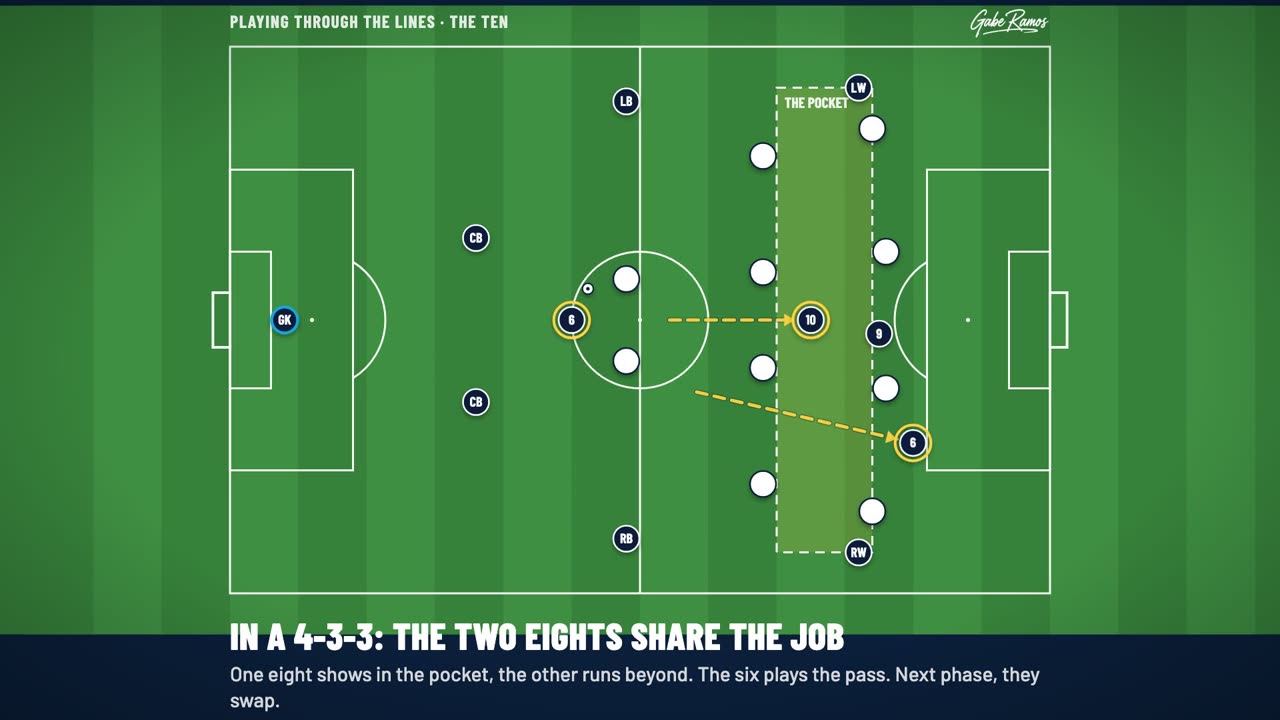
In a 4-3-3 there is no ten, so the two eights share the job. One eight shows in the pocket, the other runs beyond the back line. The six plays the pass. Next phase, they swap. Same pocket, same rules, two players taking turns instead of one who lives there.
The formation guide covers when a team should use a true ten and when the eights are the better answer. If your eights can do this, the 4-3-3 gives you two players who can receive between the lines instead of one.
The failure you will see every weekend
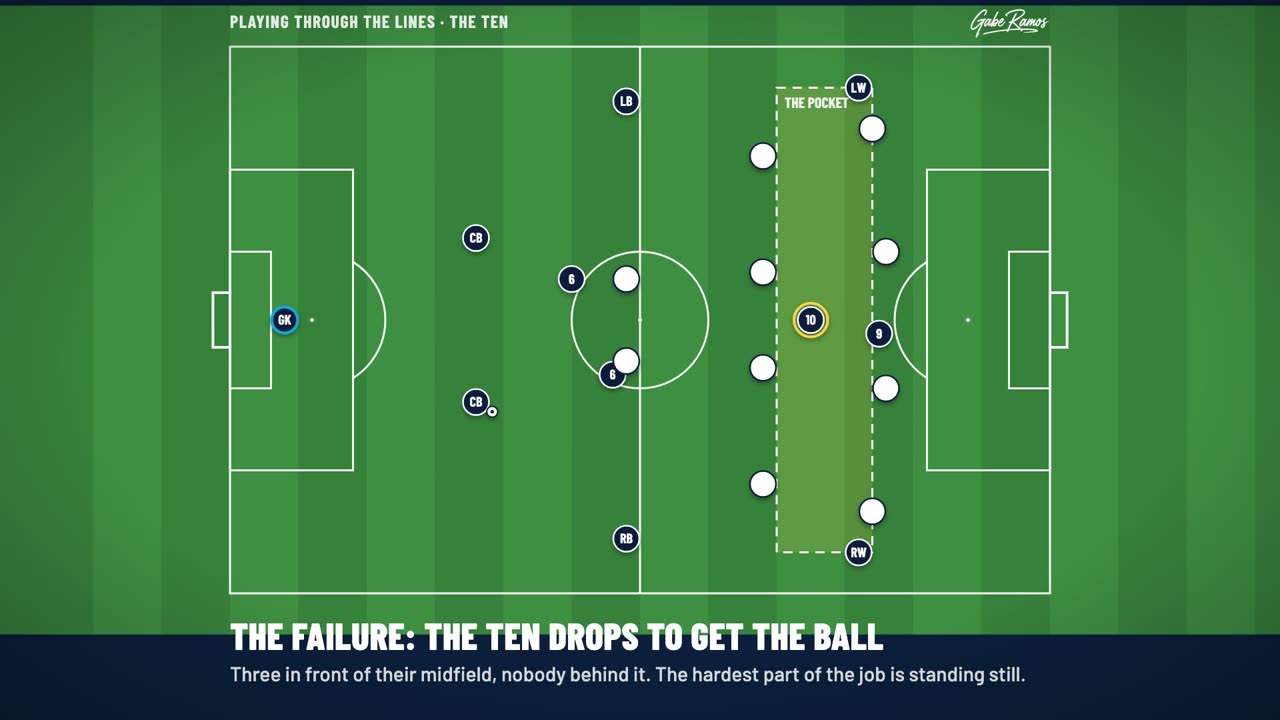
The ten is not getting the ball, so the ten comes to get it. They drop next to the pivots, and now you have three players in front of their midfield and nobody behind it. The pocket is empty and the pass through the lines no longer exists.
Watch for it after ten minutes without a touch, which is when every young ten starts to drift. The fix is a single sentence, said from the touchline: stay behind their line. If the ball is not coming, the problem is the pass or the pin, not the position.
The recap
- The pocket is the strip between their midfield and their back four, ten to fifteen yards deep.
- Hide behind the line, on the blind side of the nearest midfielder. Show late.
- Pass through the gate, on the ground, to the far foot, when the midfielder's head turns.
- Receive on the half turn: one touch to turn, one to play.
- Striker and wingers pin the back line so the pocket stays open.
- Marked? Set it back first time and go through the gate they left.
- A ten who drops to get the ball has just closed the pocket.
Coach it in one session
The midfield block of the 11v11 curriculum, weeks 5 and 6, where the principle is Help the Ball: two options, on angles, before they are needed. This is the MD-3 session, ninety minutes at medium intensity.
Pocket Rondo
RondoA 15x12 split into thirds. Four attackers on the ends, one in the middle third with three defenders. Score by passing from one end to the other through the middle, where the pocket player receives side-on between two defenders, lays it off or lets it run. Full activity page ›
Split the Gate
SharpenA 12x12 with two defenders standing as a gate in the middle, three yards apart, and four attackers on the sides. A pass through the gate is three points; around is one. Disguise it: look one way, play the other, and move the gate with the ball before going through it. Full activity page ›
Through the Lines, phase of play
SolveA 70x60. Keeper, back four, two pivots, a ten and a striker against a 4-4-2 block of ten. Three zones: our build zone, their midfield zone, and the pocket. A pass received in the pocket and played forward is two points; a ball over the top is one. Pressers counter to the goal. The coaching call is one word: when?
11v11 with a pocket bonus
PlayThree eight-minute periods. A goal that includes a pass received between their midfield and back four counts double. The coach freezes play when the ten drops below their midfield line without the ball.
Our kick-off
Set pieceTwo touches back to the six, switch to a full-back, into the winger. If we lose it: five-second fight.
For 9v9 teams the same idea is Shoulder-Check Lines and Bounce or Turn: the half turn and the set-back, one receiver at a time.
Questions coaches ask
What if the other team plays with a holding midfielder sitting in the pocket?
Then the pocket moves. A six who sits between the lines leaves a gap either side of them, usually in the half-spaces between their center back and full-back. The ten hides on the far side of the six and shows into the half-space, and the pass goes through the gate between the six and the nearest midfielder. Same rules, narrower gate.
How do we coach a ten who keeps dropping deep?
Make the pocket a rule in the Play block: the coach freezes play whenever the ten is below their midfield line without the ball, and a goal that goes through the pocket counts double. Within two sessions the ten stays high because it pays. Then tell them the truth: the hardest part of the job is standing still.
Is the pass through the lines too risky for youth teams?
It is risky when it is forced and safe when it is timed. The rule is the midfielder's head: play it when they look at the ball, keep it when they are looking at the ten. A team that only plays safe passes in front of the block never scores against one; the guide on beating a low block covers the rest.
Does this work at 9v9?
Yes, with one line fewer. A 9v9 team defending in a 3-3-2 or 2-3-3 still has a midfield line and a back line, and the center mid or a wide mid coming inside is the player who receives between them. The 2-3-3 guide covers the wide mids coming inside.
Keep reading
 Tactics guidePlaying out of the back in a 4-2-3-1
The staggered pivots, the switch through the higher pivot and how to find the ten.
Read the guide › Tactics guidePlaying out of the back in a 4-3-3
The 2-3-5 build shape, the first triangle and the four decisions a center back makes.
Read the guide › Tactics guideHow to beat a low block
Width and patience, move the block then switch, the wide two v one, the cutback.
Read the guide ›The whole 11v11 game model, twelve weeks of sessions
The Full Season Travel Curriculum for ages 13 to 18 comes as two editions, one for the 4-3-3 and one for the 4-2-3-1: the game model in six pages, 36 sessions built around a match week (MD-4, MD-3, MD-2), twelve match-day pages, set pieces and the 35-minute warm-up. Every phase of play in these guides is in it.