Coaching tools › Guides › Beating a low block
Tactics guide · in possession · final thirdHow to beat
a low block
Nine players behind the ball, twenty-five yards front to back, and no space behind them. Every youth coach meets this team twice a season and most lose to it on a counter. There is space in two places, wide and in the pockets between their lines, and these five rules are about getting to both without getting caught on the way.
 How to Beat a Low Block
The picture
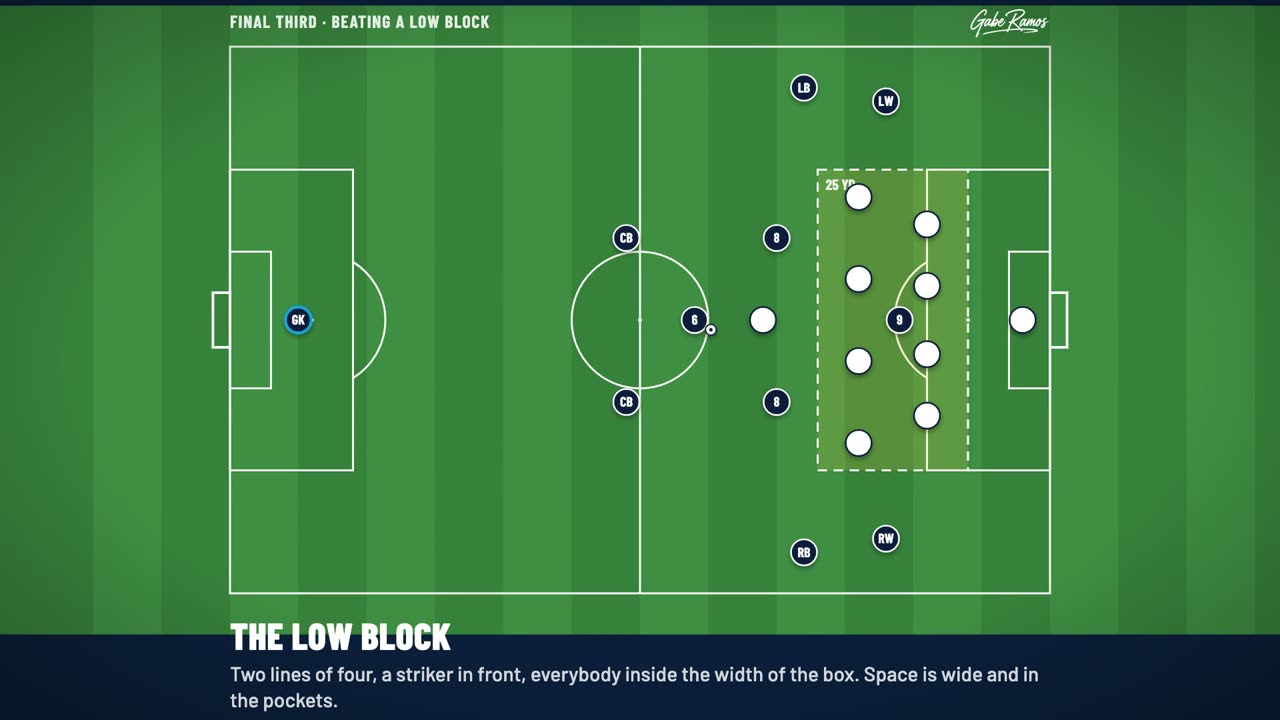
Two lines of four, a striker in front, everybody inside the width of the box. There is no space in behind. There is space in two places: wide, outside the block, and in the pockets between their lines. Everything we do is about those two places.
Show the players the picture before you show them the rules. A low block looks impenetrable from the touchline and looks like a gift from above: eighteen yards of touchline on each side that nobody is defending.
Rule one: width and patience
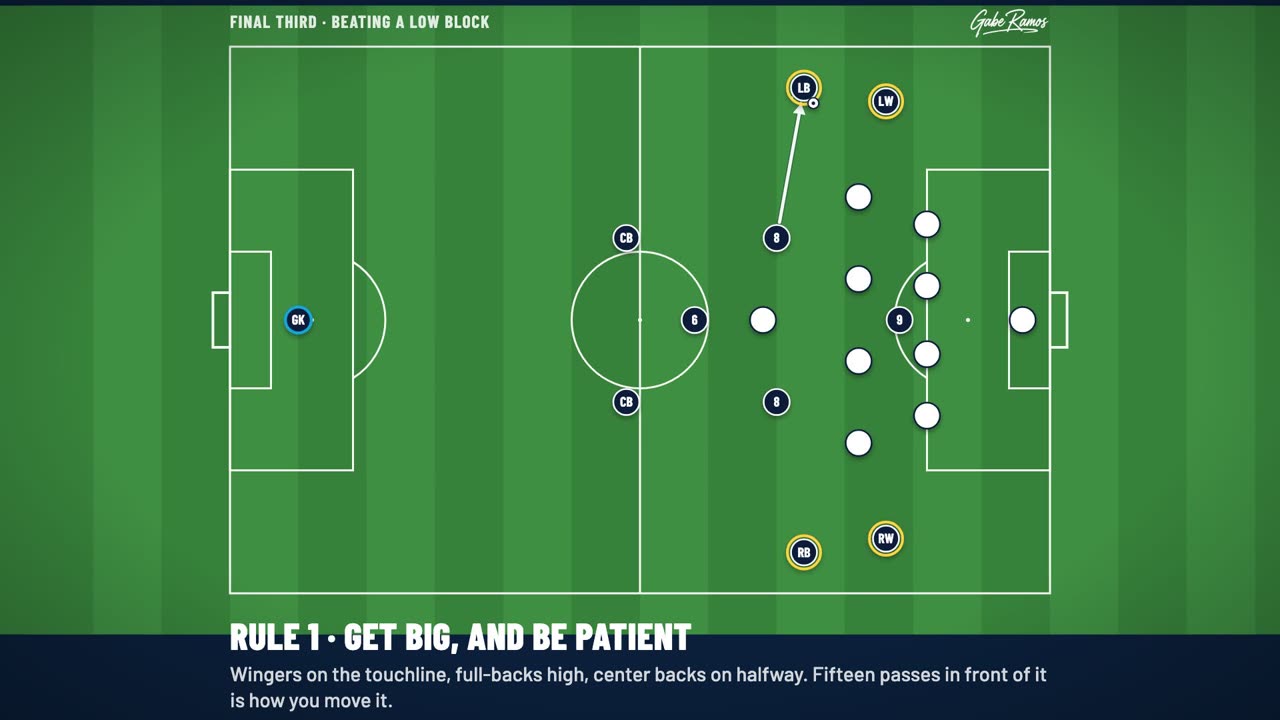
Get big. Wingers on the touchline, full-backs high, center backs on the halfway line. A block that has to cover the whole width gets thinner. And be patient. The block wants you to hurry. Fifteen passes in front of it is not failure. It is how you move it.
Patience is the hardest thing to coach into a youth team that is drawing 0-0 with ten minutes left. Say it before the game and say it at halftime: the ball in front of their block is our ball. Nobody is losing anything while we have it.
Rule two: move the block, then attack where it is not
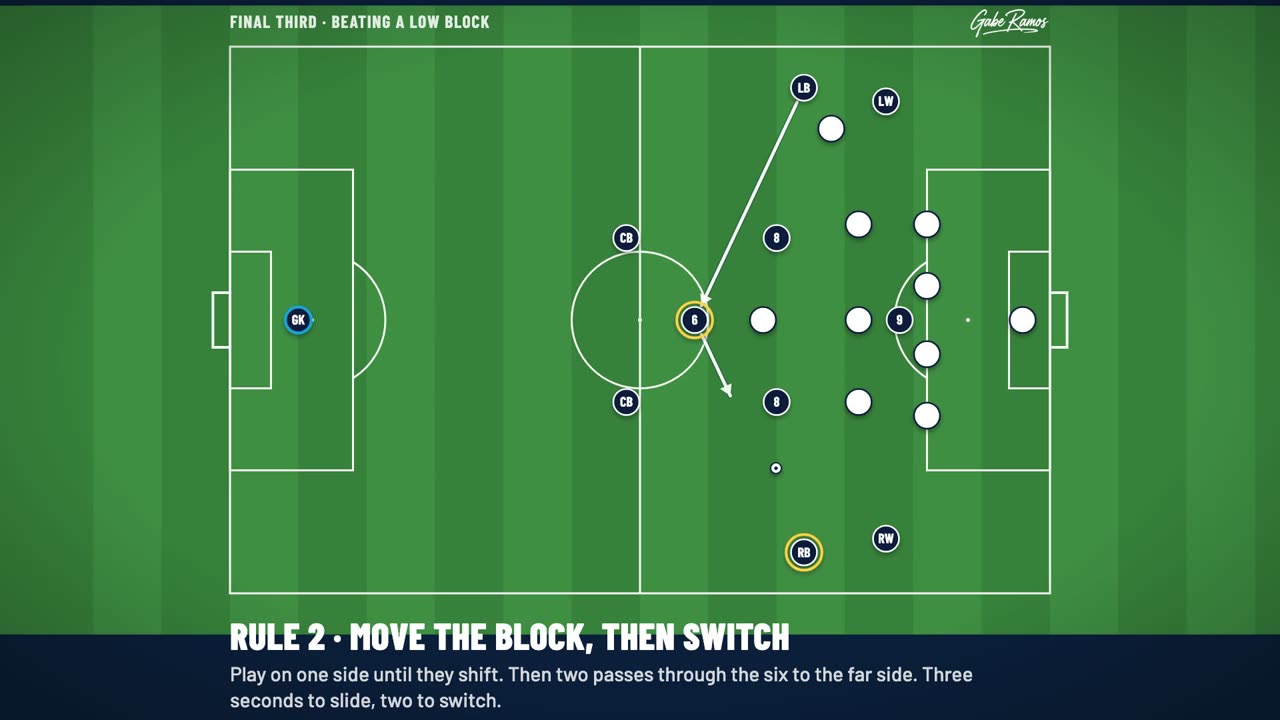
Play on one side until they shift over. Then switch, fast, through the six in two passes, to the far full-back or winger. The block takes three seconds to slide across. The switch takes two. That second is the gap.
The switch has to be two passes, not one long diagonal. A diagonal is in the air for two seconds and the block slides under it. Center back to six, six to far full-back, both along the ground, and the ball is on the far side before the block has turned its head.
Rule three: the wide two v one
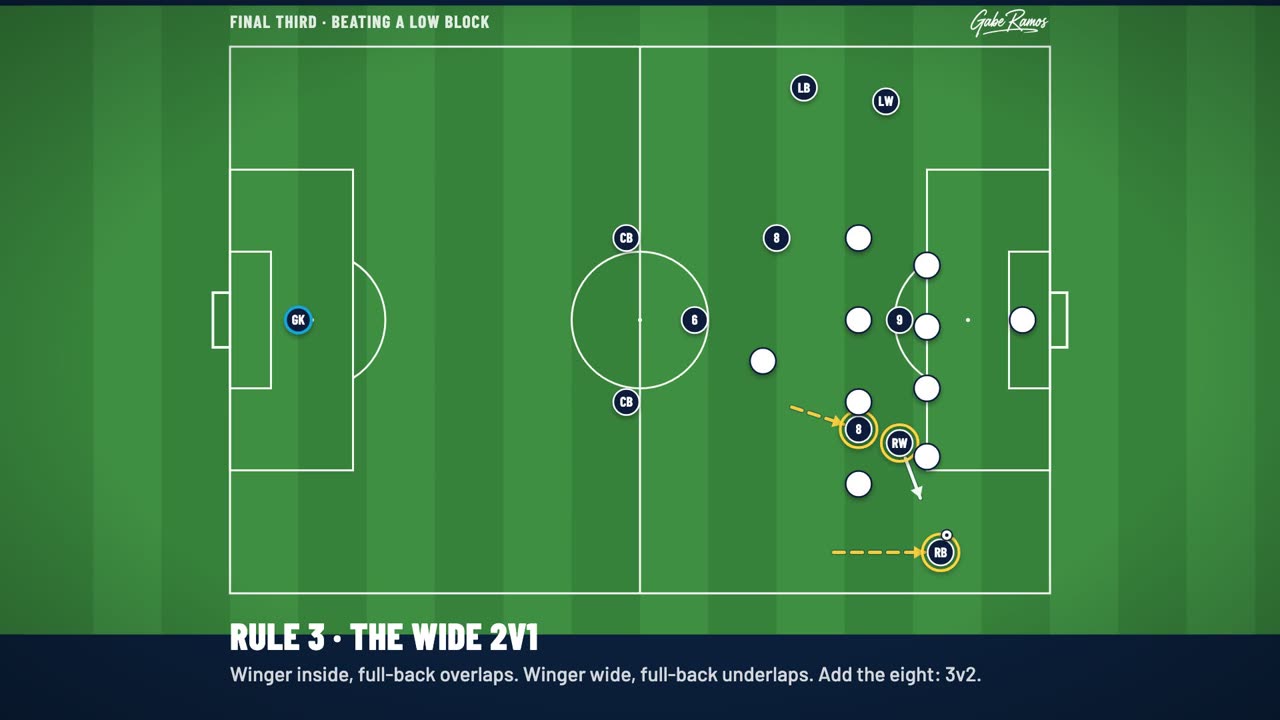
The winger and the full-back against their full-back. Winger inside, full-back overlaps. Winger stays wide, full-back underlaps. Add the eight and it is three against two. Their full-back has to choose, and whoever they leave is free.
Against a block, the wide two v one is the only overload you will get for free, because the block is built to protect the middle. Train it until the winger and full-back can run it without looking at each other.
Rule four: get to the line and cut it back
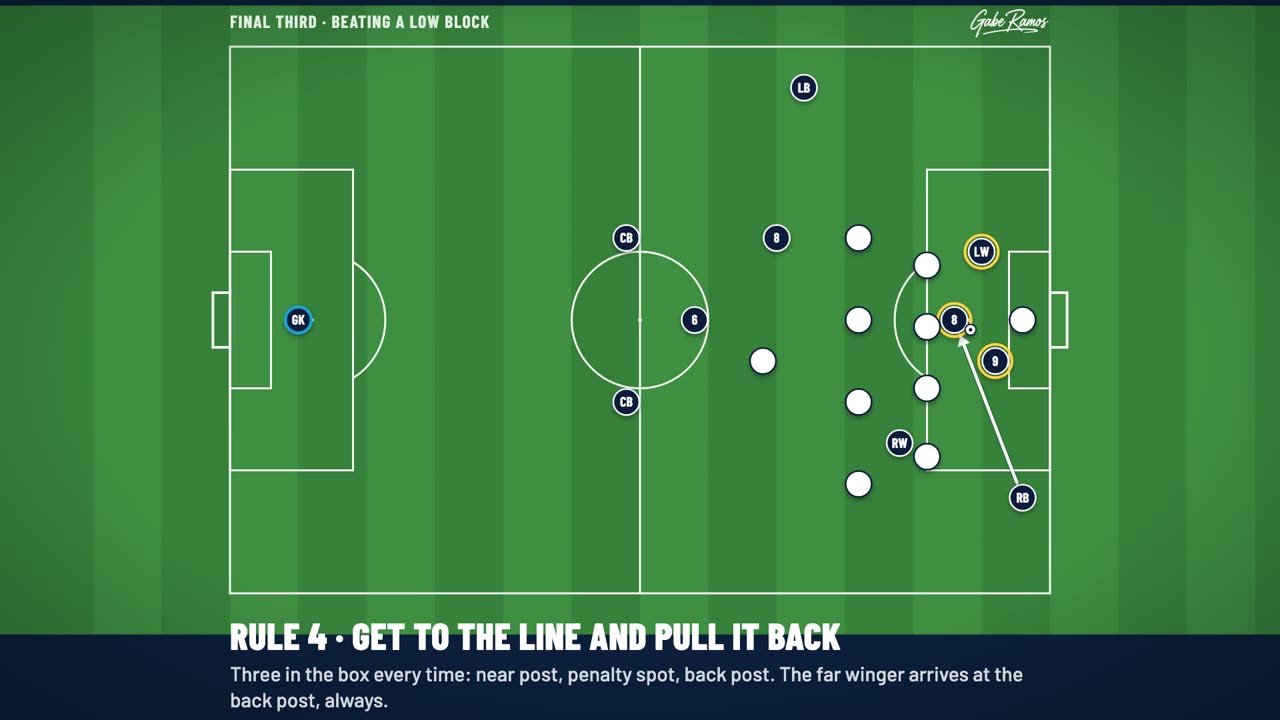
Against a deep block the cutback is our best chance, because every defender is facing their own goal and the ball comes from behind them. Three in the box every time: near post, penalty spot, back post. The far winger arrives at the back post, always.
The cutback works because a defender facing their own goal cannot see the runner arriving behind them. Get the ball to the goal line, pull it back to the penalty spot, and the first-time finish comes from a player nobody was marking.
Rule five: pin and arrive
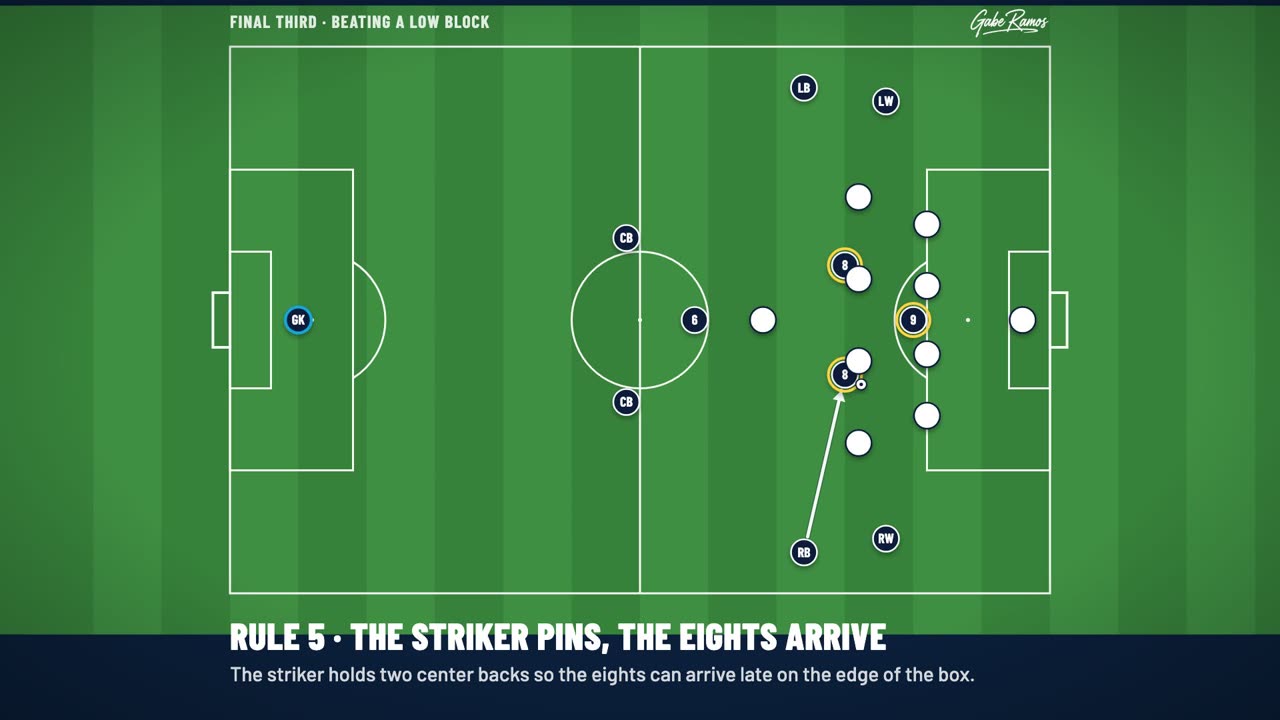
The striker pins two center backs so everyone else can arrive. The eights arrive late, on the edge of the box, where the block leaves the space. If they sit so deep that the box is full, that edge-of-the-box arrival is the shot.
The striker's job against a block is not to score. It is to hold two center backs still so that the eights have a free run to the space in front of them. Tell the striker that before the game, or they will drop to look for the ball and empty the box.
Rest defense
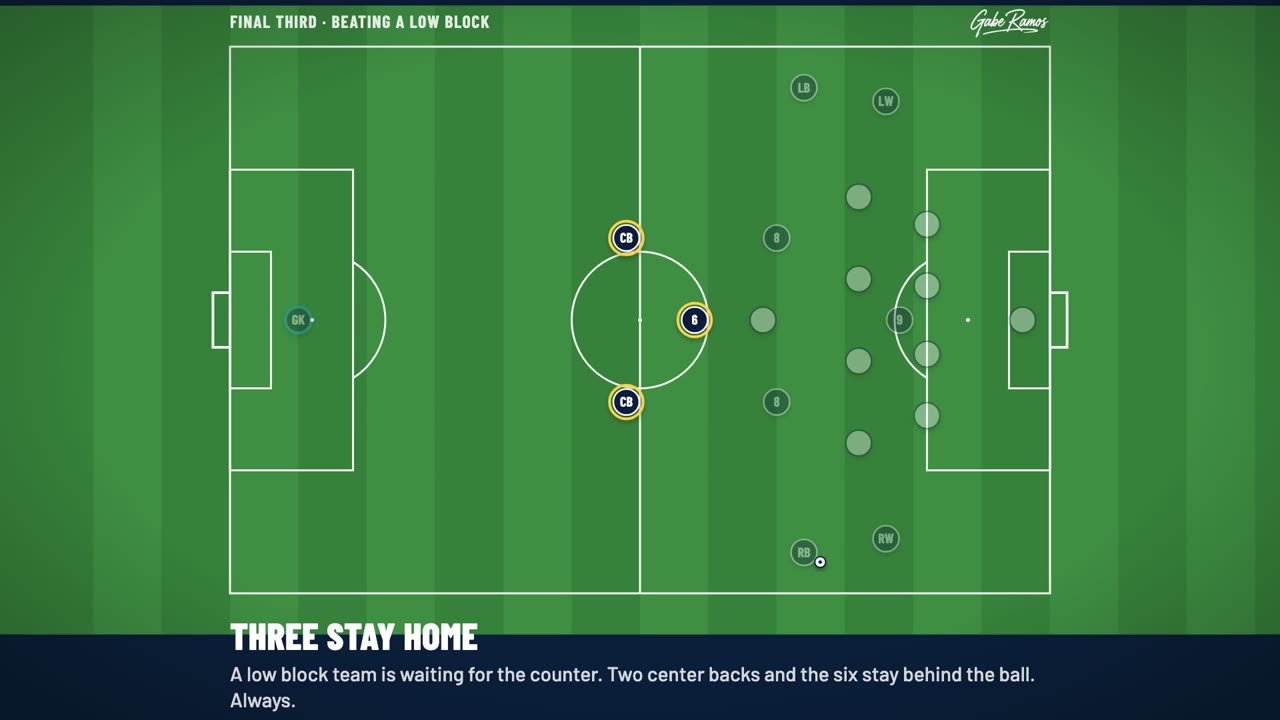
A low block team is waiting for the counter. So on every attack the two center backs and the six stay behind the ball. Always. You can send eight players at the block, but those three hold. That is what lets you commit.
Most goals conceded against a low block come from the counter, not from the block. The full guide on rest defense covers who holds and who presses when the ball is lost.
The cross that never works
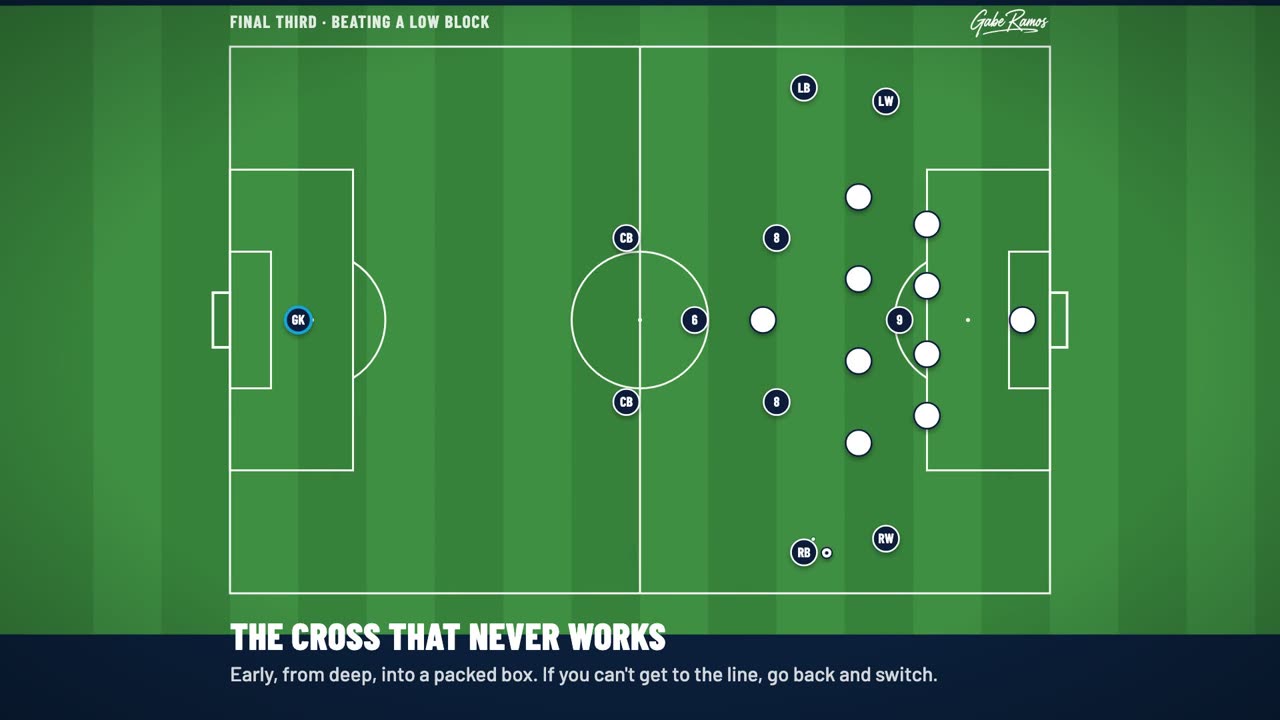
Early, from deep, into a packed box, against a team with three center backs and a keeper waiting for it. Ninety percent of them come straight out. If you cannot get to the line, go back and switch. The block has to move before the ball goes in.
An early cross is the block's favorite outcome. It gives their biggest players the ball in the air, in their own box, with your team facing the wrong way for the counter. Ban it in training for a month and the players will find the line instead.
The recap
- Get big and be patient. Fifteen passes in front of the block is how you move it.
- Move the block, then switch in two passes through the six.
- Wide two v one: winger inside, full-back overlaps; winger wide, full-back underlaps.
- Get to the line and cut it back, three in the box.
- Striker pins, eights arrive late.
- Three stay home. No early crosses from deep.
Coach it in one session
A final-third session built from the overload and switching themes of 100 Possession Activities, scaled to 11v11 in the Play block. Ninety minutes.
Two-Side Rondo
RondoA 16x8 with two attackers on each short end and two defenders inside. Score by passing from one end to the other along the ground: draw the defenders to one side with a short pass, then hit the far side. Short, short, long. Full activity page ›
Switch Through the Middle
SharpenTwo attackers on each side line of a 20x14, two in the middle, three defenders. Score by moving the ball from one side to the other through a middle player. The switch is quicker through the six than around the outside. Full activity page ›
Full-Back Joins
SolveA 30x25 with a goal and keeper. Two wide players and a striker against three defenders; on the first pass to a wide player, the full-back joins to make it 4v3 with ten seconds to a shot. Coach the cutback, and coach who arrives where: near post, spot, back post. Full activity page ›
11v11 against a block
PlayThree eight-minute periods. One team defends in a low block from the edge of its own third and counters to two mini goals on halfway. A goal from a cutback counts double; a cross from outside the width of the box gives the ball to the other team.
Attacking corners
Set pieceA driven delivery to the back-post zone between the six and the penalty spot, three late runners from outside the box, one short option, two on the edge. Two stay back: the six and a center back, always.
The 7v7 and 9v9 version of the wide overload is Channel Game, where a goal counts double if the move went through a wide channel.
Questions coaches ask
How long should we keep the ball in front of a block before trying something?
As long as it takes the block to move. Fifteen passes is normal, twenty-five is fine. The only wasted pass is the one played into the block before it has shifted. Give the players a number before the game so patience feels like a plan, not a failure.
Should we shoot from distance against a low block?
Yes, when the eight arrives late on the edge of the box after the striker has pinned the center backs. That is rule five, and it is a real chance. A speculative shot from thirty yards with the block in place is a turnover with extra steps.
What if they have a giant center back who wins every cross?
Then stop crossing in the air and cut it back along the ground. A center back who wins headers is facing their own goal when the ball comes from the goal line, and the cutback goes behind them to a player they cannot see. The giant is the reason the cutback exists.
We keep getting countered. Is it the attack or the defense?
It is the shape you attack in. If both full-backs and the six are ahead of the ball when you lose it, one long pass is a two v two at your goal. Keep the two center backs and the six behind the ball on every attack and the counter dies before it starts.
Keep reading
 Tactics guideRest defense: attack without getting countered
Three stay behind the ball, the nearest three press for five seconds, and the bench calls every turnover.
Read the guide › Tactics guidePlaying out of the back in a 4-3-3
The 2-3-5 build shape, the first triangle and the four decisions a center back makes.
Read the guide › Tactics guideHow to press in a 4-3-3
Three moments, four triggers, the touchline trap and the six who never joins.
Read the guide ›Ten build-up activities, each with a video
100 Possession Activities has a full theme on playing out from the back, from a keeper and two backs against one presser to a 9v9 where every goal kick is short, plus nine more themes: rondos, through the lines, switching, overloads, movement, timing, counter-pressing and counter-attacks.