Coaching tools › Guides › Rest defense
Tactics guide · transitions · the moment it changesRest defense: how to attack
without getting countered
Every coach has watched their team send eight players forward, lose the ball, and concede a goal in nine seconds. The fix takes three players and one rule, and it is the reason a team can attack bravely in the first place. This guide covers rest defense in the 4-3-3 and the 4-2-3-1, the five-second fight, who goes and who holds, and the phase of play that makes holding the line worth something.
 Rest Defense: How to Attack Without Getting Countered
What rest defense is
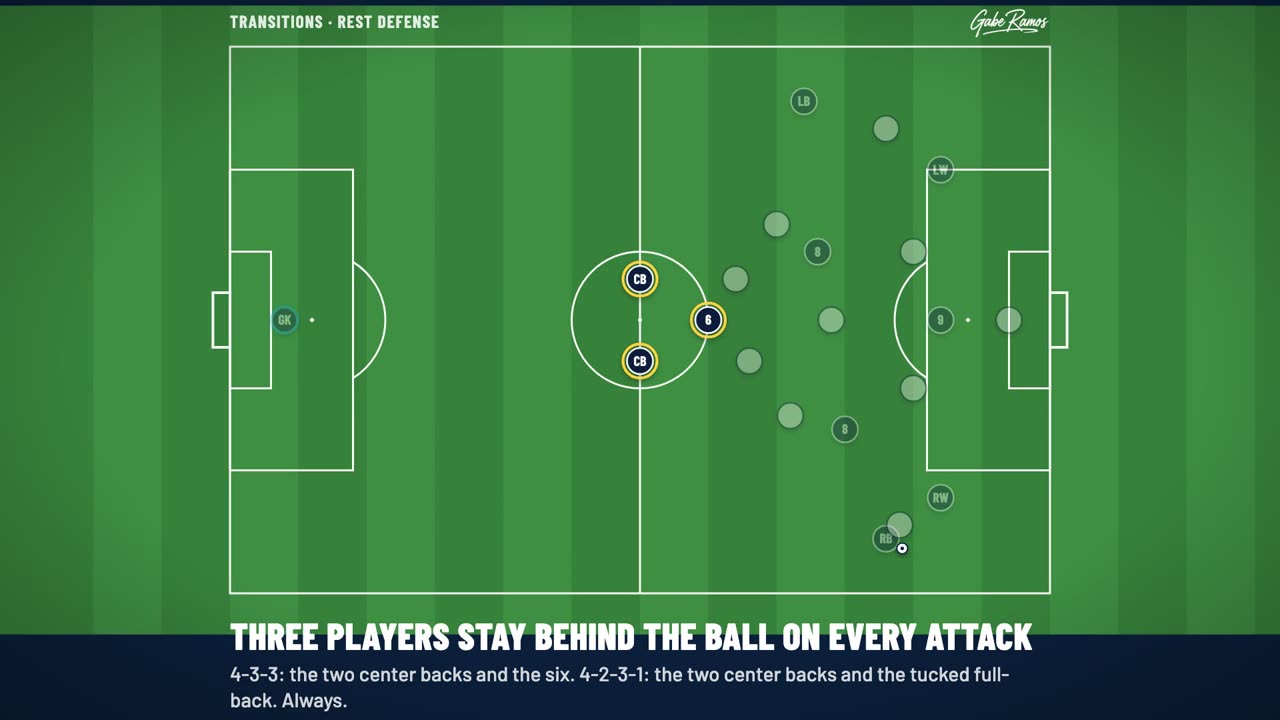
Rest defense is the shape you keep while you attack. The rule is simple: on every attack, three players stay behind the ball. In a 4-3-3, that is the two center backs and the six. In a 4-2-3-1, it is the two center backs and the full-back who tucked in. Always. Even when you are winning. Especially when you are winning.
The name is misleading because nobody is resting. The three players behind the ball are the reason the other seven can commit, and they are working as hard as anyone: adjusting to the ball, holding a line, talking the shape.
The picture
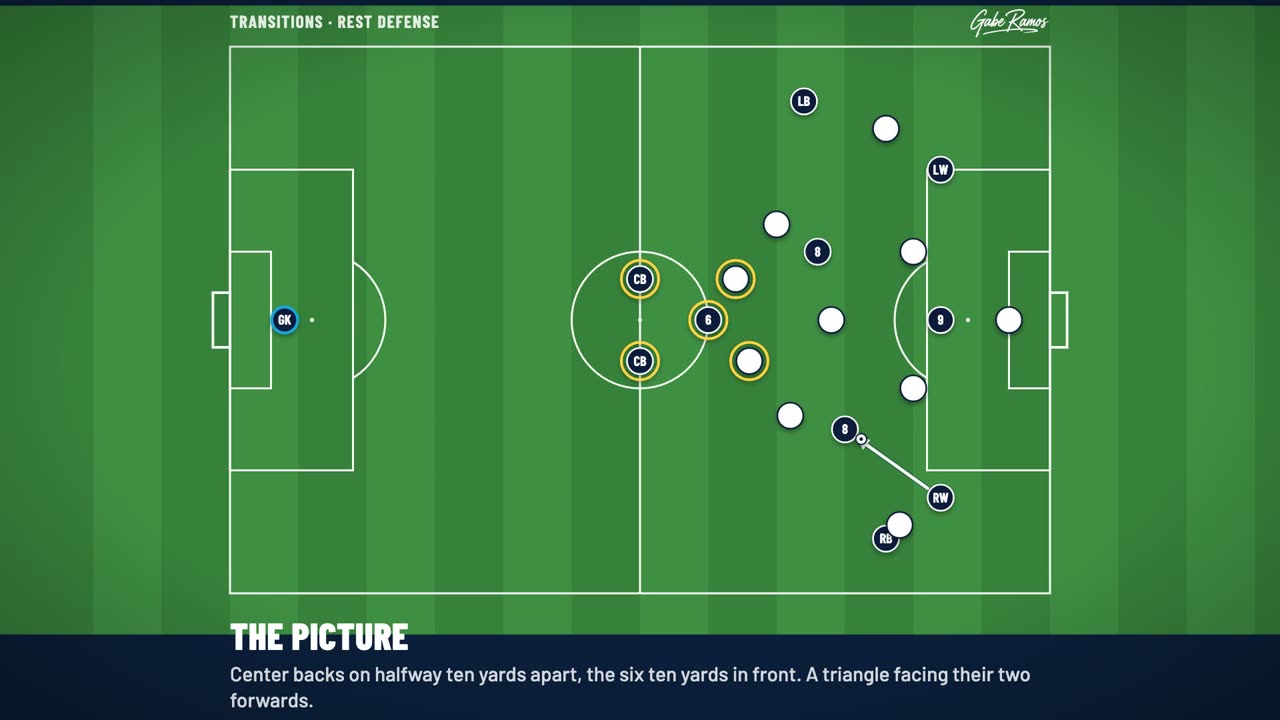
The ball is wide right in their half. The right back, the eights, the front three: all in the attack. Behind the ball: two center backs on the halfway line, ten yards apart, and the six ten yards in front of them. Three players, a triangle, facing their two forwards. That triangle is the reason you can commit everyone else.
Ten yards apart and ten yards in front are the distances to coach. Center backs thirty yards apart are two players on their own; a six standing level with them is a flat line that one pass goes through. The triangle is three players who can see each other and the two forwards at the same time.
- Two center backs on the halfway line, ten yards apart.
- The six ten yards in front of them, between the ball and the forwards.
- All three facing their forwards, not watching the attack.
Lost it: the five-second fight
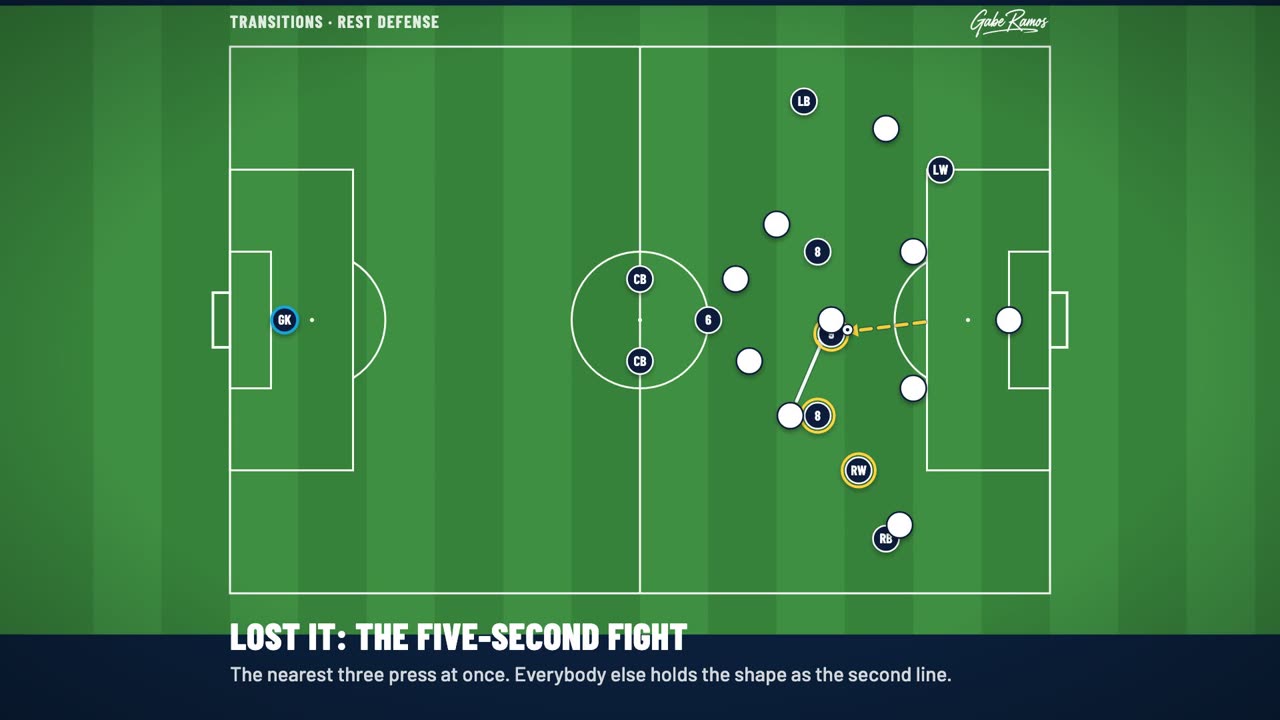
Now we lose it. The nearest three press at once: the player who lost it and the two nearest. Everybody else holds the shape, so the press has a second line. Win it back, and we are attacking a team that is turning. That is the five-second fight.
The press works because of the players who do not join it. Three go, and the three behind the ball hold, which means the counter has to go through a triangle before it reaches the keeper. A press with no second line is a press that loses by one pass.
After five seconds
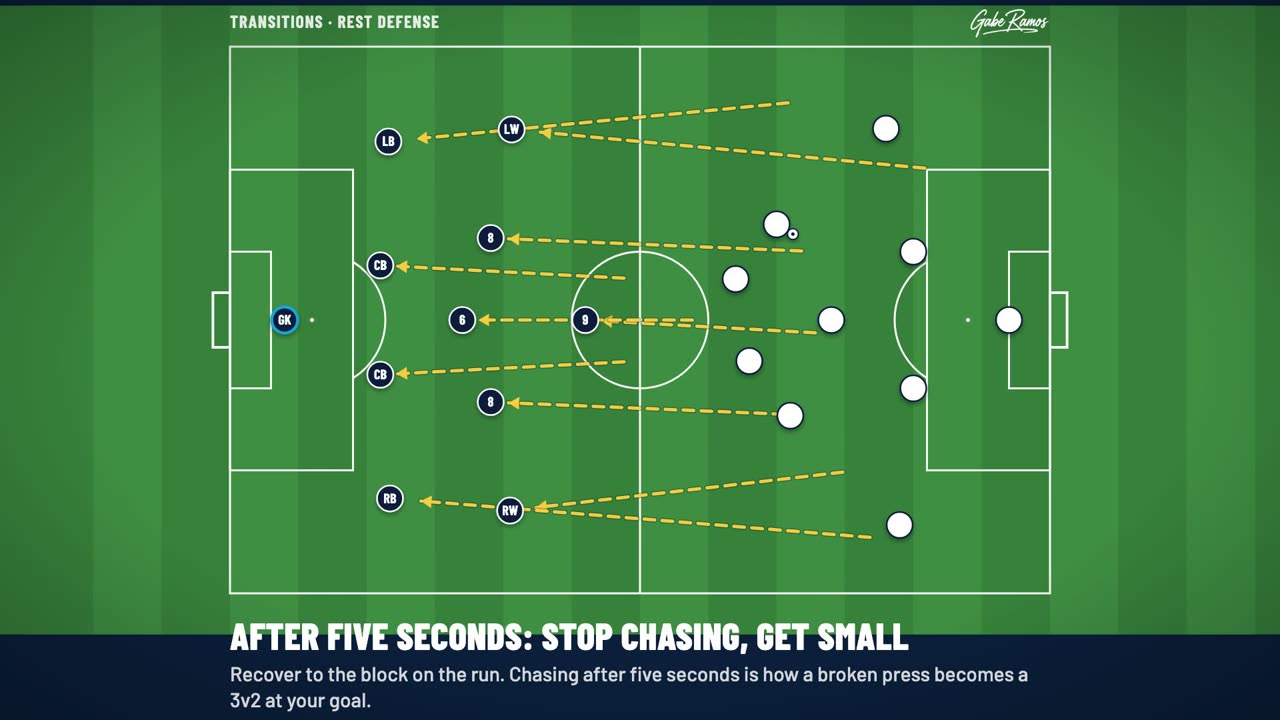
Fail to win it in five seconds, and we stop chasing. Everyone gets small and recovers to the block on the run. Chasing after five seconds is how a broken press becomes a three v two at your goal. The bench counts it down: five, four, three.
Five seconds is the number because that is roughly how long a team that has just won the ball is still disorganized. After that they have passed it twice, the shape is set, and chasing only pulls your players further out of position.
Who goes
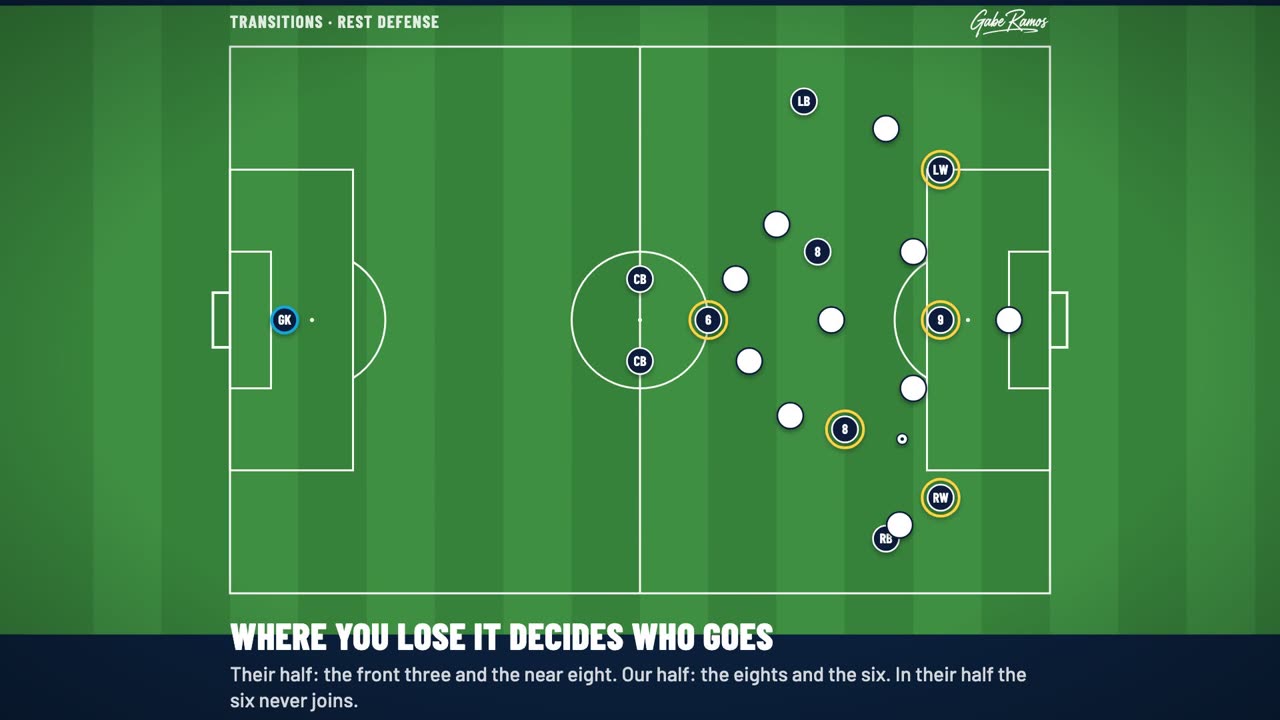
Where you lose it decides who goes. In their half, the front three and the near eight are the fight. In our half, the eights and the six. And one rule above the rest: in their half, the six never joins the press. The six is the second line. The six stays with the center backs.
Giving the players a rule for who goes stops the most common failure, which is five players going and nobody staying. The nearest three is easy to see on the field; naming them by position in training makes it automatic.
Full-backs decide whether it works
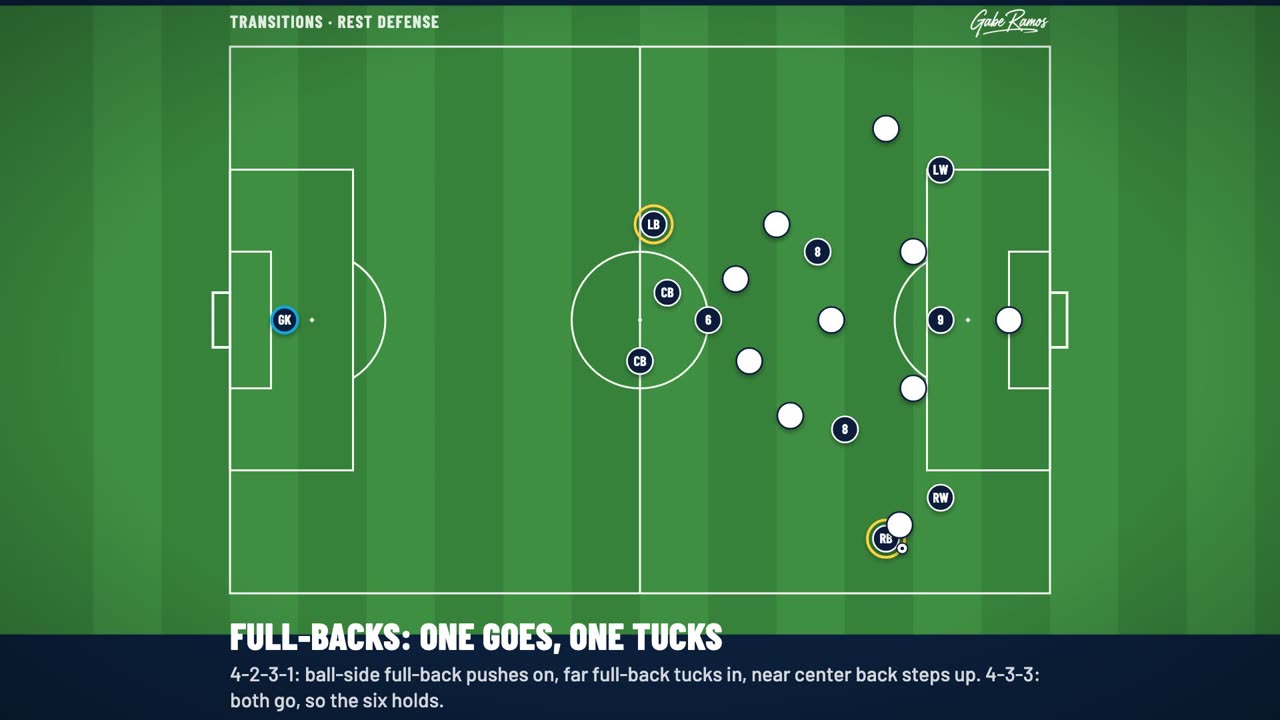
In the 4-2-3-1 the rule is one goes, one tucks: the full-back on the ball side pushes on, the far full-back slides in beside the center backs, and the near center back steps up so the three are level. In the 4-3-3 both full-backs go, so the six has to hold, no exceptions.
The two shapes solve the same problem differently, and the players need to know which rule they are playing. A 4-3-3 six who joins the attack because the full-backs did is the single most common way a youth team gets countered.
The failure you will see every weekend
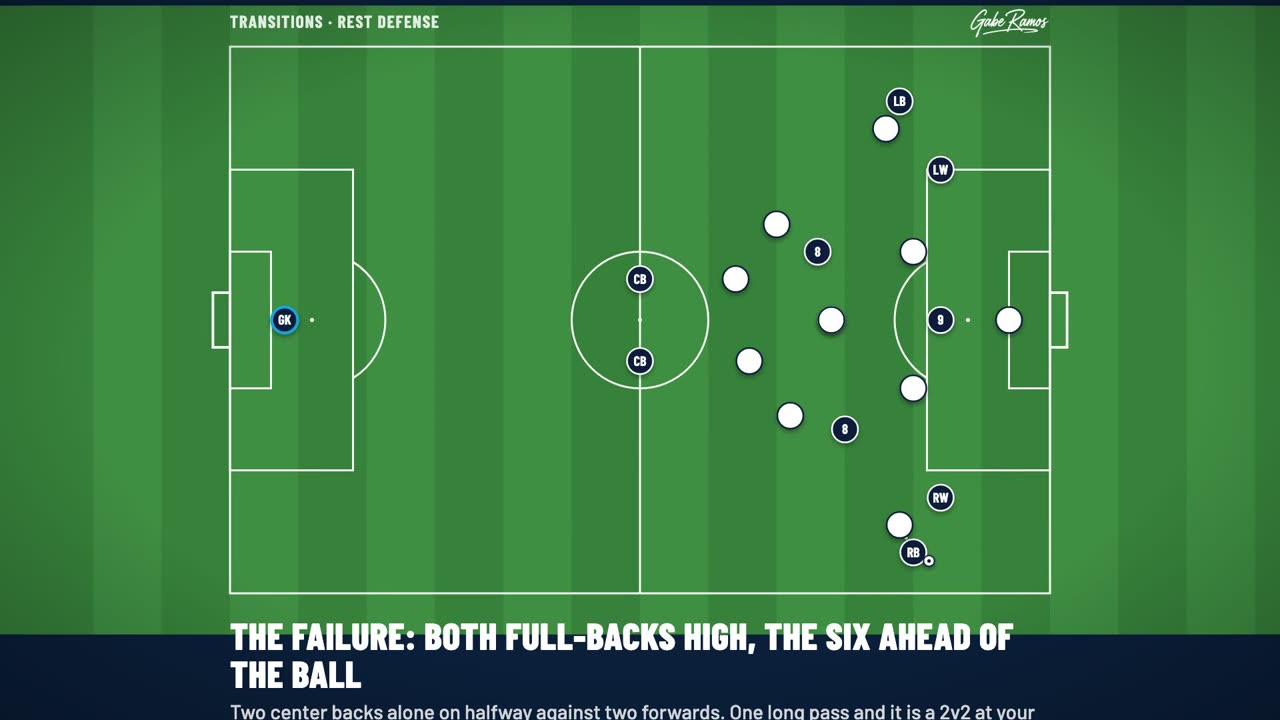
Both full-backs high, the six ahead of the ball, and the two center backs alone on halfway against two forwards. One long pass and it is a two v two at your goal. It is not bad luck. It is a shape you chose.
Watch for it most when you are winning. A team that is 2-0 up and comfortable pushes the six forward to join the fun, and the goal that follows is always described afterward as a lapse. It was a shape.
The bench job
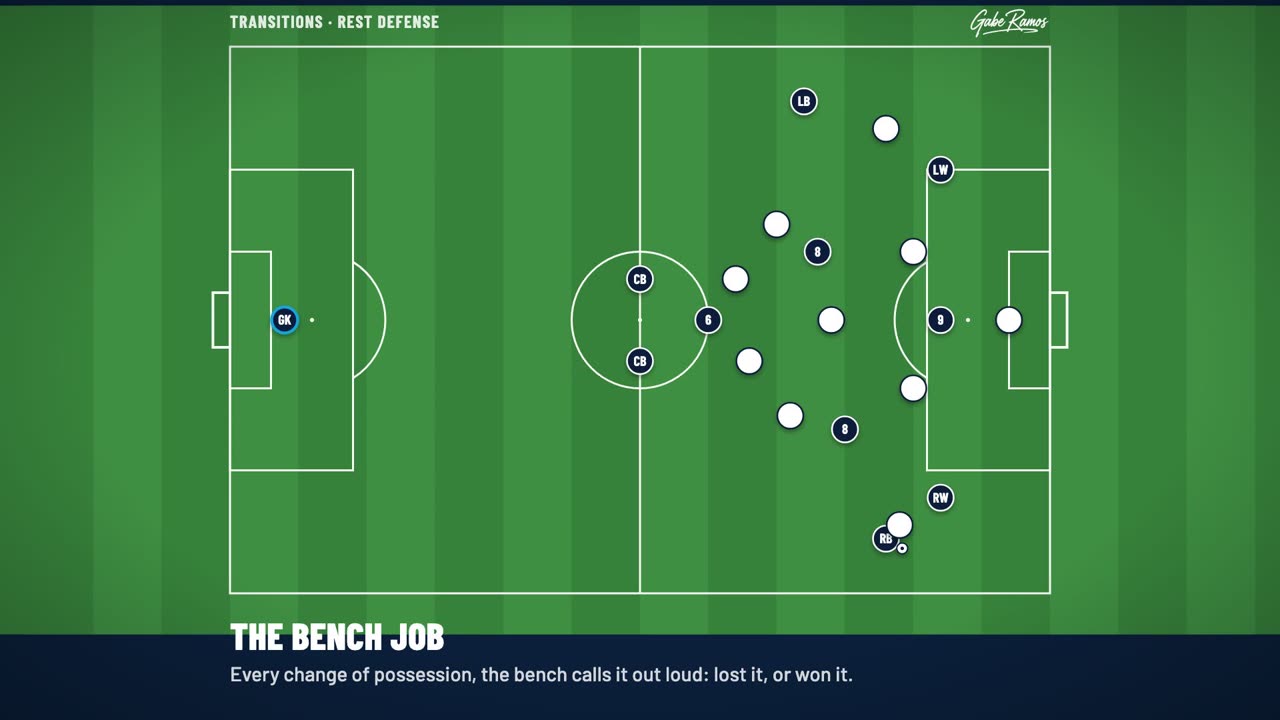
Every change of possession, the bench calls it out loud: lost it, or won it. It sounds childish. It is the fastest way to build a team that reacts before the coach can speak.
Give the job to the substitutes and the injured. It keeps them in the game, it keeps them watching the right thing, and by mid-season the players on the field are calling it before the bench does.
The recap
- Three behind the ball on every attack.
- Lose it, and the nearest three press for five seconds. Then get small.
- The six never joins the press in their half.
- 4-2-3-1: one full-back goes, one tucks. 4-3-3: both go, the six holds.
- The bench calls every turnover.
Coach it in one session
The transitions block of the 11v11 curriculum, weeks 11 and 12, where the principle is the Five-Second Fight. This is the MD-4 version: hard, small numbers, full speed. Ninety minutes.
Five-Second Rondo
RondoA 12x12, 4v2. When the defenders win it they try to keep it in the square, and the four have five seconds, counted out loud, to win it back. Fail, and the loser and the player to their right go in. React first, think second. Full activity page ›
Win-It-Back Boxes
SharpenSeveral 12x12 boxes with a 2v2 in each. Five passes is a point; lose the ball and you have five seconds to win it back for two. Sixty-second rounds, winners move up a box. Nearest player presses the ball, partner covers the pass. Full activity page ›
Rest defense, phase of play
SolveA 70x60. We attack a back four and a keeper with eight, and the two center backs and the six hold the halfway line. When the defenders win it, they counter to two mini goals on halfway. If our rest defense stops the counter, we score double on the next attack. It makes holding the line worth something.
The Transition Game
PlayA full game with nothing marked and one rule: every time possession changes, the bench calls it. Won it: ten seconds to shoot for a double. Lost it: five seconds to win it back for a point. Progress to the players calling it themselves. Full activity page ›
Attacking free kicks, two stay back
Set pieceWide delivery to the back-post zone, three late runners, one short option, two on the edge for the second ball. Two stay back: the six and a center back, always. Rest defense on a set piece is the same rule.
The ages 9 to 12 version of this session is weeks 11 and 12 of the travel curriculum, built around Five-Second Rondo, Win-It-Back Boxes and Swarm and Score.
Questions coaches ask
Does rest defense mean we attack with fewer players?
It means you attack with eight instead of eleven, and you keep the ball. A team with no rest defense attacks with eleven for twenty seconds and then defends with eleven for a minute. Three players behind the ball is what lets the other eight stay in the final third.
What do the three do while we are attacking?
They move. The center backs slide toward the ball side and hold the halfway line, the six screens the gap between them and the ball, and all three face the forwards, not the attack. If a center back is watching the winger take on a full-back, they are not doing rest defense.
Should the three ever join the attack?
A center back can step forward to carry the ball out when nobody presses, and the six can show for a pass, but somebody fills in behind every time. The rule is three behind the ball, not three specific players. If the six goes, a full-back tucks.
How do we practice it without the attack getting boring?
The phase of play fixes that: if the rest defense stops the counter, the next attack scores double. Now the attackers want the three to hold, because it is worth a goal to them. Nobody stands still in a game where holding the line pays.
Keep reading
 Tactics guideHow to press in a 4-3-3
Three moments, four triggers, the touchline trap and the six who never joins.
Read the guide › Tactics guideHow to beat a low block
Width and patience, move the block then switch, the wide two v one, the cutback.
Read the guide › Tactics guidePlaying out of the back in a 4-3-3
The 2-3-5 build shape, the first triangle and the four decisions a center back makes.
Read the guide ›The whole 11v11 game model, twelve weeks of sessions
The Full Season Travel Curriculum for ages 13 to 18 comes as two editions, one for the 4-3-3 and one for the 4-2-3-1: the game model in six pages, 36 sessions built around a match week (MD-4, MD-3, MD-2), twelve match-day pages, set pieces and the 35-minute warm-up. Every phase of play in these guides is in it.