Coaching tools › Guides › Pressing in a 4-3-3
Tactics guide · 4-3-3 · out of possessionHow to press in a 4-3-3:
triggers and the 4-5-1 block
Most youth teams press with one player and chase with the rest. The system is simpler than the chaos: three moments, four triggers, one trap, and one player who never joins. This guide shows the 4-5-1 block a 4-3-3 defends in, what makes it press, how the trap on the touchline works, and the failure that turns a press into a counter against you.
 How to Press in a 4-3-3
Three moments
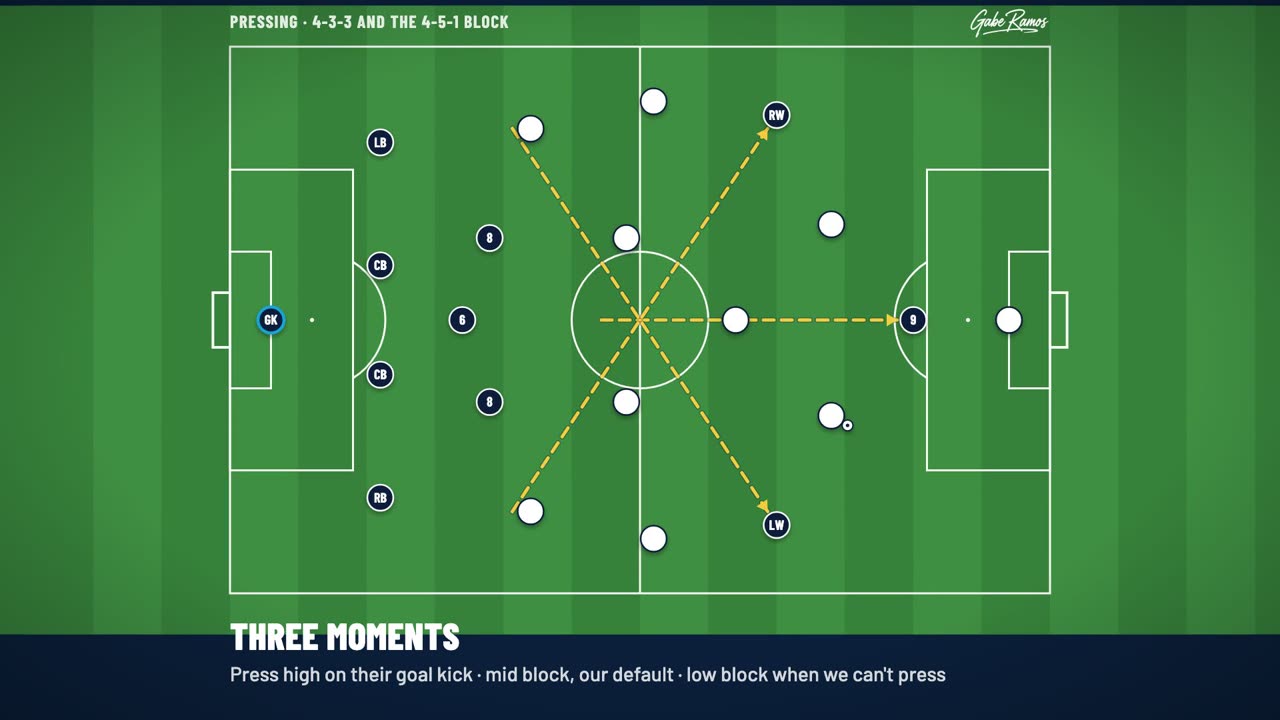
Press high: on their goal kick, we go and win it near their goal. Mid block: our default, we hold a line fifteen yards inside our half and press on a trigger. Low block: when we cannot press, everybody behind the ball and the counter is the plan.
Three pictures. The team needs to know which one it is in, and the bench needs to be able to say it in one word. Most youth defending goes wrong because the players are in three different moments at once: the striker pressing high, the midfield in a mid block, the back four sitting low.
Press high: go together on the first pass
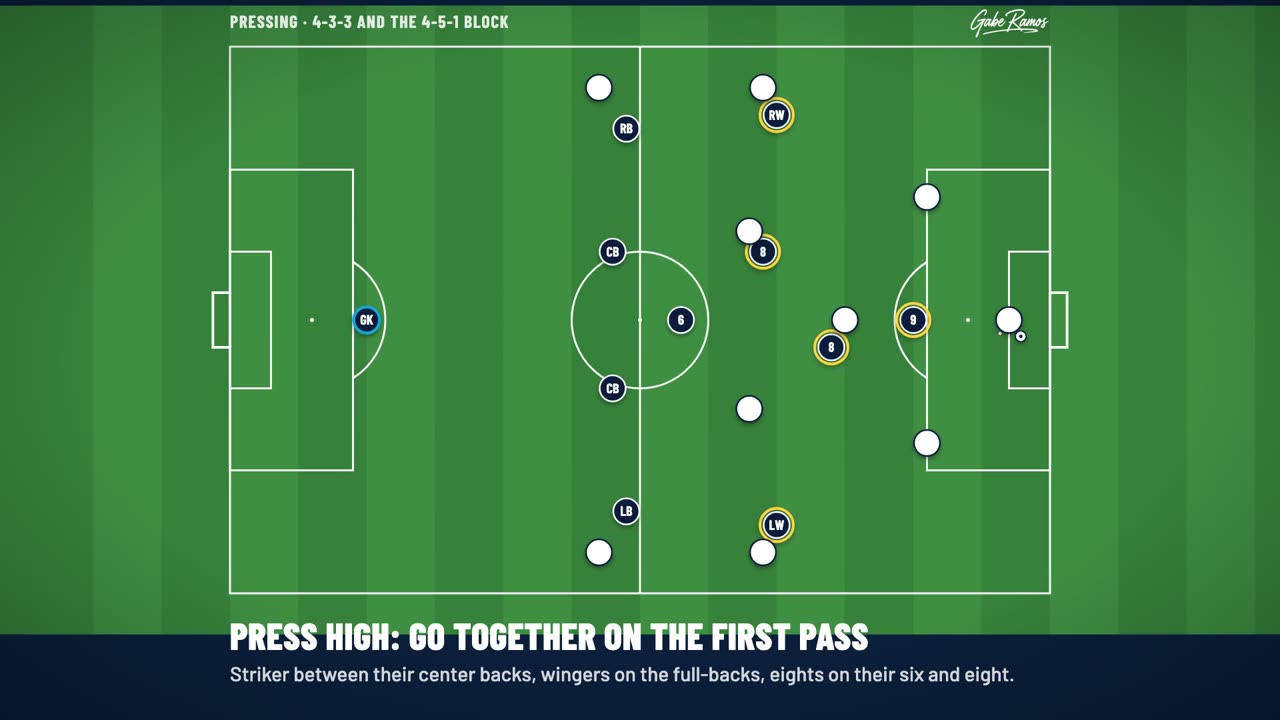
On their goal kick the striker stands between their center backs. The wingers stand on their full-backs. The eights take their six and their eight. And the rule is: go together on the first pass. Not before it. The moment the ball leaves the keeper, everyone steps at once.
Going before the first pass is how a press gets split: one player arrives early, the keeper plays around them, and the rest of the team is now chasing. Waiting for the pass means the ball is traveling while you move, and the receiver has pressure arriving with the ball.
The mid block: a 4-5-1
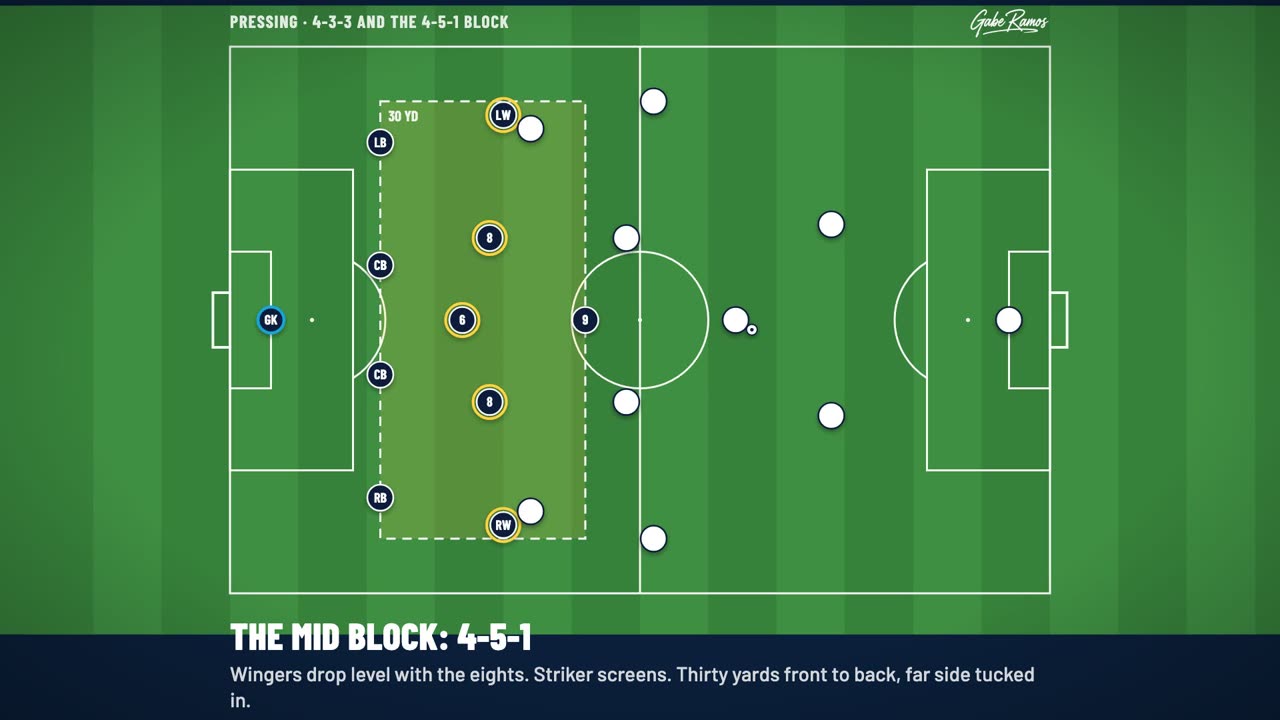
The mid block is where we live. The wingers drop level with the eights, so the 4-3-3 becomes a 4-5-1. The striker screens the pass between their center backs. The whole unit is thirty yards front to back, and the far side tucks in. Compact. Nobody is more than fifteen yards from a teammate.
Thirty yards front to back is the number to coach. Measure it in training with cones, because a block that is fifty yards front to back is two lines with a hole in it, and that hole is where their ten plays.
Show them the outside
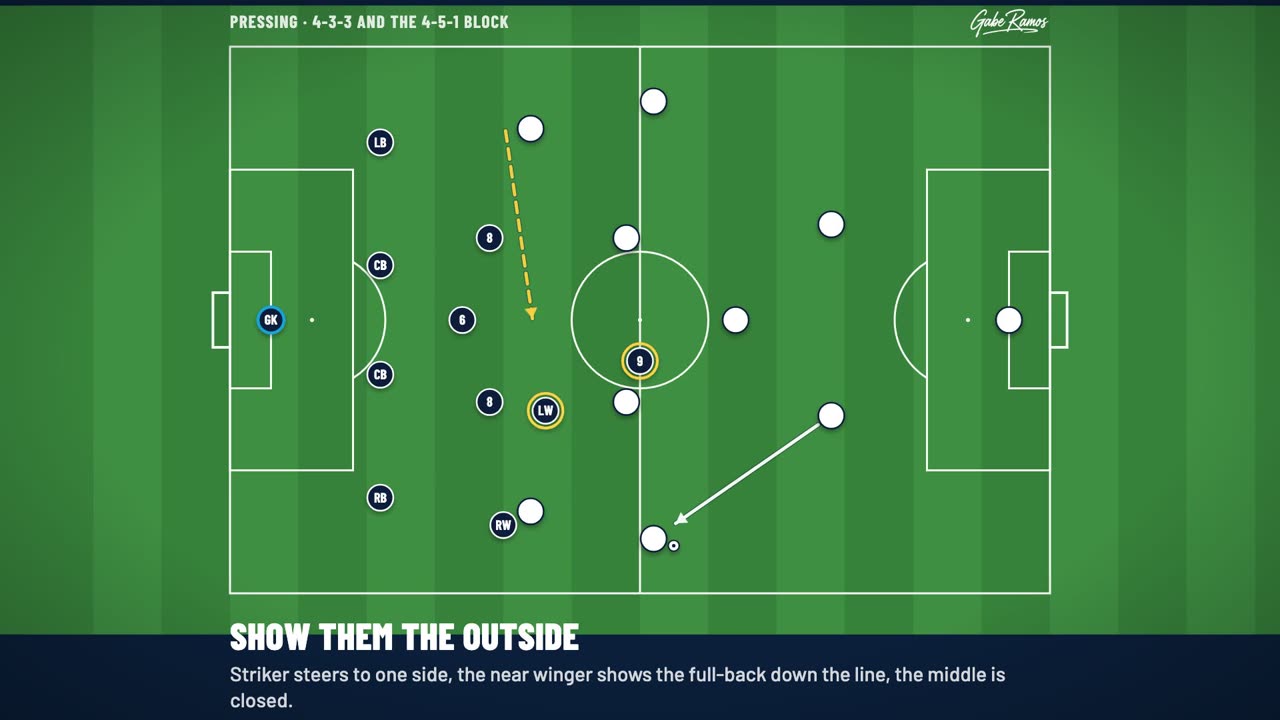
In the block we show them the outside. The striker steers play to one side, the near winger shows the full-back down the line, and the middle is closed. We want them wide, with their back to play, near the touchline, because that is where the trap is.
This is the opposite of what most youth teams do, which is chase the ball into the middle and leave the wide players free. The middle is where goals come from. The touchline is where turnovers come from.
The four triggers
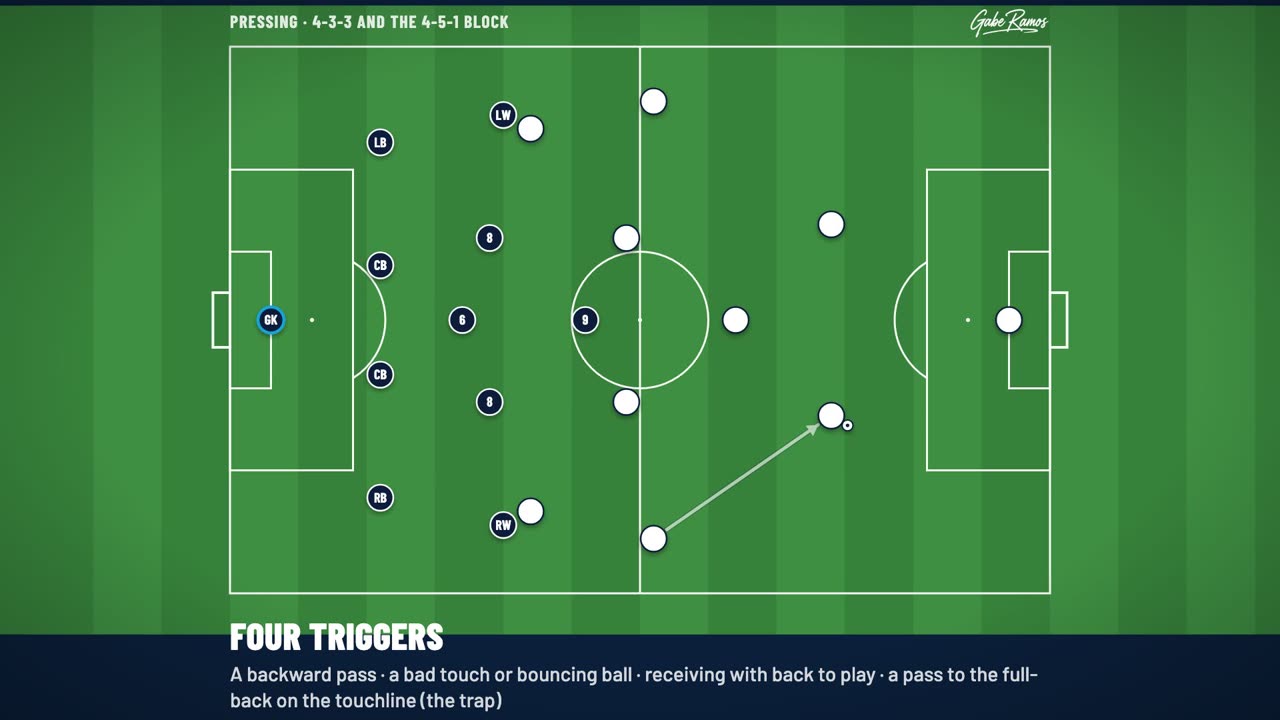
When you see one, the block presses. A backward pass. A bad touch or a bouncing ball. A player receiving with their back to play. And a pass to the full-back on the touchline. That last one is the trap, and it is the one we coach most.
Give the triggers to the players as words, not as a lecture. In training the bench calls the trigger out loud when they see one, and within a week the players are calling it themselves.
- A backward pass.
- A bad touch or a bouncing ball.
- A player receiving with their back to play.
- A pass to the full-back on the touchline.
The trap on the touchline
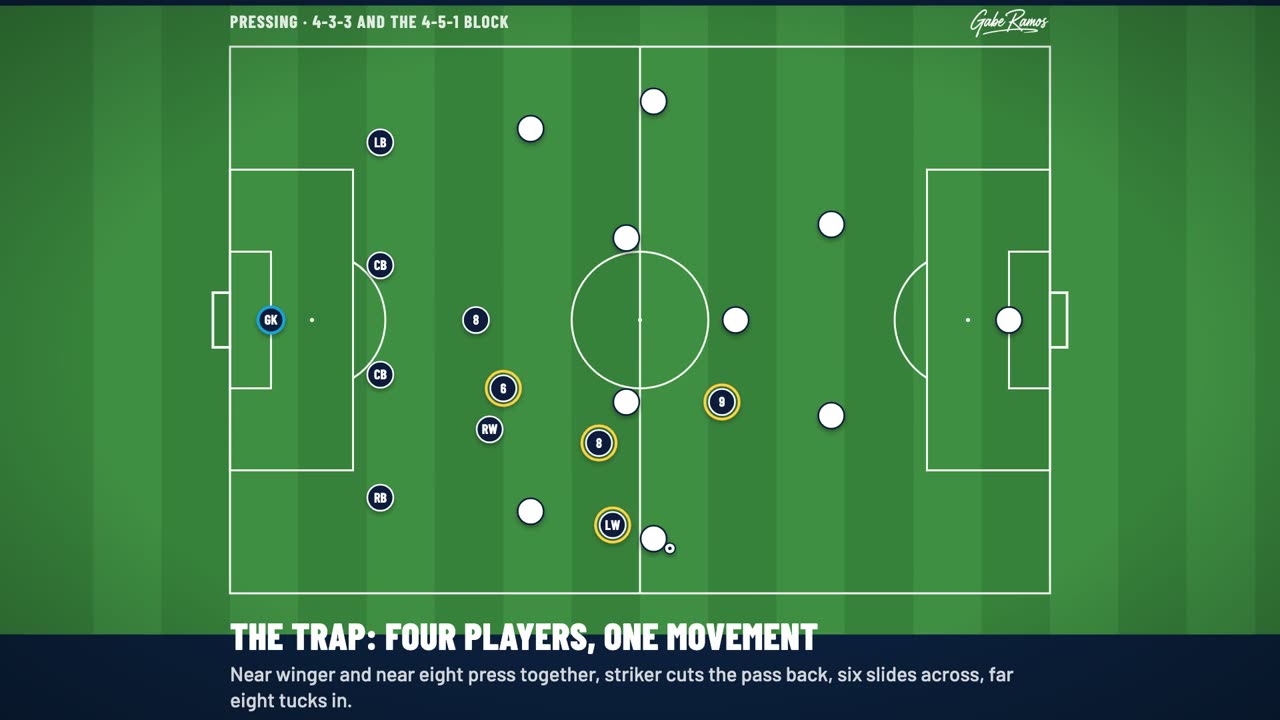
They pass to their full-back on the touchline. The near winger and the near eight press together, one on the ball, one on the pass inside. The striker cuts the pass back to the center back. The six slides across behind them, and the far eight tucks in. Four players, one movement. The full-back has the touchline on one side and three of us on the other.
The striker's job is the one most often missed. If the pass back to the center back is open, the full-back escapes and the press is wasted. The striker closes it, and now the only options are forward into pressure or over the touchline.
The six never joins
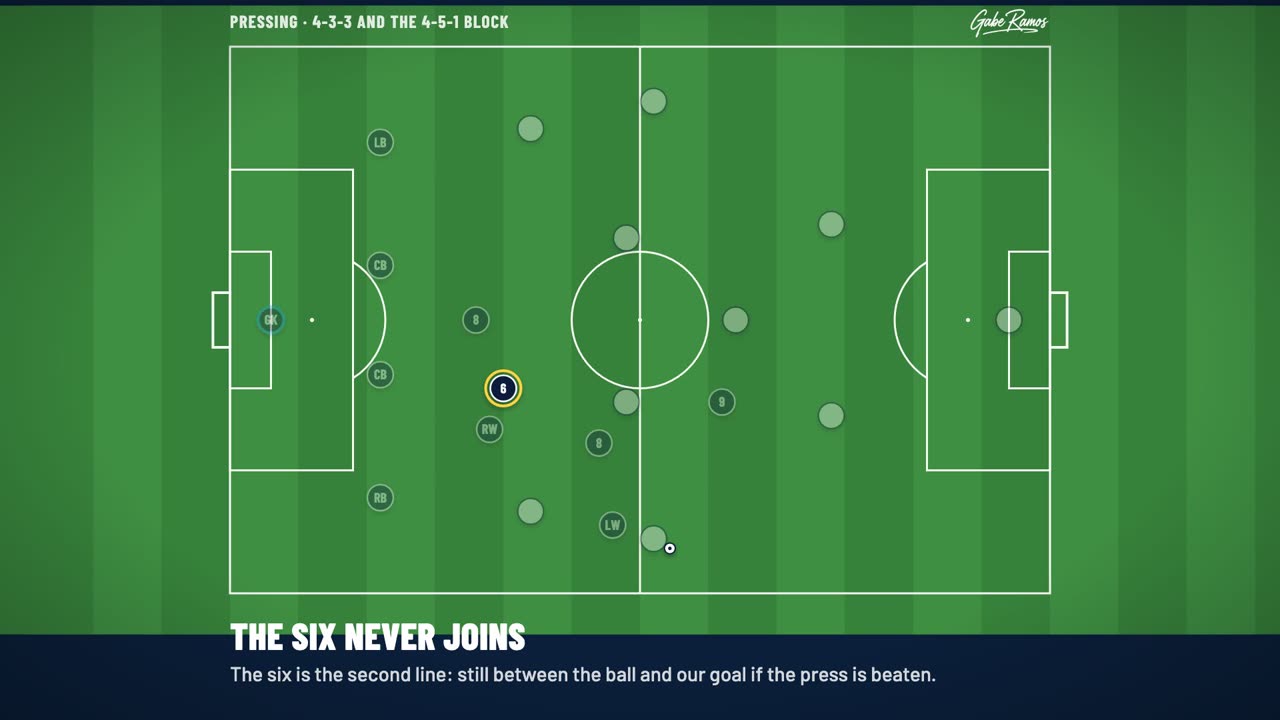
One rule above all of them. The six never joins the press. The six is the second line. If the press gets beaten, the six is the player who is still between the ball and our goal. A six who chases the ball is how a press turns into a counter against you.
This is hard for a competitive player to accept, because the six can see the ball and wants it. Tell them their job is to be the reason the rest of the team can press. If the six holds, the press is a risk the team can afford.
Lost it high: the five-second fight
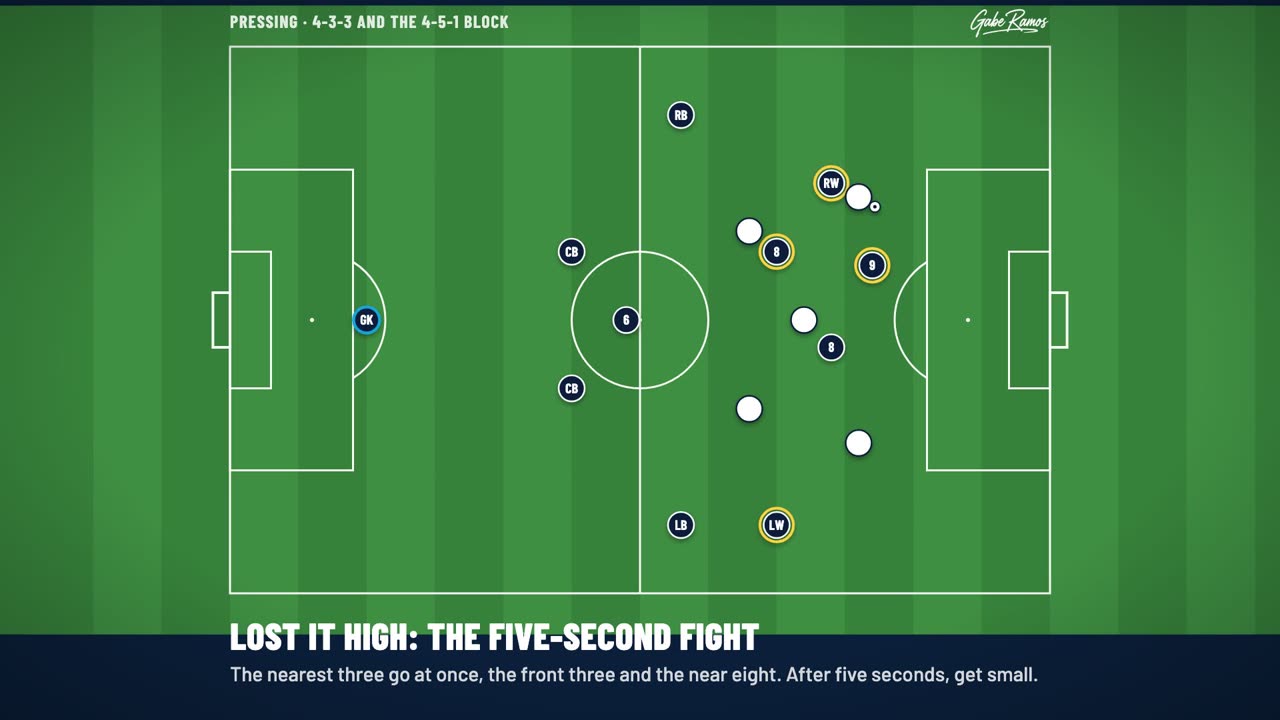
When we lose the ball in their half, that is a press too. The nearest three go at once: the player who lost it and the two closest. The front three and the near eight are the five-second fight. Win it back, and we are attacking a team that is still turning. Fail, and after five seconds we stop chasing and get small into the block.
The count is literal. The bench counts five, four, three, and when it reaches zero the team drops. The guide on rest defense covers who holds while the three go.
The failure you will see every weekend
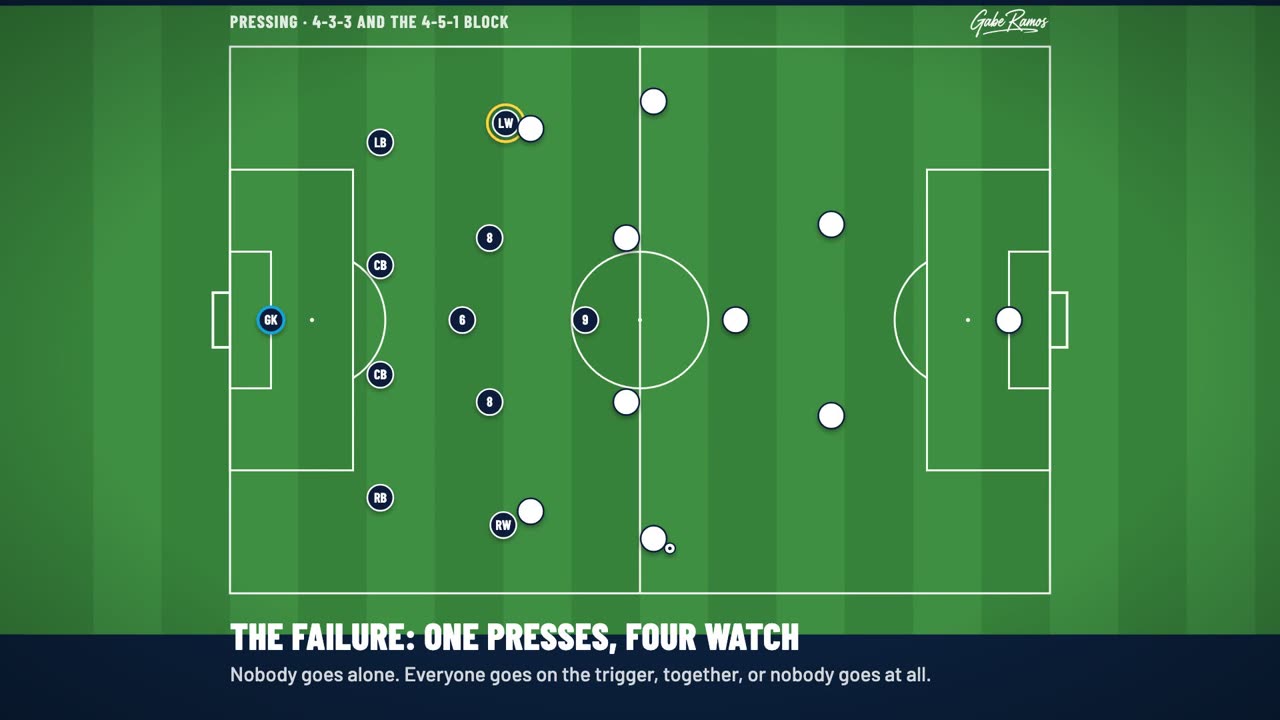
One player presses, four watch. The presser gets beaten by one pass and now the block is broken. The fix is the trigger. Nobody goes alone. Everyone goes on the trigger, together, or nobody goes at all.
If your team presses in ones, the problem is not effort. It is that nobody has told them what the signal is. Give them the four triggers and the solo chasing stops within two sessions.
The recap
- Three moments: high, mid, low. Know which one you are in.
- In the block, a 4-5-1 thirty yards front to back. Show them the outside.
- Four triggers: backward pass, bad touch, back to play, full-back on the line.
- On the trap: winger and eight together, striker cuts the pass back, six slides, far eight tucks.
- The six never joins.
- Lost it high: three go for five seconds, then get small.
Coach it in one session
This is week 1, MD-3 of the 11v11 curriculum, where the principle is Get Small: when they have the ball, protect the middle and press as a unit. Ninety minutes, medium intensity.
4v2 Press Pair
RondoA 12x12, 4v2. The two defenders work as a pair: one presses, one covers the split. A pass that splits them costs the defenders a point; a win inside eight seconds earns one. Pairs rotate every minute. The 4v2 Split page has the full setup.
Pressing triggers, 6v6 + 2
SharpenA 30x30, 6v6 plus two neutrals for the team in possession. The defending team may only press on a trigger: a backward pass, a bad touch, or a pass to a player facing their own goal. On the trigger, three go together; before it, they hold shape. The coach calls the triggers missed. Harder: the press must win it inside eight seconds for two points.
Defend the block, phase of play
SolveA 70x60. A back four, three midfielders and a striker defend against a full 4-3-3 attack of ten plus keeper. Two mini goals on halfway for the defenders to counter into. Defenders start in a 4-5-1 on the edge of the final third; attackers build from their keeper; defenders hold, then press on the trigger. Compact first, thirty yards front to back. If the block is too deep and passive, move the starting line to halfway and reward wins in the middle third with two points.
11v11, in the block before halfway
PlayThree eight-minute periods. The team out of possession must be in its 4-5-1 before the ball crosses halfway; the coach freezes play to check. A team caught open concedes a free kick from where the ball is.
Defending corners and free kicks
Set pieceTwo zonal players on the six-yard line, front and back post. Everyone else marks a player, goal side and ball side. Keeper owns the six-yard box and calls. Two stay outside the box for the counter.
For 7v7 and 9v9 teams the same idea is taught through Lock the Middle, where shutting the center gate is worth three points and leaving the wide gates open costs one.
Questions coaches ask
Should a youth team press high or sit in a block?
Sit in the block by default and press on triggers. A team that presses high all game needs fitness and timing most youth teams do not have yet, and every failed press is a counter. Press high on their goal kicks, where the trigger is built in, and in the mid block the rest of the time.
How do we stop one player pressing alone?
Give the team the four triggers and have the bench call them out loud in training. Pressing alone is almost always a signalling problem: the eager player sees a chance and nobody else knows it is one. Once everyone knows the trigger, the eager player waits for it and the rest go with them.
What does the striker do in the block?
Screens the pass between their center backs and steers play to one side. The striker is not there to win the ball in the block; the striker is there to decide which side the trap is on. When the trap springs, the striker cuts the pass back to the center back so the full-back cannot escape.
How do you coach a six to hold instead of chasing?
Explain the job as the reason the press is allowed. If the six holds, the other five can go without fear; if the six chases, nobody can. Then reward it: in the phase of play, a counter that is stopped by the six holding the line scores for the defending team.
Keep reading
 Tactics guideHow to beat a high press
The keeper is the plus one, the third player is free, and five rules that get you out.
Read the guide › Tactics guideRest defense: attack without getting countered
Three stay behind the ball, the nearest three press for five seconds, and the bench calls every turnover.
Read the guide › Tactics guide4-3-3 or 4-2-3-1: which fits your team?
Four questions about your six, your ten, your full-backs and how you defend.
Read the guide ›The whole 11v11 game model, twelve weeks of sessions
The Full Season Travel Curriculum for ages 13 to 18 comes as two editions, one for the 4-3-3 and one for the 4-2-3-1: the game model in six pages, 36 sessions built around a match week (MD-4, MD-3, MD-2), twelve match-day pages, set pieces and the 35-minute warm-up. Every phase of play in these guides is in it.