Coaching tools › Guides › 4-3-3 or 4-2-3-1
Tactics guide · formations · picking a shape4-3-3 or 4-2-3-1:
which one fits your team?
Most coaches pick a formation because they like it. Here is how to pick one because of the players you actually have. The two shapes share a back four and a front line; the whole difference is the middle, and the middle is decided by four questions about your six, your ten, your full-backs and how you want to defend.
 4-3-3 or 4-2-3-1: Which Formation Fits Your Team?
The two shapes
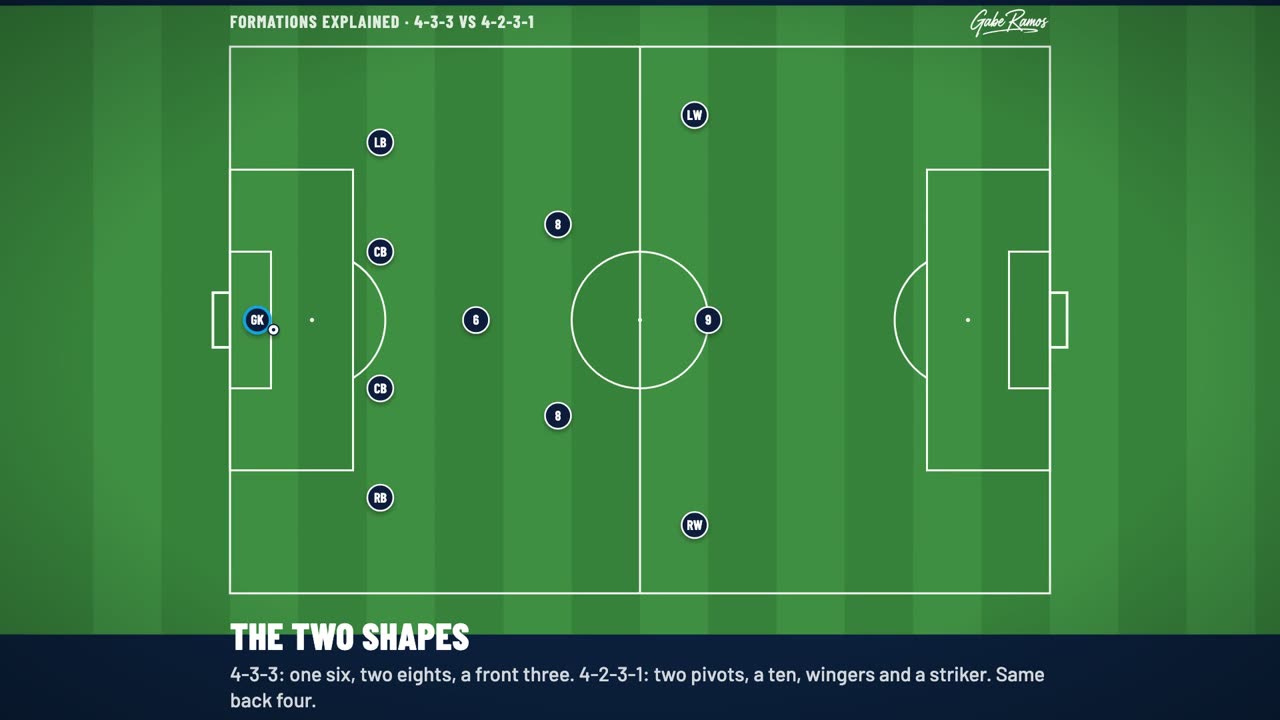
The 4-3-3: a back four, one six with two eights ahead of it, and a front three. The 4-2-3-1: the same back four, two pivots side by side, a ten in front of them, wingers, and a striker. Same eleven players. The difference is all in the middle.
That is worth saying twice to a youth team, because players hear formation names as if they were different sports. They are not. Your center backs, full-backs, wingers and striker have the same jobs in both. Three players in the middle change what they do, and that is the decision.
What the middle asks of your players
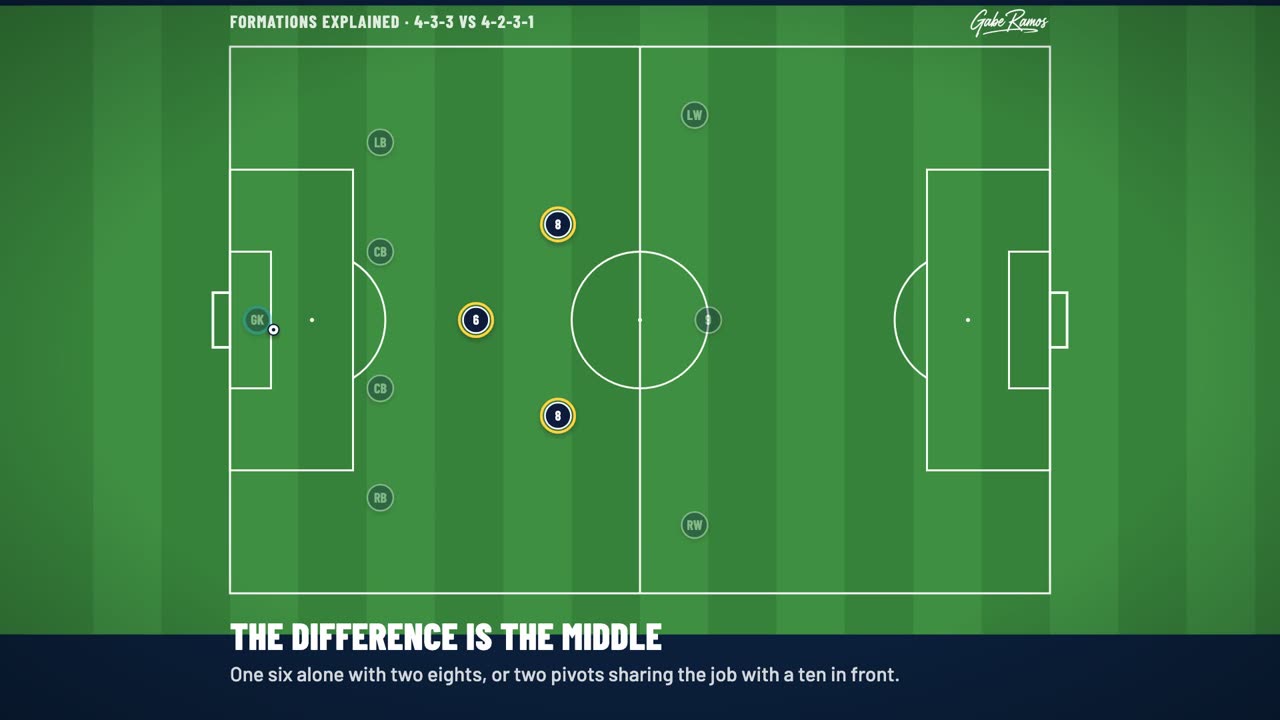
In the 4-3-3 the six plays alone. It protects the back four, connects it to the eights, and every rotation runs through it. In the 4-2-3-1 that job is shared by two pivots, one deeper and one ahead, and the ten becomes the free player between the lines.
One shape asks a lot of one player. The other spreads the load. Neither is better; they are built for different squads, and the four questions below are how you find out which squad you have.
Question one: do you have a six who can play alone?
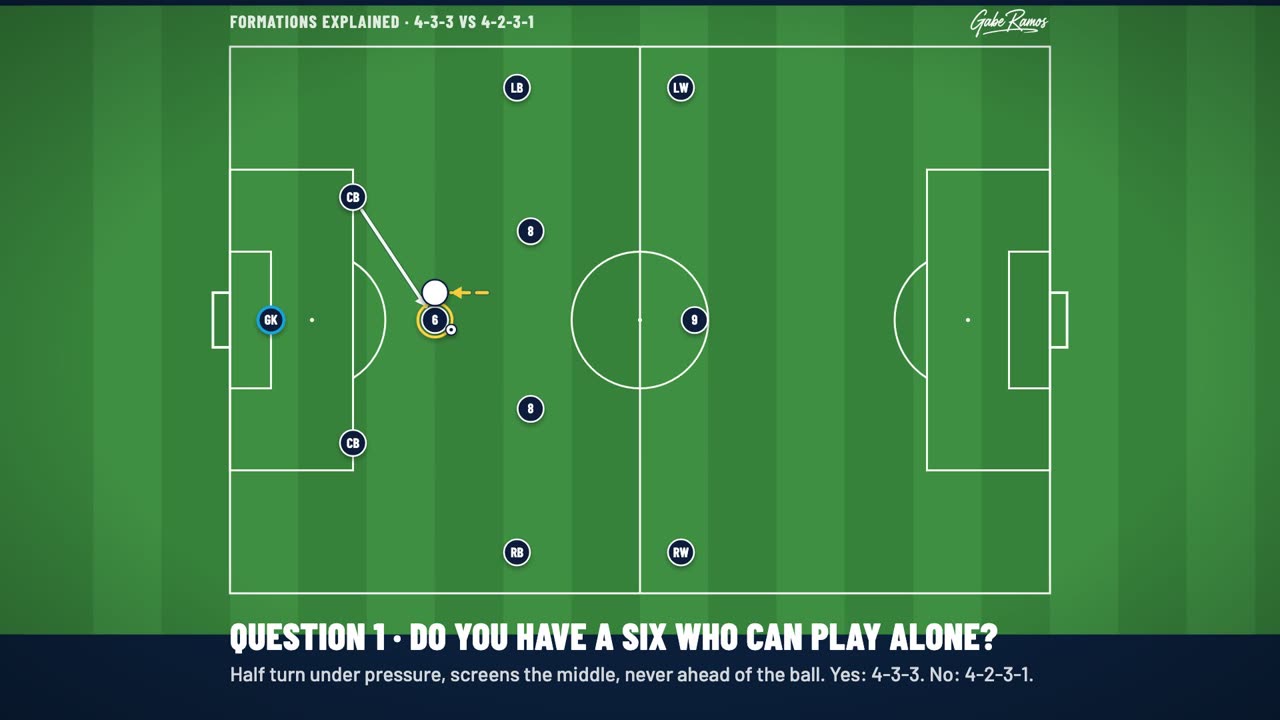
A player who receives on the half-turn under pressure, screens the middle without the ball, and never gets caught ahead of play. If yes, the 4-3-3 gives that player the whole game: every build goes through them, every press is covered by them, every switch runs through them or the keeper.
If no, the 4-2-3-1 gives them a partner, and the mistakes get covered. A young six who is still learning the position will concede goals alone that a pair would have prevented. Be honest about this one; it is the question coaches most often answer with hope rather than evidence.
Question two: do you have a ten?
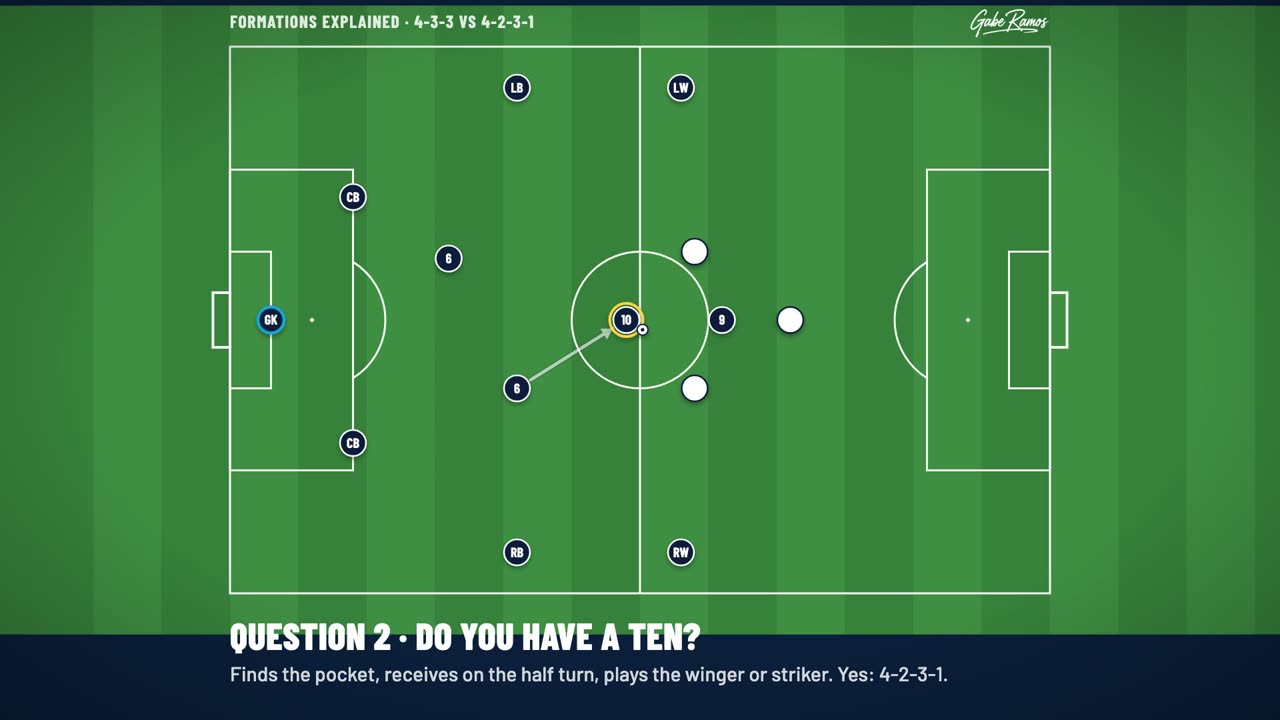
A player who finds the pocket behind their midfield, receives on the half-turn, and plays the winger or the striker. If you have one, the 4-2-3-1 builds the team around them and gives them the space they need to do it.
If you do not, the 4-3-3 does not need one. The eights share that job: one shows short, one runs beyond. Two average eights produce more than one average ten, because the ten only works when the player in the pocket is genuinely better than the people around them.
Question three: your full-backs
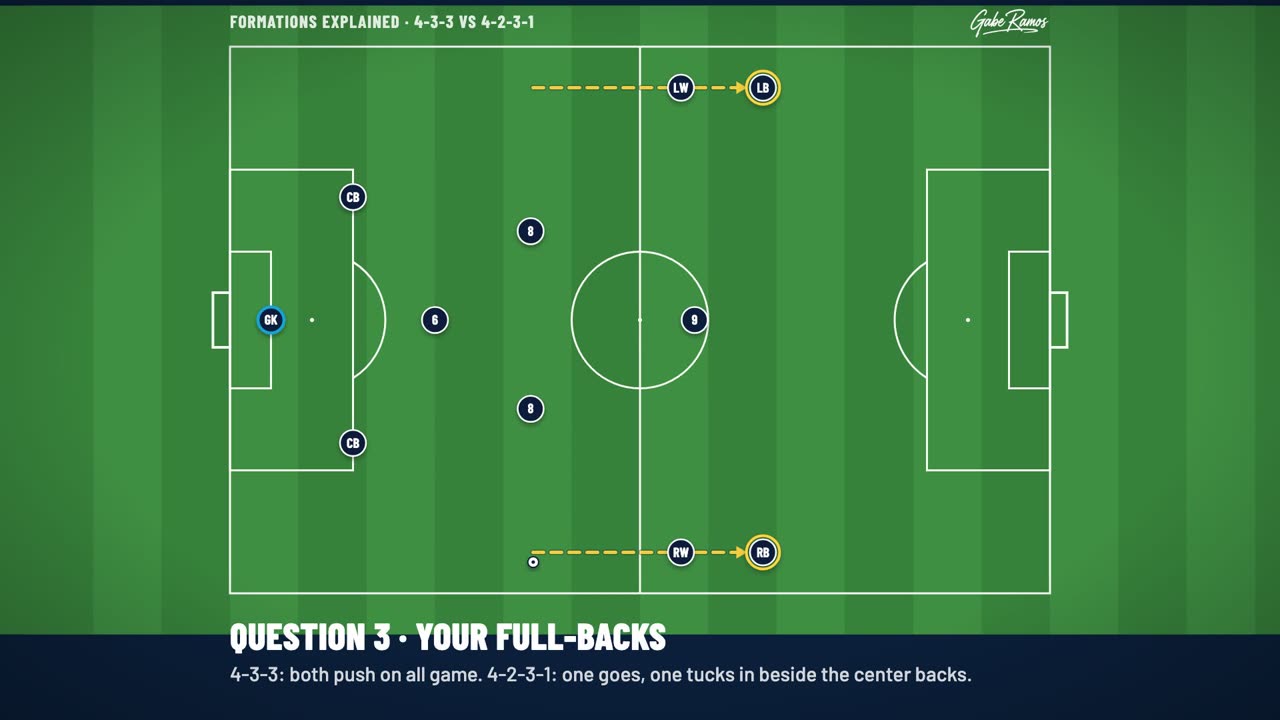
In the 4-3-3 both full-backs push to halfway in build and overlap in the final third, all game long. That is two players who run all day. In the 4-2-3-1 only one goes. The other tucks in beside the center backs, and the shape becomes a 3-4-3 when the ball is secure.
If you have one athlete at full-back and one defender, that is the 4-2-3-1. If you have two athletes, the 4-3-3 lets you use both. A squad with two defenders and no athletes at full-back is a squad that should play out slowly through the pivots and not worry about overlaps at all.
Question four: how do you want to defend?
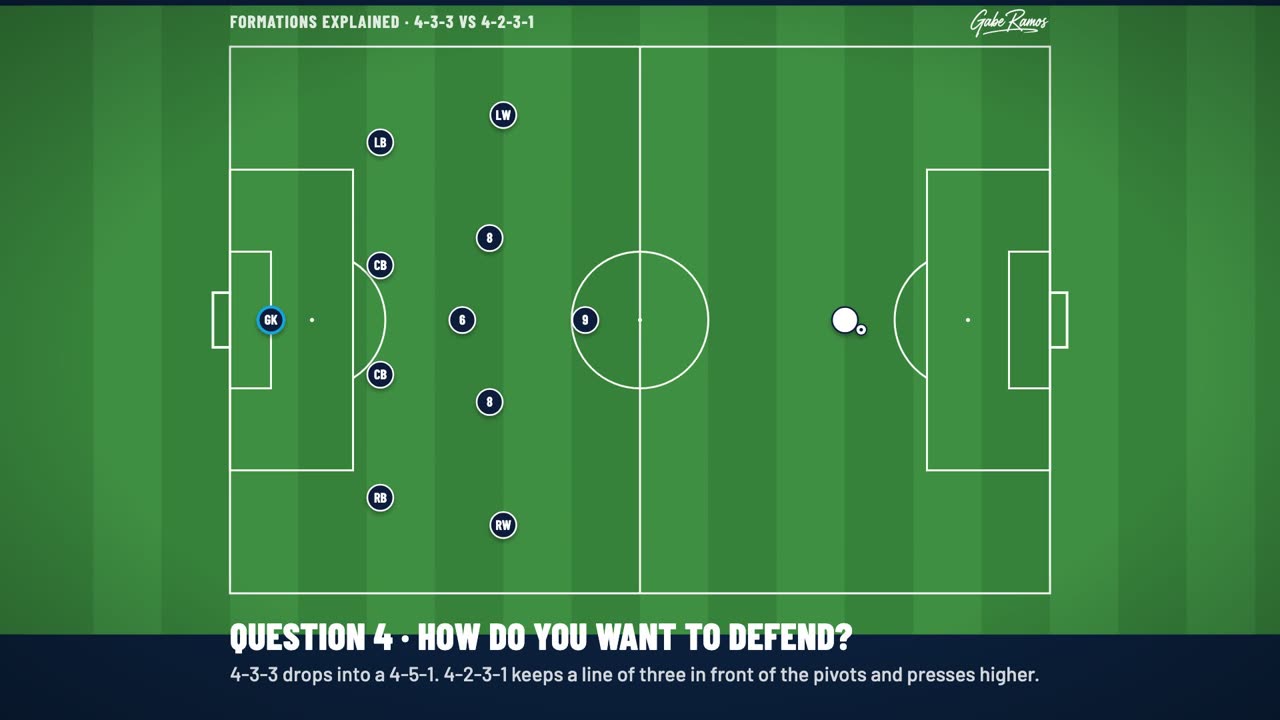
The 4-3-3 drops the wingers level with the eights and becomes a 4-5-1. Five across the middle, hard to play through, but the striker is alone up front and the press starts later. The 4-2-3-1 keeps a line of three ten yards in front of the pivots, the ten screens their pivot, and the wingers press their full-backs. It presses higher, and it needs two disciplined pivots to do it.
A team that wants to sit in a block and counter is a 4-3-3 team out of possession. A team that wants to win the ball in the opposition half needs the 4-2-3-1 and the two pivots to cover what the press leaves behind. The guide on pressing in a 4-3-3 shows the block and the triggers in detail.
What stays the same
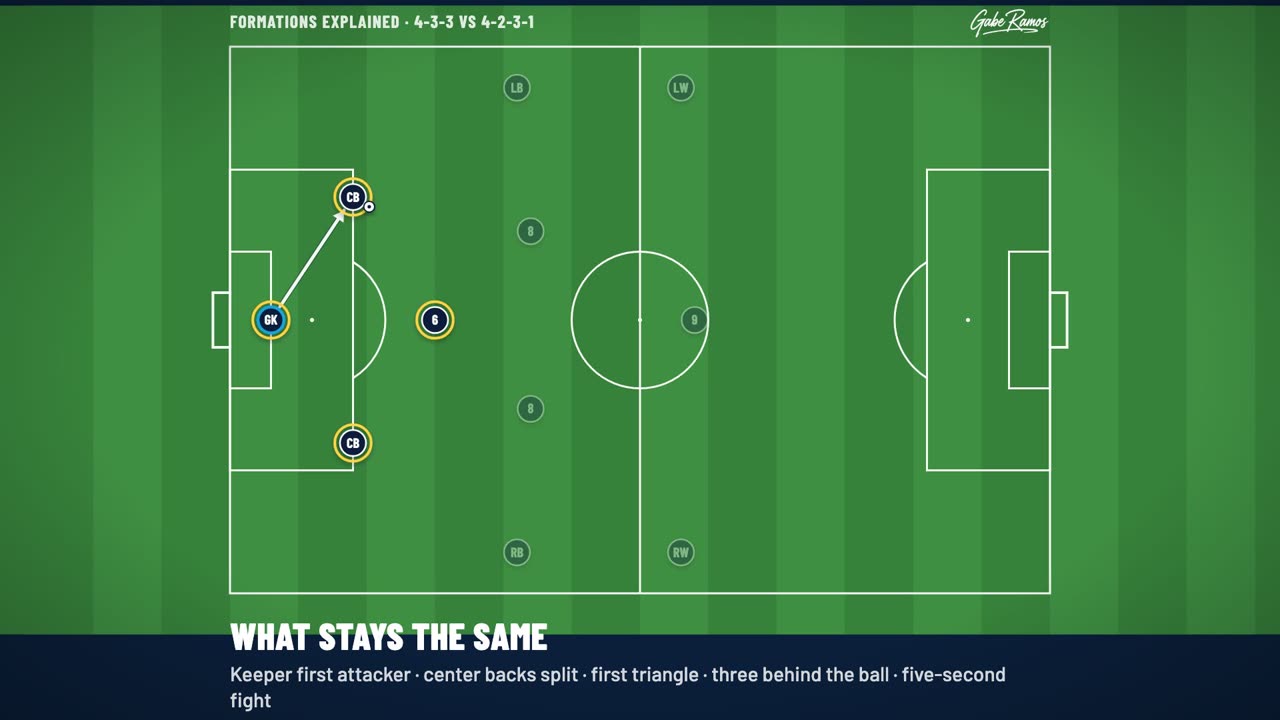
Whichever you pick, the keeper is the first attacker. The center backs split to the edge of the box. The first pass goes through a triangle. Three players stay behind the ball on every attack. And when you lose it, the nearest three press for five seconds.
The game model is the same. The formation is just where people stand. Coaches who understand this stop treating the shape as an identity and start treating it as a tool, which is exactly how the players should see it too.
- The keeper is the first attacker.
- Center backs split to the edge of the box.
- The first pass goes through a triangle.
- Three behind the ball on every attack.
- Lose it: the nearest three press for five seconds.
The recommendation
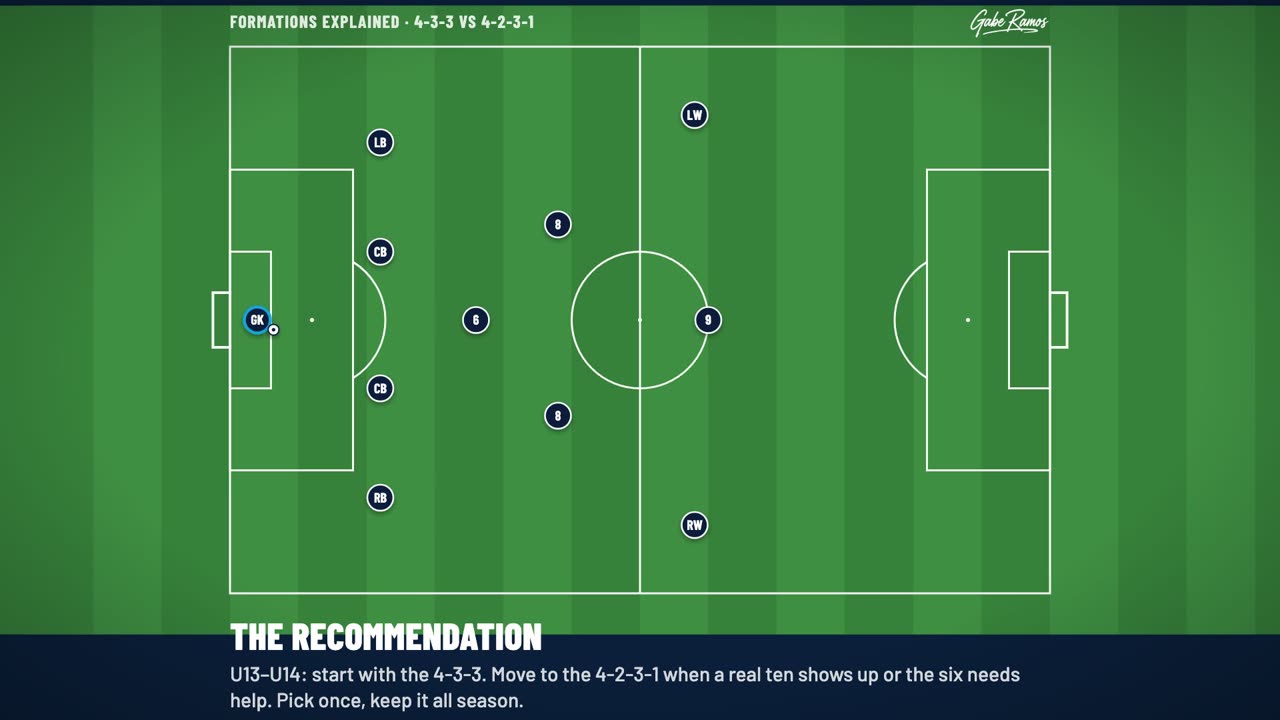
Under thirteen and under fourteen: start with the 4-3-3. Every unit is a triangle, every player has two options, and the roles are simpler to teach. Move to the 4-2-3-1 when a real ten shows up, or when your six needs help.
And whichever you pick, keep it for the season. Teams that change shape every week never learn either one. The players need twelve weeks of the same picture before the picture becomes theirs.
You do not have to choose before you train
The build-up phase, the rondos, the wide two v one, the five-second fight: they are the same sessions in both shapes. Coach the principles for the first four weeks, watch who your players are, then pick.
Four weeks is enough. By then you will know whether your six can play alone, whether anyone finds the pocket on their own, and which full-back is still running in the eightieth minute.
The recap
- A six who can play alone: 4-3-3.
- A real ten: 4-2-3-1.
- Two running full-backs: 4-3-3.
- One runner and one defender: 4-2-3-1.
- Want to sit in a block: 4-3-3. Want to press high: 4-2-3-1.
- Under fourteen, start with the 4-3-3. Pick once, keep it all season.
Coach it in one session
Week 1, MD-3 of the 11v11 curriculum is the same in both editions, because the first block is about shape and the principle is Get Small. Run it in both formations for a fortnight and the answer to the four questions usually appears on its own.
4v2 Split
RondoFour attackers on the sides of a 10x10, two defenders inside working as a pair. Six passes is a point, a split is three. The defending pair learns the one-presses-one-covers rule your pivots or your six and an eight will need. Full activity page ›
Around the Shape
SharpenCones in your team shape on half a field, one player per cone. The ball travels keeper, back, pivot or six, wide player, striker, finish. Follow your pass to the next spot so every player plays every position. Run it once as a 4-3-3 and once as a 4-2-3-1. Full activity page ›
Defend the block, phase of play
SolveA 70x60. A back four, three midfielders and a striker defend against a full attack of ten plus keeper, with two mini goals on halfway to counter into. Defenders start in the block on the edge of the final third, hold, then press on the trigger. Compact first: thirty yards front to back.
11v11, two shapes
PlayThree eight-minute periods. First period in the 4-3-3, second in the 4-2-3-1, third in whichever the captains choose. The team out of possession must be in its block before the ball crosses halfway; the coach freezes play to check.
Defending corners
Set pieceTwo zonal players on the six-yard line, everyone else marks goal side and ball side, keeper owns the six-yard box, two stay out for the counter. Walk it, then live with ten deliveries.
Both game models, each with twelve weeks of sessions, are in the ages 13 to 18 curriculum: one PDF for the 4-3-3 and one for the 4-2-3-1.
Questions coaches ask
Can we switch shapes during a game?
You can, but at youth level it costs more than it gains. A team that has trained one shape for twelve weeks reacts to problems inside that shape; a team that switches mid-game stops reacting and starts looking at the bench. Change the shape between seasons, or at the very least between blocks, not between halves.
Is the 4-2-3-1 more defensive than the 4-3-3?
No. Out of possession the 4-3-3 becomes a 4-5-1 and sits deeper; the 4-2-3-1 presses higher with a line of three. In possession the 4-2-3-1 keeps one full-back home and the 4-3-3 sends both. Which is more defensive depends entirely on how you coach the moments, not on the numbers.
What about a 4-4-2 or a 3-5-2?
Both work with the same principles. We teach the 4-3-3 first because every unit in it is a triangle and every player has two options, which makes the game model easier to learn. Once a team understands triangles and the free player, any shape is a week of cones away.
We play 9v9. Does any of this apply?
The questions do. At 9v9 the choice is usually between a 2-3-3 and a 3-2-3, and it comes down to whether you have a center mid who can be the pivot alone. The 9v9 guide explains the 2-3-3.
Keep reading
 Tactics guidePlaying out of the back in a 4-3-3
The 2-3-5 build shape, the first triangle and the four decisions a center back makes.
Read the guide › Tactics guidePlaying out of the back in a 4-2-3-1
The staggered pivots, the switch through the higher pivot and how to find the ten.
Read the guide › Tactics guideHow to press in a 4-3-3
Three moments, four triggers, the touchline trap and the six who never joins.
Read the guide ›The whole 11v11 game model, twelve weeks of sessions
The Full Season Travel Curriculum for ages 13 to 18 comes as two editions, one for the 4-3-3 and one for the 4-2-3-1: the game model in six pages, 36 sessions built around a match week (MD-4, MD-3, MD-2), twelve match-day pages, set pieces and the 35-minute warm-up. Every phase of play in these guides is in it.