Coaching tools › Guides › Playing out of the back
Tactics guide · 4-3-3 · in possessionHow to play out of the back
in a 4-3-3
Playing out of the back is not a style choice. It is a set of distances, one triangle and four decisions, and a 13-year-old can learn all of it in a month. This guide walks through the build shape of the 4-3-3, what the center back does when nobody presses, when one presses and when two press, the failure you will see every weekend, and the phase of play we use to train it.
 How to Play Out of the Back in a 4-3-3
The build shape is a 2-3-5
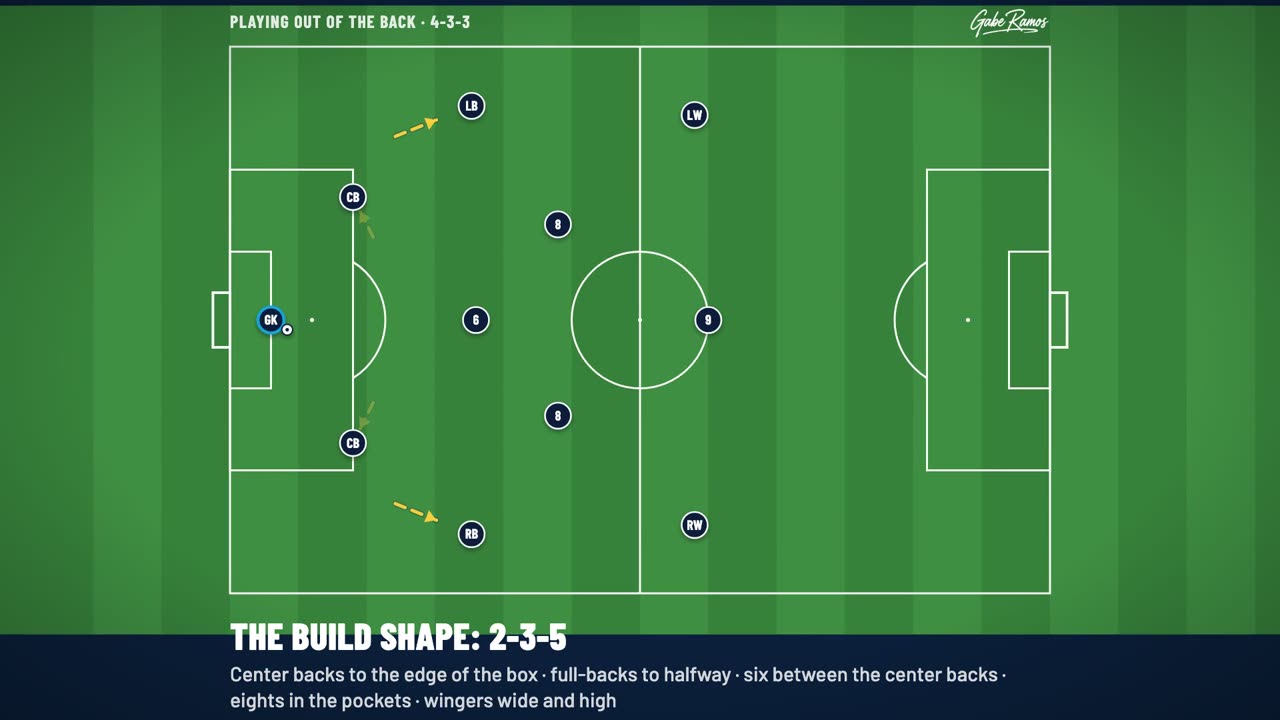
On a goal kick the 4-3-3 does not look like a 4-3-3. The two center backs split to the corners of the penalty area, the full-backs push all the way to the halfway line, the six sits between the center backs, the two eights slide into the pockets between the lines, and the wingers stay wide and high with the striker on the last defender. Count it and you have two, three, five.
Nobody changed position to get there. The shape is the same eleven players standing in the places that give every one of them two options. That matters more than the formation name: a center back with the ball should always see a pass inside, a pass outside and a carry forward, and the 2-3-5 is simply the arrangement that guarantees it.
The distances are the whole lesson. Edge of the box for the center backs, not the edge of the six-yard box. Halfway for the full-backs, not the corner of the eighteen. If your team gets the distances right, the triangles appear on their own. If it does not, no amount of shouting “play out” will produce a pass.
The first triangle: keeper, center backs, six
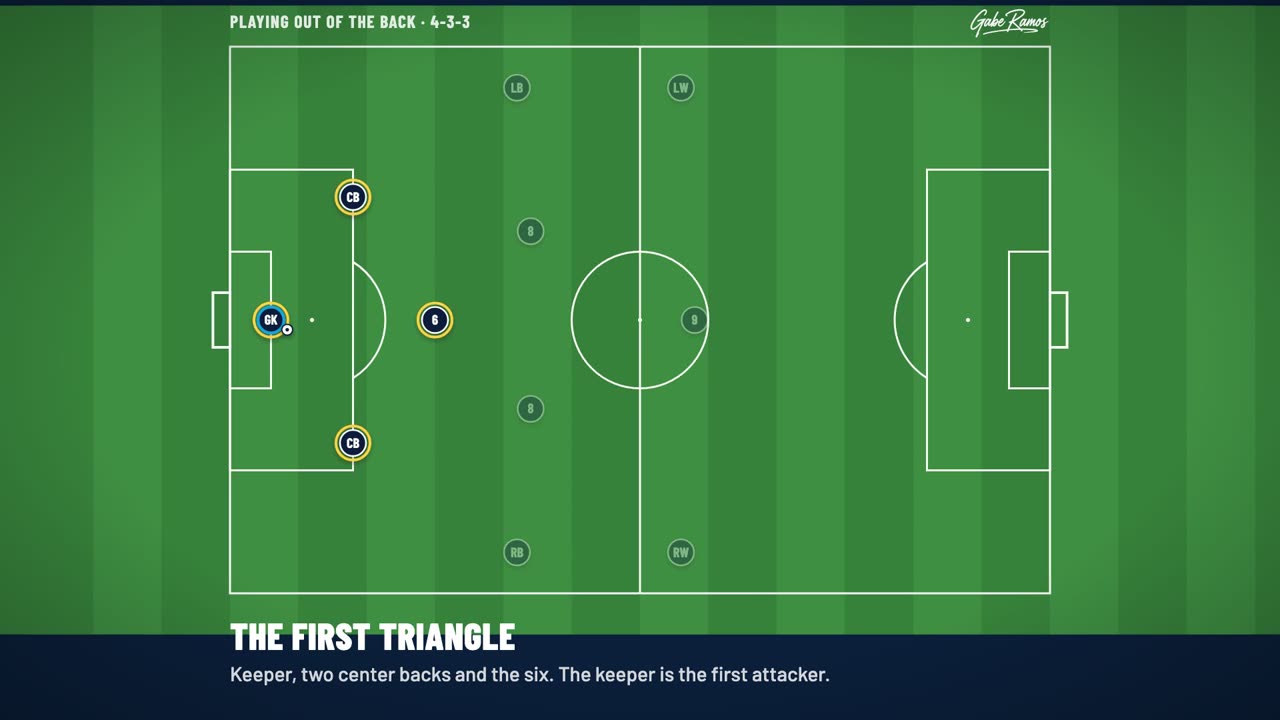
The whole build runs through one triangle: the keeper, the two center backs and the six. The keeper is the first attacker, not the last defender, and the first pass splits the center backs, played to the one the striker is not going toward.
The center back receives on the open foot, facing the field, so that the next pass is already there. A center back who receives on the near foot with their back to play has to take a second touch to turn, and that second touch is where youth build-ups die. Receive open, see the field, play.
- The keeper picks the free center back, never the nearest one.
- Receive on the back foot, body open to the field.
- The six is in the picture before the first pass is played, not after.
Decision one: nobody presses, so carry
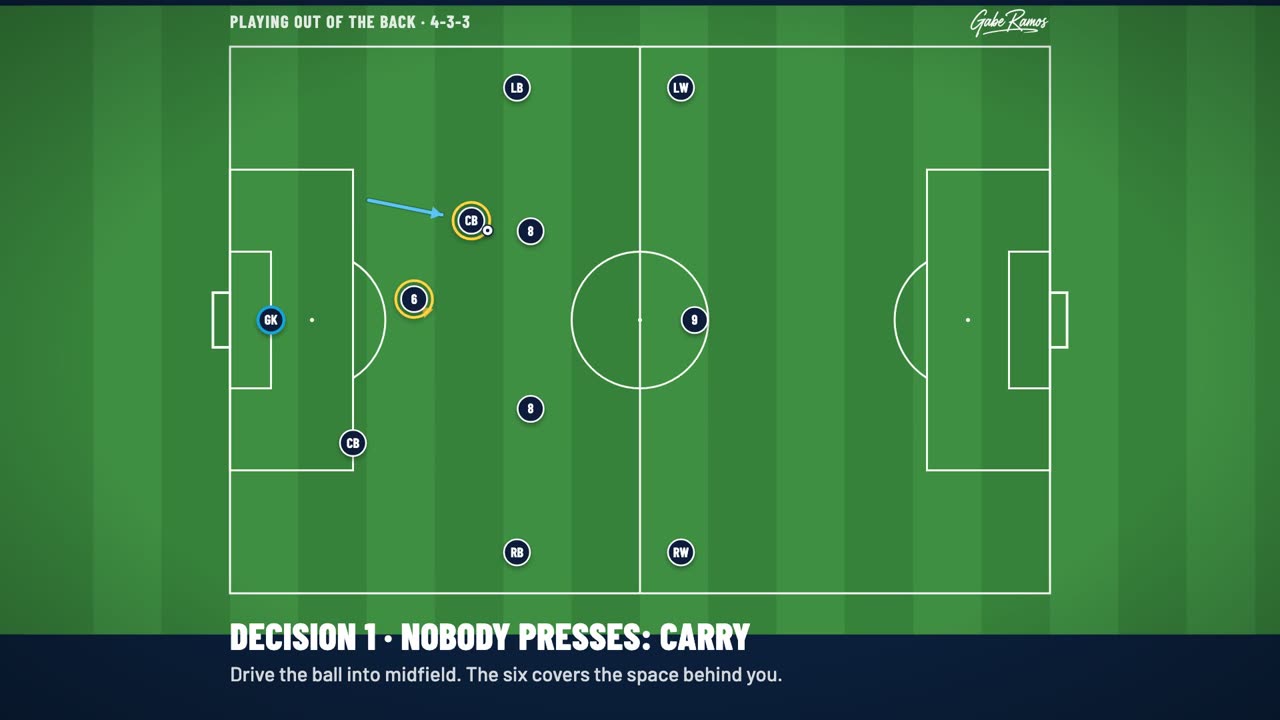
The center back has the ball and nobody comes. The instinct at every youth level is to pass anyway. Do not. Drive the ball into midfield. Every yard the center back carries pulls a defender toward the ball, and the six covers the space behind.
Center backs who only pass give away free yards. A center back who carries twenty yards has moved the whole opposition block twenty yards, and the pass that comes at the end of the carry is played into a team that is no longer organized. Coach the carry first, because it is the decision young defenders are least willing to make.
Decision two: one presser, the six on the half-turn
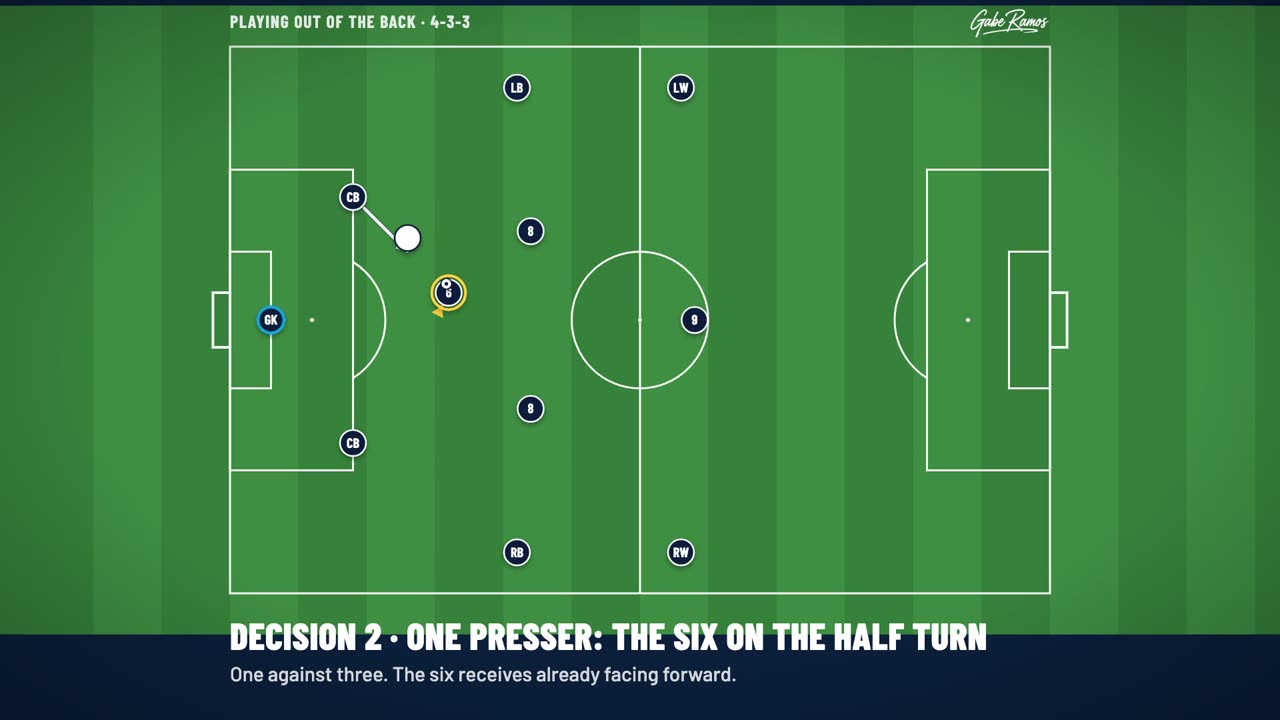
One striker steps to press the center back. That is one against three, because the six and the other center back are both free. The six shows for the ball on the half-turn and the center back plays into them.
Half-turn means the six receives already facing forward, so the ball goes to an eight in one more pass. A six who receives square has to turn under pressure; a six who receives on the half-turn is already looking at the eights. This is the single most valuable receiving habit in the game and it is worth a month of rondos.
Decision three: two pressers, the six drops
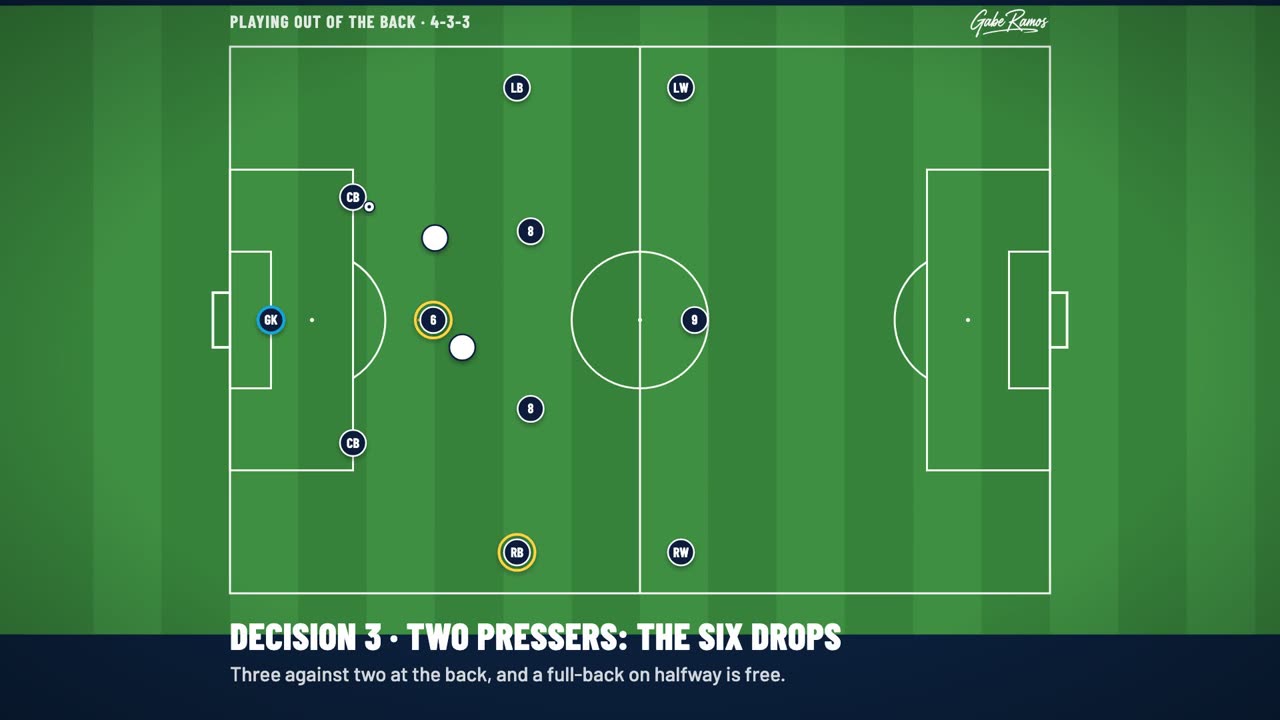
They press with two, so the six is marked. This is the rule that fixes most youth build-ups: when they press with two, the six drops between the center backs. Now it is three against two at the back, and one of the two full-backs on halfway is completely free.
The drop has to be early and it has to be deep: between the center backs, not in front of them. If the six drops in front, the two pressers simply cover three players with two and the picture has not changed. Between the center backs, the six becomes a third center back and the numbers at the back are finally right.
Then find the free full-back. The pass is usually a driven ball along the ground from the wide center back, and the full-back receives it with thirty yards of space in front of them and the press behind them.
Decision four: the middle is closed, switch through the keeper
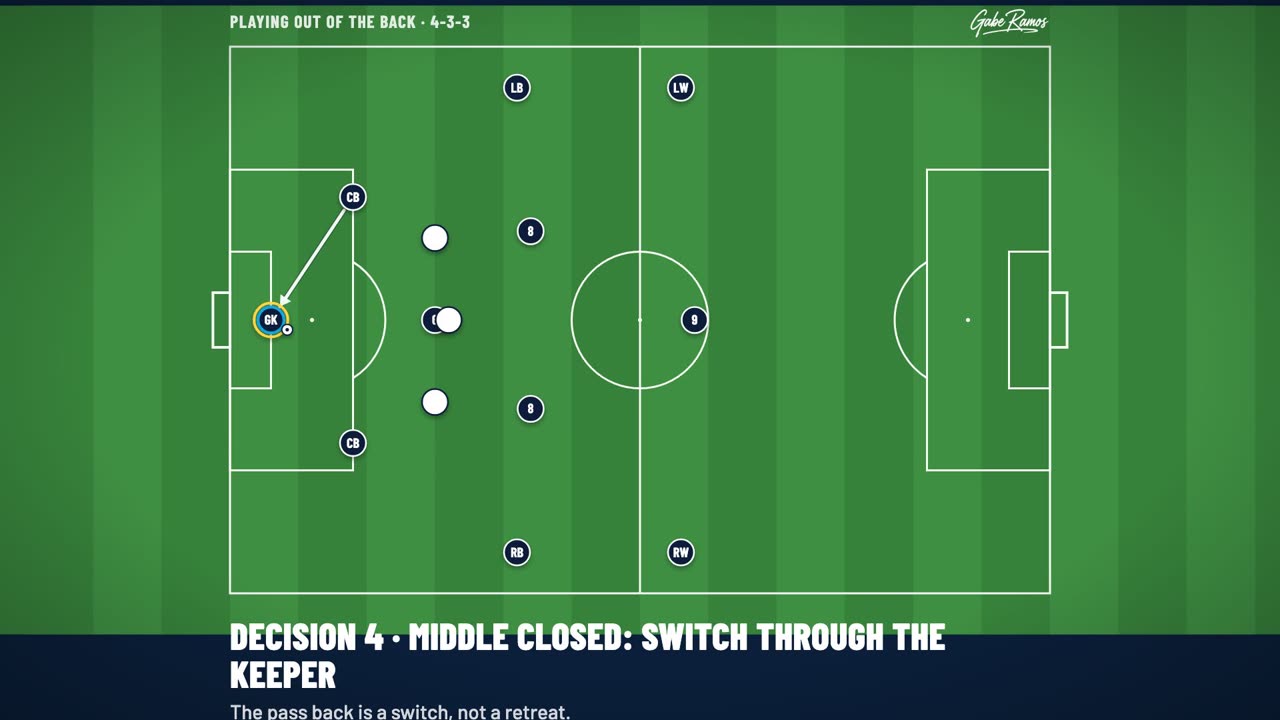
The whole middle is closed. Do not force it. Play back to the keeper, and the keeper switches the ball to the other side. The pass back is a switch, not a retreat: two passes through the keeper and the ball is on the far full-back with space in front.
Coaches who ban the back-pass are banning the best switch in the game. The keeper is the only player on the field whom nobody can press without leaving someone free, which is why the keeper is the plus one in every build-up. Teach the pass back as a positive action and the panic clearances disappear.
The wide two v one
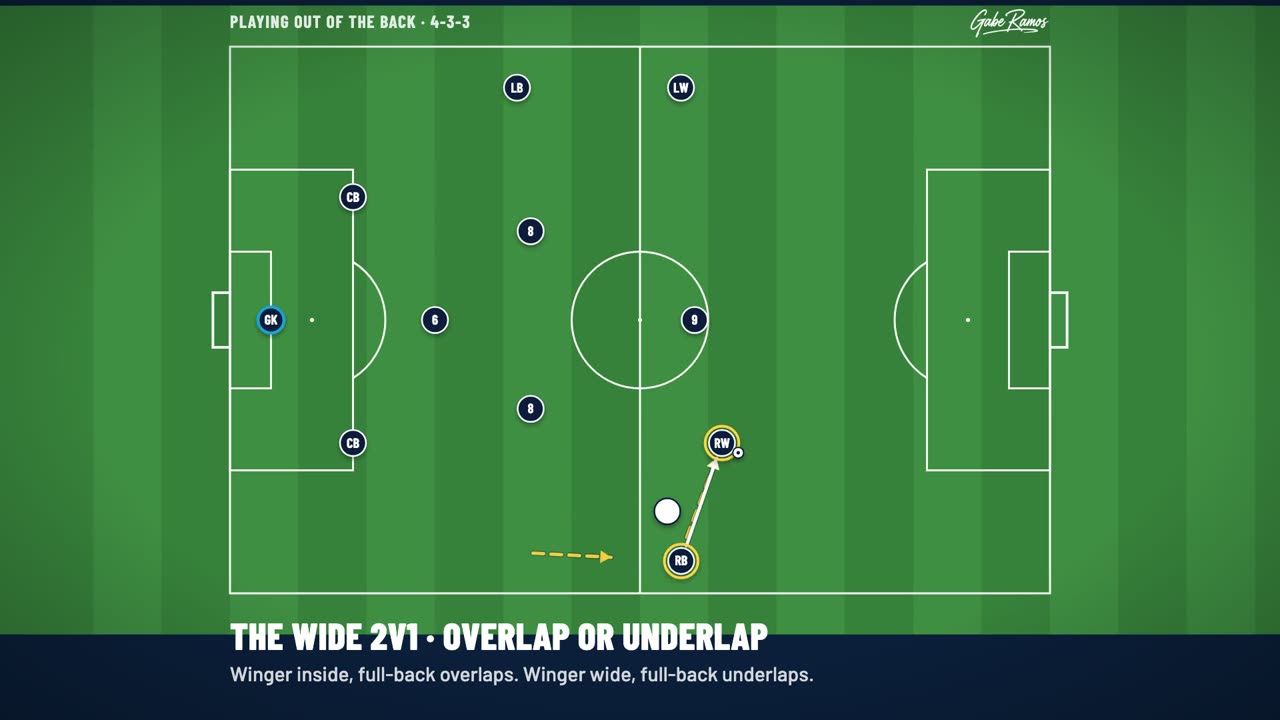
Once the ball reaches the full-back, the winger and the full-back are a two against one, both ways. If the winger comes inside, the full-back overlaps. If the winger stays wide, the full-back underlaps. Either way, the defender marking the full-back has to choose, and whoever they leave is the free player.
The winger decides and the full-back reacts. Coach the winger to make the first movement early, before the ball arrives, so the full-back is already running when the pass comes.
The failure you will see every weekend
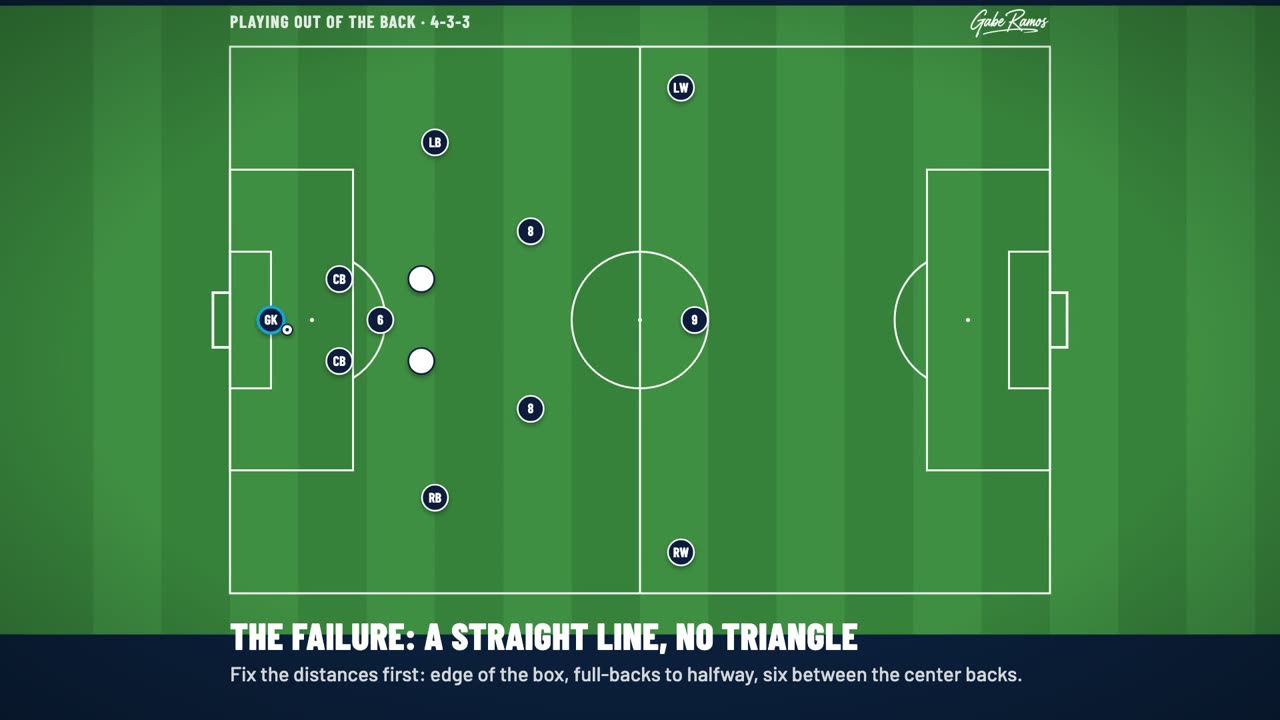
The center backs do not split far enough, the six stands still in front of them, and everybody is in a straight line. Now there is no triangle, and the only pass is long. The keeper kicks it, the striker loses the header, and the team spends the next minute defending.
Fix the distances first. Edge of the box, full-backs to halfway, six between the center backs. The distances create the triangles, and the triangles create the passes. If a team cannot play out, nine times out of ten it is a distance problem, not a technique problem.
Rest defense: three stay home
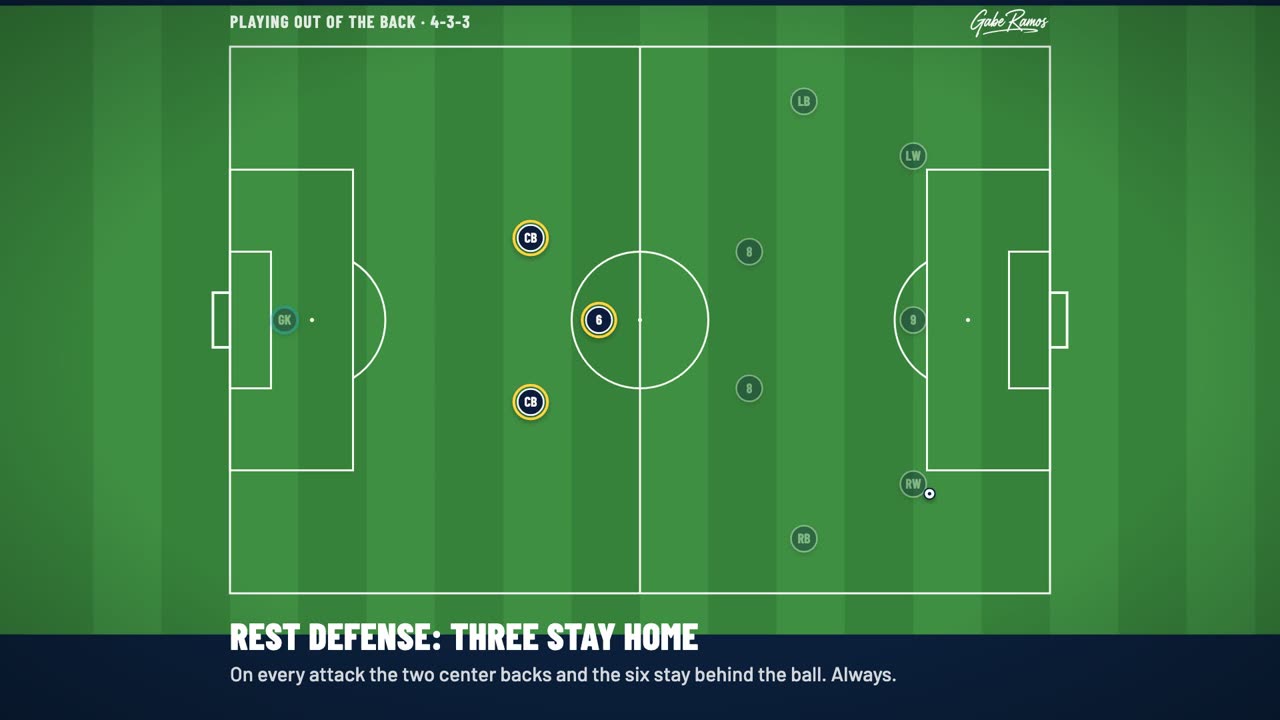
One more thing before you try it. On every attack, the two center backs and the six stay behind the ball. Always. The full-backs can go, the eights can go, but those three hold. That is what lets a team play out bravely without getting countered, and it is a rule you will hear in every one of these guides.
There is a full guide on rest defense, including who presses when the ball is lost and who holds.
The recap
- 2-3-5 on the goal kick: center backs to the edge of the box, full-backs to halfway, six between the center backs.
- Split the first pass to the center backs; receive on the open foot.
- Nobody presses: carry.
- One presser: the six shows on the half-turn.
- Two pressers: the six drops between the center backs, find the free full-back.
- Middle closed: switch through the keeper.
- Three stay home, every time.
Coach it in one session
This is the MD-3 session from week 3 of the 11v11 curriculum, where the block topic is build-up and the principle is Look First. Ninety minutes, sixteen to twenty players, medium intensity.
4v1 With a Call
RondoA 10x10 rondo where the receiver calls a number shown by a helper before the first touch. No call, no count. Eyes up before the ball arrives is the habit the whole build-up depends on. Full activity page ›
Build-up pattern, unopposed
SharpenHalf a pitch. Keeper, two center backs, two full-backs, the six and one eight. Pattern A: keeper to center back, center back to full-back, full-back inside to the eight on the half-turn, eight forward to a target on halfway. Pattern B: keeper to center back, center back to the six who drops, six to the far full-back. Rotate every eight balls, then add a passive presser on the six so the players choose A or B.
Build against the press, phase of play
SolveA 70x60. Keeper, back four, three midfielders and the striker build from a goal kick against a full 4-3-3 press of ten. Score by reaching either winger, who waits in a wide end zone past halfway, with the ball under control. Pressers score in the goal. Ten goal kicks each side. Your coaching call: who is free? Play them. Full activity page ›
11v11, every goal kick short
PlayThree eight-minute periods. A goal that started from a short goal kick and had eight or more passes counts double. The 4-3-3 builds as a 2-3-5 with the full-backs high.
Our goal kicks
Set pieceCenter backs to the corners of the box, full-backs to halfway, six in the D, eights in the pockets. The keeper picks the free one. Walk it, then ten live against six pressers.
If you coach 7v7 or 9v9, the same ideas scale down: a keeper, two backs and a center mid make the diamond, and the free U12 practice plan is the playing-out-of-the-back session from the ages 9 to 12 curriculum.
Questions coaches ask
At what age should a team start playing out of the back?
From the first season with a goalkeeper, usually 7v7 at U9, with a keeper, two backs and a center mid in a diamond. The distances and the first pass are the same at every age; only the size of the picture changes. By 11v11 at U13 the full 2-3-5 shape is teachable in a month.
What do we do when the other team presses with three?
Count. Three pressers on your keeper and two center backs leaves your six and both full-backs free. The six drops between the center backs to make a three against three at the back, and the first pass goes straight to a full-back on halfway, who now has the whole far side. A press with three is the easiest press to play through if the full-backs are high.
Should the keeper ever go long?
Yes, on purpose. When it is a real trap, the striker pins the center back, both eights run beyond before the ball is kicked, and the second ball is yours because you were running first. A long pass with runners is a plan. A long pass without them is a clearance. The guide on beating a high press covers it.
How many goals will we concede learning this?
Some, in the first three weeks. Count completed build-ups instead of goals for a month and the players stop panicking. Every team that plays out well conceded a goal or two learning it, and every team that never learned is still kicking it long at U16.
Keep reading
 Tactics guidePlaying out of the back in a 4-2-3-1
The staggered pivots, the switch through the higher pivot and how to find the ten.
Read the guide › Tactics guideHow to beat a high press
The keeper is the plus one, the third player is free, and five rules that get you out.
Read the guide › Tactics guideRest defense: attack without getting countered
Three stay behind the ball, the nearest three press for five seconds, and the bench calls every turnover.
Read the guide ›The whole 11v11 game model, twelve weeks of sessions
The Full Season Travel Curriculum for ages 13 to 18 comes as two editions, one for the 4-3-3 and one for the 4-2-3-1: the game model in six pages, 36 sessions built around a match week (MD-4, MD-3, MD-2), twelve match-day pages, set pieces and the 35-minute warm-up. Every phase of play in these guides is in it.