Coaching tools › Activities › Rondos
Free activity · 100 Possession Activities4v1 With a Call
A 4v1 rondo where the receiver has to call a number shown by a helper before the first touch. No call, no count. It trains the look before the ball arrives.
Setup
A 10x10, one attacker on each side, one defender in. A helper walks the outside holding up one to five fingers.
How it works
- The receiver calls the number before the first touch.
- No call, no count. Six counted passes is a point.
- Swap the defender every 45 seconds.
Scoring
Points in 45 seconds; the group tries to beat its own score.
- Look before the ball arrives, not after.
- Open your body so you can see the helper and the ball.
- Say the number loud enough for the group to hear.
Make it easier or harder
- Progression 1: The helper changes the number while the ball travels.
- Progression 2: Two helpers on opposite sides: call the one behind you.
Coach’s notes
- If It Stalls: Players calling after the touch? Slow the passing down until the call comes first, then speed it up.
Why it works
Every coach says “look before you receive”. This rondo makes it a rule with a score attached, which is the only way most players actually change the habit. The call has to come before the touch, out loud, so the whole group can hear who looked and who did not.
The helper matters as much as the players. Rotate a resting player into the job and tell them to change the number while the ball is traveling: now the receiver has to look late as well as early.
Where it sits
This is activity 2 of 100 in 100 Possession Activities (Theme 1 · Rondos: Keep It Under Pressure). The book is ten themes of ten rungs each, from a 3v1 square to a full 9v9 transition game, and every activity has its setup, rules, scoring, two progressions, three coaching points and an animated video like the one above.
More like this
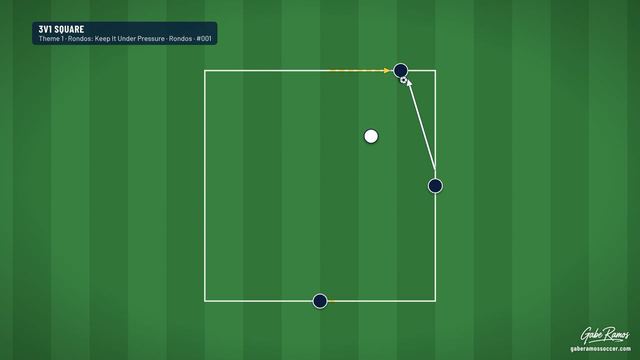 Ages 11+ · Rondos3v1 Square
The first rondo. Three attackers on three sides of a small square, one defender inside, two touches and five passes for a point.
Open the activity ›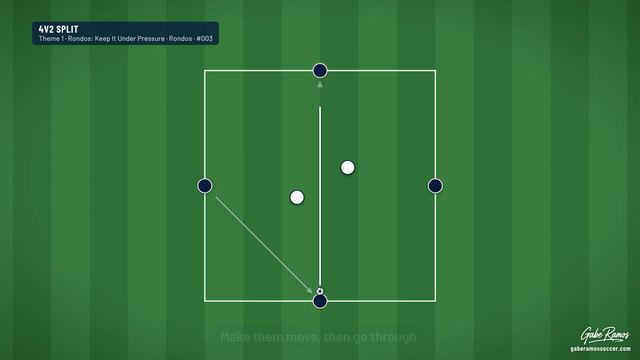 Ages 11+ · Rondos4v2 Split
Four attackers on the sides of a 10x10, two defenders inside working as a pair.
Open the activity ›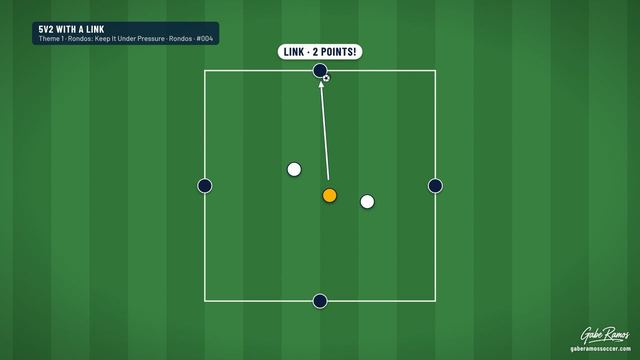 Ages 11+ · Rondos5v2 With a Link
The first rondo with a player in the middle. Four attackers on the sides, one inside as the link, two defenders.
Open the activity ›All ten rungs of this theme, and nine more themes
100 Possession Activities is a 115-page PDF with 100 animated MP4 videos: rondos, playing out from the back, through the lines, support, switching, overloads, movement, timing, counter-pressing and counter-attacks. Print the page, watch the clip, run the session.