Coaching tools › Guides › The 2-3-3 for 9v9
Tactics guide · 9v9 · ages 11 to 12The 2-3-3 for 9v9,
explained
If your team just moved up from 7v7, this is the shape, this is what changes, and this is what does not. The 2-3-3 keeps the back five of the 2-3-1 exactly as they were and adds two wingers, which changes three things: where the width lives, what the striker has for company, and how the team presses.
 The 2-3-3 for 9v9 Explained
What changes, and what does not
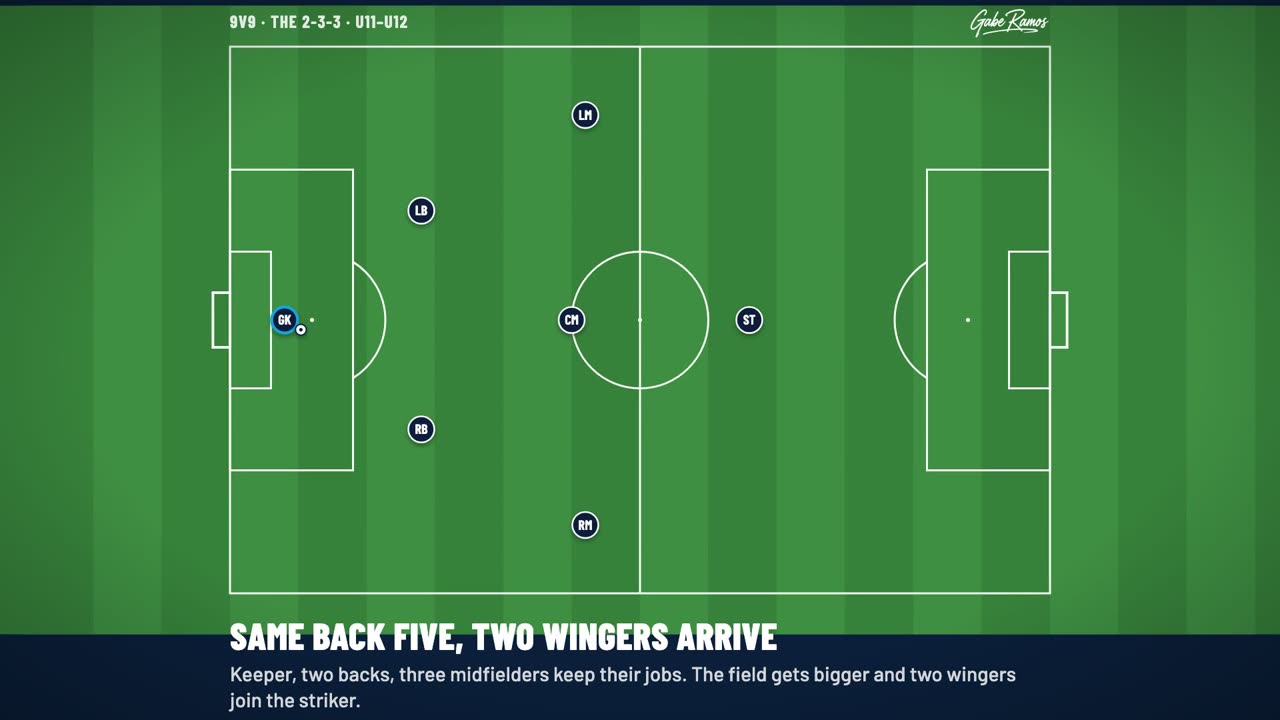
The same back five as the 2-3-1: keeper, two backs, three midfielders. The two new players are wingers, so the striker is no longer alone. Almost nothing changes at the back, on purpose. Players who learned the 2-3-1 keep their jobs.
This is the reason to pick the 2-3-3 over the other 9v9 shapes. A U11 team has spent two years learning that the backs split, the wide mids give width and the center mid links. The 2-3-3 keeps all of that true and adds two players in front of it. The field gets bigger, two wingers arrive, and that changes three things.
Change one: width moves forward
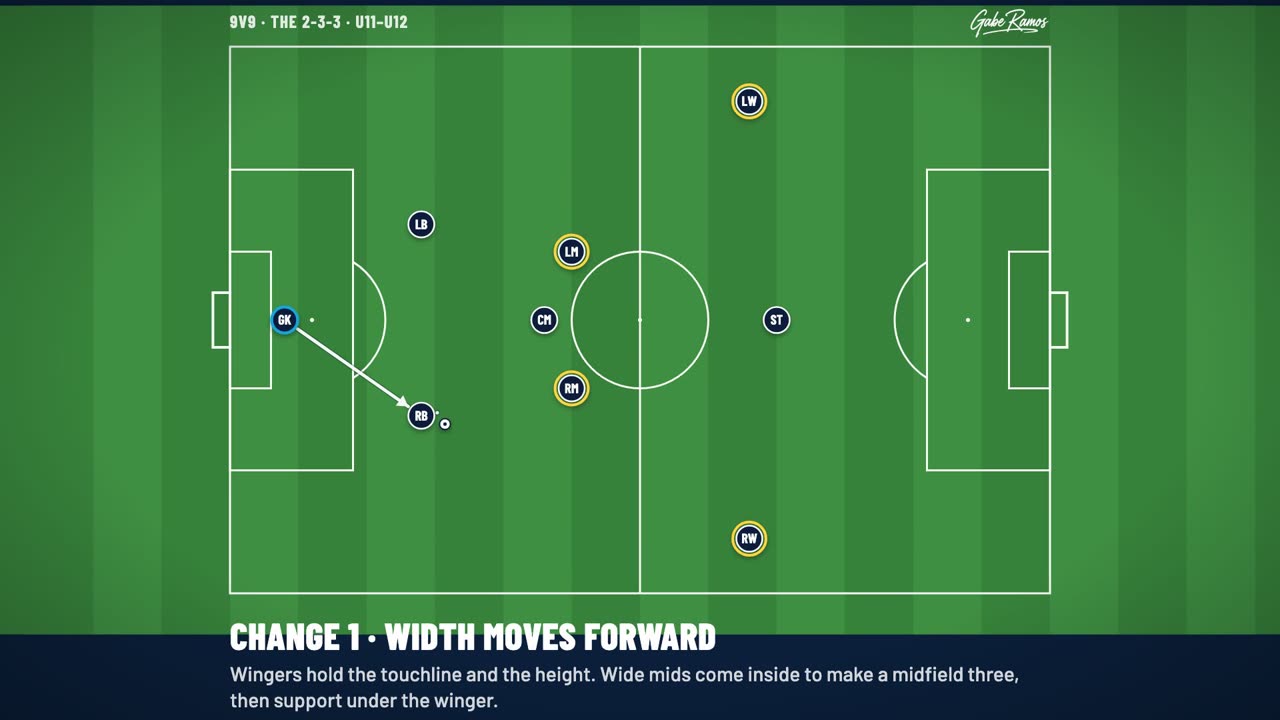
The wingers hold the touchline and the height, so the wide mids no longer have to. The wide mids come inside to make a midfield three with the center mid, then support underneath the winger on their side.
This is the hardest change for a wide mid who was the widest player on the field last season. Tell them plainly: the winger owns the touchline now, you own the space just inside it. Two jobs, two lines.
Change two: the striker has company
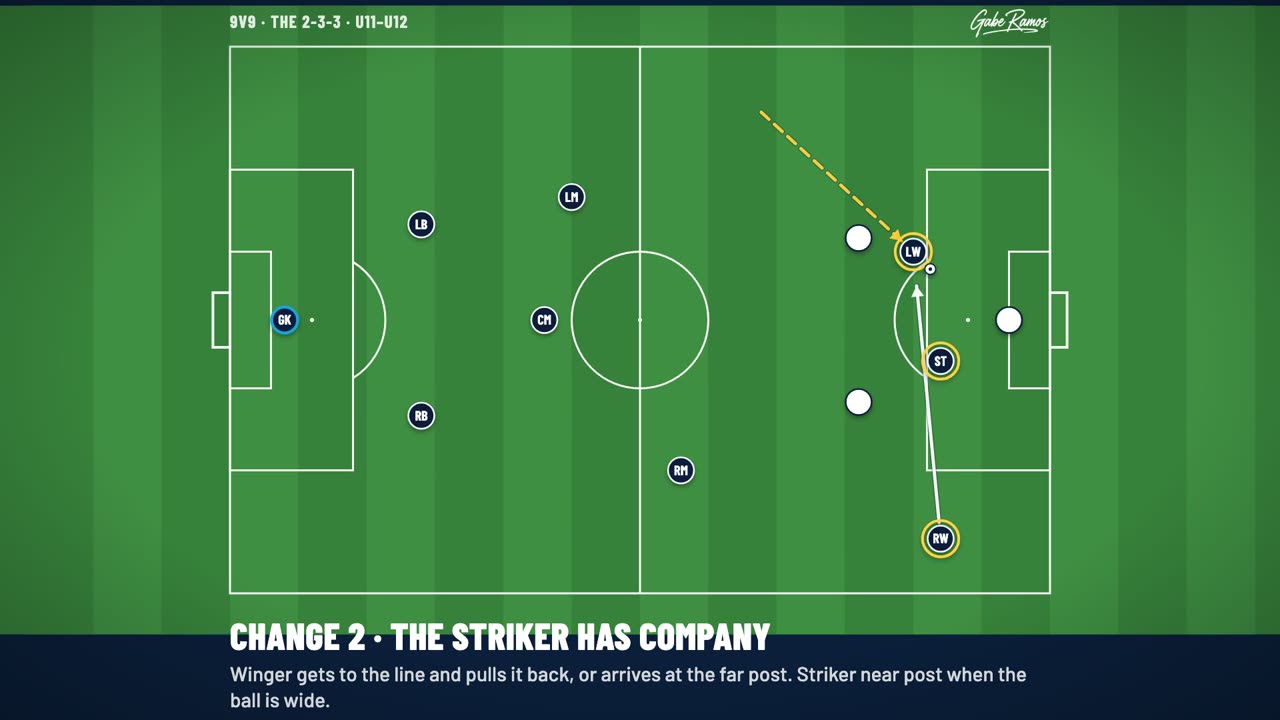
Runs beyond and cutbacks become real options. The winger gets to the line and pulls it back, or arrives at the far post. The striker goes near post when the ball is wide. Two players in the box instead of one.
At 7v7 the striker scored by beating a defender. At 9v9 the striker scores by being in the right place when a winger arrives at the goal line. Near post when the ball is wide is the first rule to teach, because it is the one the striker will resist: it feels like running away from the ball.
Change three: the press has a front line
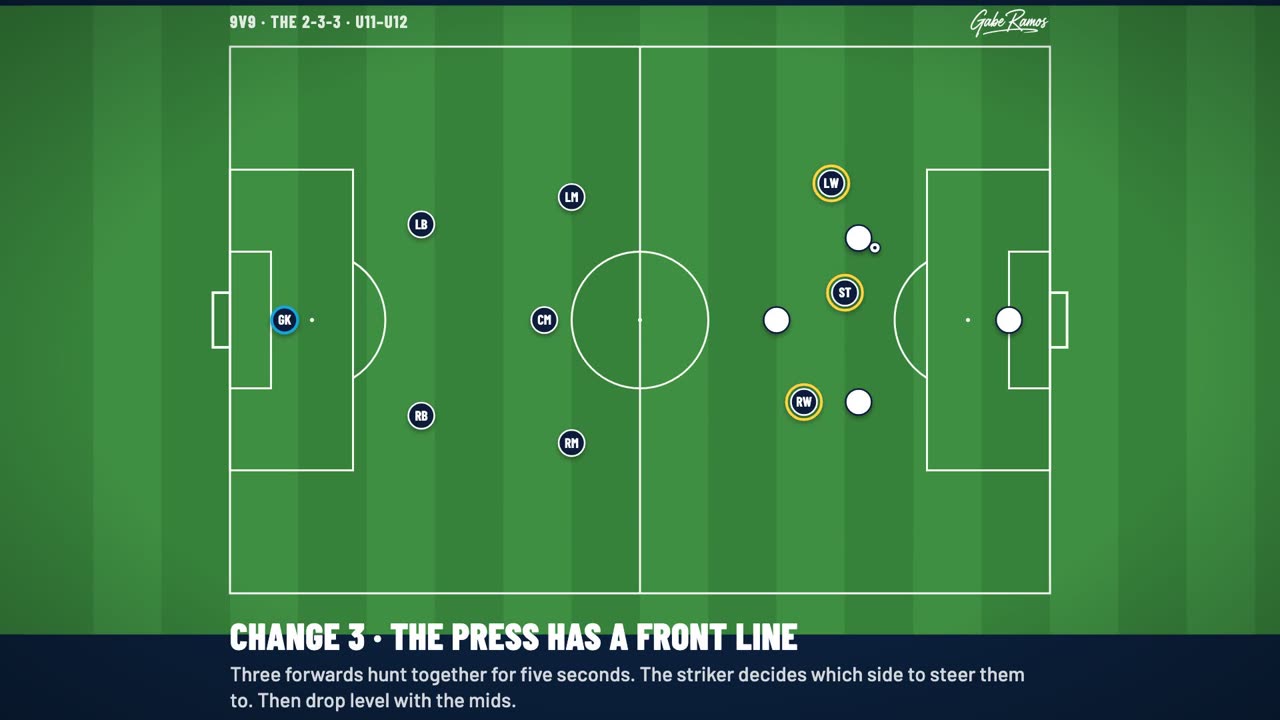
Three forwards hunt together for five seconds when we lose it, and the striker decides which side to steer them toward. After five seconds the wingers drop level with the mids and the team gets small.
At 7v7 one striker could not press alone and the team learned to drop. At 9v9 three forwards can press together, and the five-second rule is what stops it from becoming three players chasing one ball while the rest of the team watches.
- Width moves forward: wingers on the touchline, wide mids inside.
- The striker has company: near post, cutback, far post.
- The press has a front line: three go for five seconds, then get small.
The center mid is the pivot
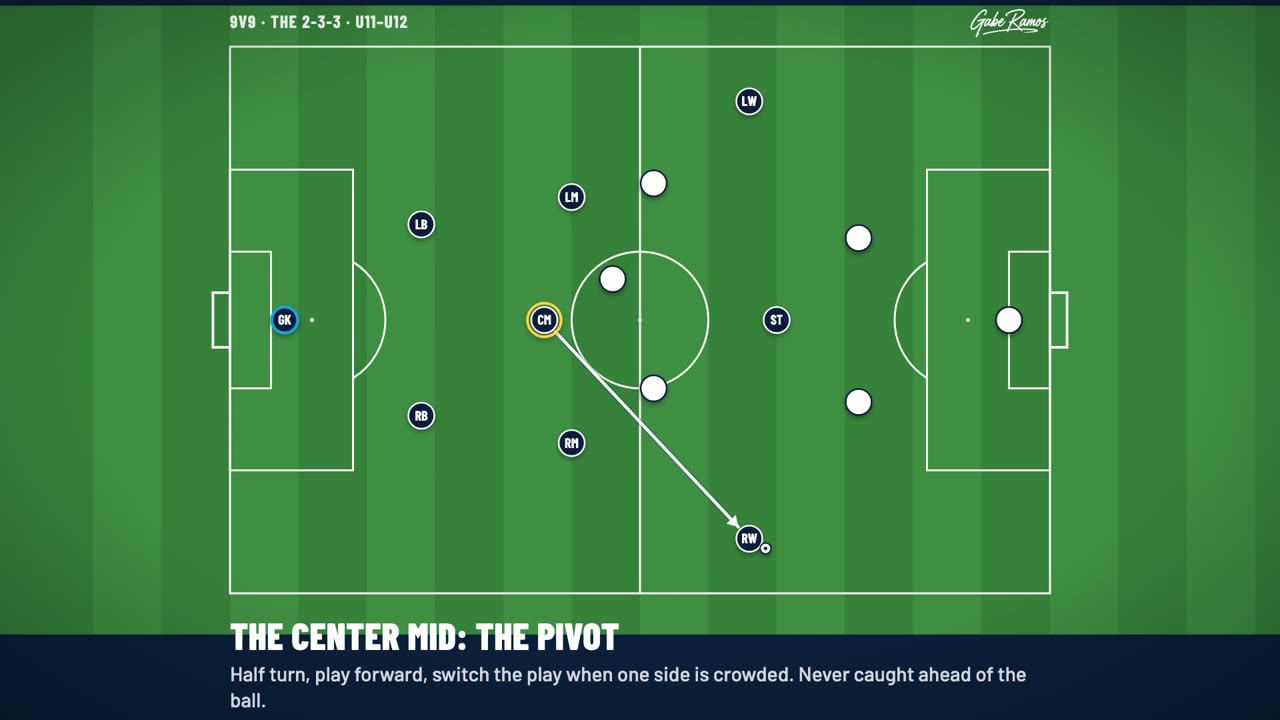
The center mid becomes the pivot. Half turn, play forward, switch the play when one side is crowded. Without the ball, guard the middle and never get caught ahead of the ball when we lose it. This is the player the whole shape turns around.
It is also the player to pick most carefully. The pivot at 9v9 is the six at 11v11, two years early. A player who can receive on the half-turn with a defender behind them at eleven will play the position for the rest of their career.
The backs
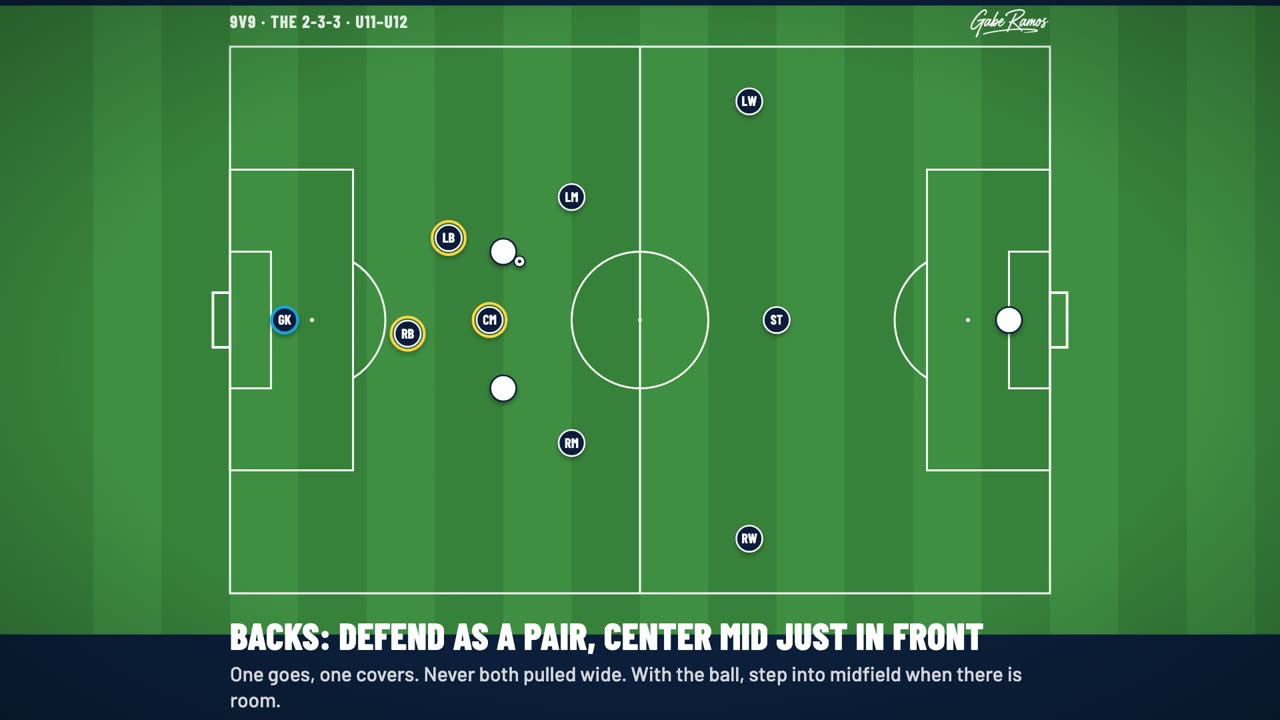
The backs split, open up, and step into midfield with the ball when there is room. Without it they defend as a pair with the center mid just in front, and they do not get pulled wide together. One goes, one covers. Same as 7v7, on a bigger field.
The bigger field is the trap for a pair of backs. At 7v7 they could cover the width between them; at 9v9 they cannot, so the one who is not going to the ball has to stay central and let the wide mid deal with the touchline.
Goal kicks: short for a month
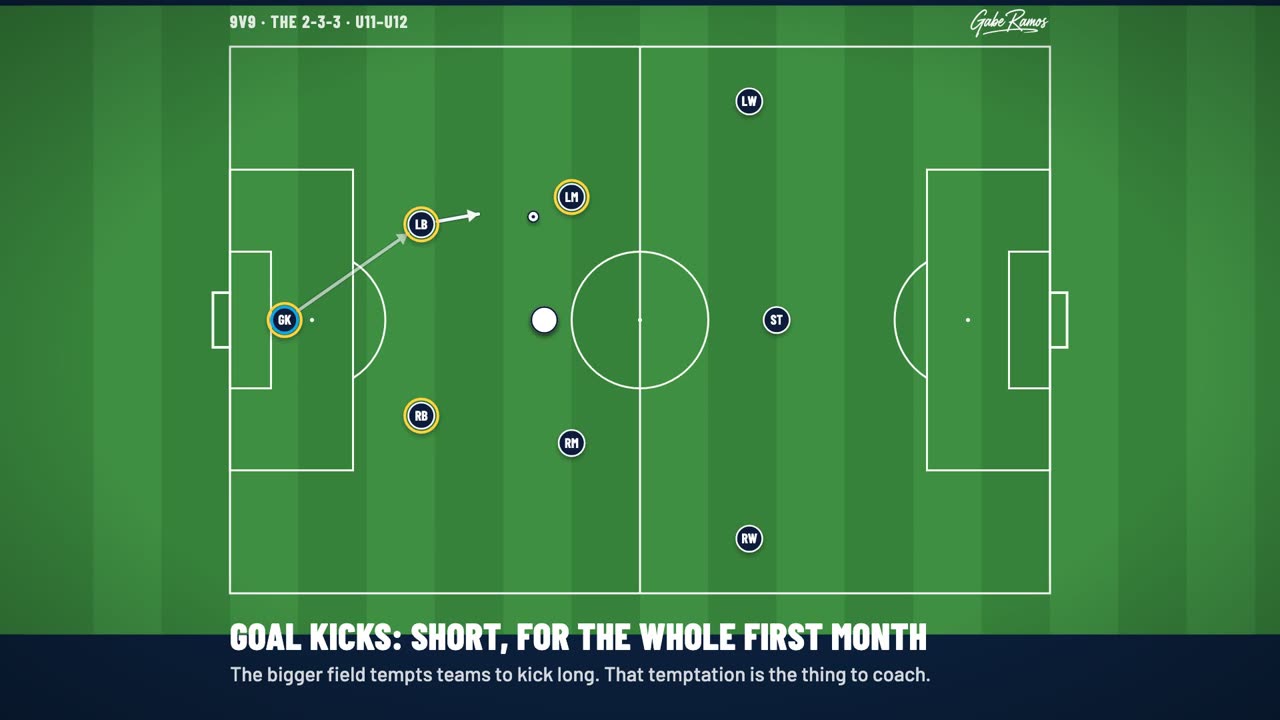
The first month of 9v9, play every goal kick short and keep the 7v7 habits. The bigger field tempts teams to kick long. That temptation is the thing to coach. The keeper is the first attacker, and now the pass to a wide mid is on.
The build-out line is gone at 9v9 in most leagues, which means the other team can press the goal kick. That is not a reason to kick long; it is the reason the backs split to the corners of the box and the center mid shows. The guide on beating a high press is written for exactly this moment.
Positions at eleven and twelve
At eleven and twelve, players start to have a best position. Let them have one, and still give everyone a second. Growth spurts change who is suited to what, and the player who is your striker in September may be your center back in March.
The match-day pages in the curriculum ask you to play every player in at least two positions each game for the first six weeks. It costs you very little in results and it tells you things about your squad that training never will.
The failure you will see every weekend
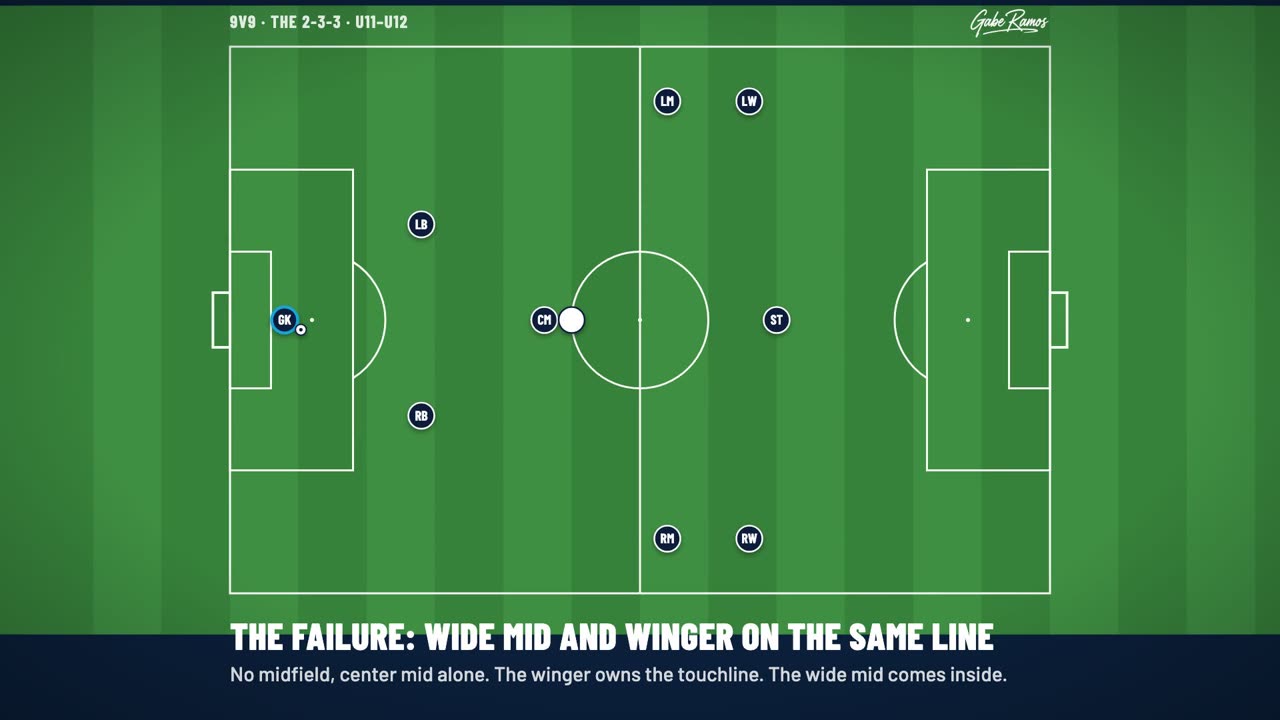
The wide mid and the winger standing on the same line, both wide, both waiting. Now there is no midfield and the center mid is alone. The winger owns the touchline. The wide mid comes inside. Two jobs, two lines.
Freeze the game when you see it and ask the two players which of them is the winger. They know. They have just not been told that the other one has to move.
The recap
- Same back five as the 2-3-1. Wingers are the new players.
- Wingers own the width and the height. Wide mids come inside.
- Striker has company: near post, cutback, far post.
- Three press for five seconds, then get small.
- Center mid is the pivot.
- Goal kicks short for a month.
- One best position, plus a second.
Coach it in one session
Week 1, Session 1 of the ages 9 to 12 curriculum, drawn for 9v9. The habit is Get Big: when we have the ball, stretch the field. Ninety minutes, twelve to sixteen players. This is also the free U10 practice plan, with the 7v7 shape in the Play block.
Four-Line Rondo
RondoA 10x10 with one attacker on each side line and one defender inside. Attackers may slide along their own line but not leave it. Eight passes is a point. Use your whole line: slide until the ball can see you. Full activity page ›
Around the Shape
SharpenCones in the 2-3-3 on half a field, one player per cone. The ball travels keeper, back, wide mid, center mid, winger, striker, finish in a mini goal. Follow your pass to the next spot, so everyone plays every position and names it as they run. Full activity page ›
Channel Game
Solve4v4 to mini goals on a 35x30 with a five-yard channel down each side. One attacker at a time may be in a channel and nobody may tackle them there. A goal counts double if the move went through a channel. Where is the space? Get it wide, then go. Full activity page ›
The Build-Up Game, 9v9
PlayA full 9v9 on a 60x40 where every goal kick is played short and the opponents drop to halfway until the first pass is received. A goal that started from a short goal kick counts double. It makes the long kick the worst option on the field. Full activity page ›
Rules and throw-ins
Set pieceTwo minutes on the rules your league uses at 9v9: restarts, offside, and the build-out line if you have one. Then throw-ins in pairs: both feet down, ball from behind the head, throw to feet.
The 7v7 shape this grows out of is covered in the guide to the 2-3-1 for 7v7.
Questions coaches ask
Is the 2-3-3 better than the 3-2-3 or the 3-3-2 for 9v9?
For a team coming up from a 2-3-1, yes, because the back five keep their jobs and only two players learn something new. A 3-2-3 asks the center mids to play as a pair, which is a 4-2-3-1 skill two years early. A 3-3-2 gives up the wingers and with them the width. Pick the 2-3-3 unless you have a specific reason not to.
Where do the wide mids go when we defend?
Inside, level with the center mid, to make a line of three that protects the middle. The wingers drop in front of them after the five-second press. Out of possession the 2-3-3 looks like a 2-3-3 with everybody ten yards closer together, thirty yards front to back.
Should the two backs be our best defenders or our best passers?
Your best passers who are willing to defend. At 9v9 the backs touch the ball more than anyone except the center mid, and a back who cannot split, open up and play the first pass makes the whole shape kick long. Teach the defending; it is simpler than the passing.
How do we handle a team that kicks it long over our two backs?
Keeper starts high enough to sweep, and the back who is not going to the ball drops instead of stepping. The center mid screens the second ball. And on your own goal kicks, keep playing short: a team that kicks long is a team that has given up the ball, and the 2-3-3 is built to keep it.
Keep reading
 Tactics guidePlaying out of the back in a 4-3-3
The 2-3-5 build shape, the first triangle and the four decisions a center back makes.
Read the guide › Tactics guideHow to beat a high press
The keeper is the plus one, the third player is free, and five rules that get you out.
Read the guide › Tactics guide4-3-3 or 4-2-3-1: which fits your team?
Four questions about your six, your ten, your full-backs and how you defend.
Read the guide ›The whole 9v9 season, with the 7v7 season in the same book
The Full Season Travel Curriculum for ages 9 to 12 is twelve weeks of sessions built around six team habits, every game drawn at 7v7 and 9v9, with match-day pages, the 30-minute game-day warm-up and an animated video of every activity. Week 1 is free as a sample.