Coaching tools › Activities › Possession and passing
Free activity · 100 Possession ActivitiesTwo-Side Rondo
A long, narrow rondo. Two attackers on each short end of a 16x8, two defenders inside. Score by passing from one end to the other along the ground. Short, short, long.
Setup
A 16x8. Two attackers on each short end, two defenders inside.
How it works
- Score by passing from one end to the other along the ground.
- End players may pass to their partner first to draw the defenders.
- Defenders swap on a win.
Scoring
First to ten switches.
- Draw the defenders to one side with a short pass, then hit the far side.
- Receive the switch moving toward the ball.
- Play the switch with the inside of the foot, along the ground.
Make it easier or harder
- Progression 1: End-to-end passes must be one touch.
- Progression 2: Add a neutral in the middle who can be used or skipped.
Coach’s notes
- If It Stalls: Switches bouncing? Shorten the area to 12x8 until they travel on the ground.
Why it works
The switch is the pass that moves a defending team, and it is usually set up by the two short passes before it. In this rondo the end pairs learn to pull the defenders to one side with a short pass and then hit the far end before the defenders turn.
Keep the switch on the ground. A bouncing switch takes two touches to control, and by then the defenders have slid across.
Where it sits
This is activity 41 of 100 in 100 Possession Activities (Theme 5 · Switching the Play). The book is ten themes of ten rungs each, from a 3v1 square to a full 9v9 transition game, and every activity has its setup, rules, scoring, two progressions, three coaching points and an animated video like the one above.
All switching the play drills ›
More like this
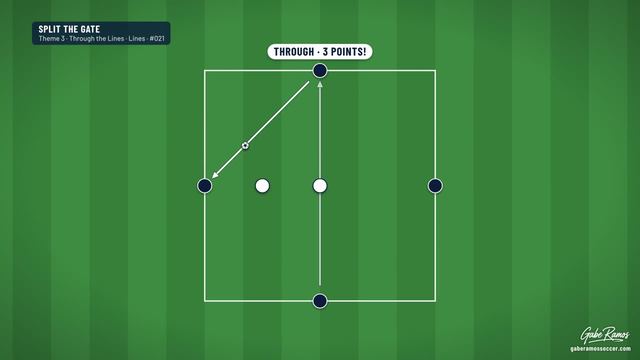 Ages 11+ · Possession and passingSplit the Gate
Four attackers around a 12x12 with two defenders standing as a gate in the middle, three yards apart.
Open the activity ›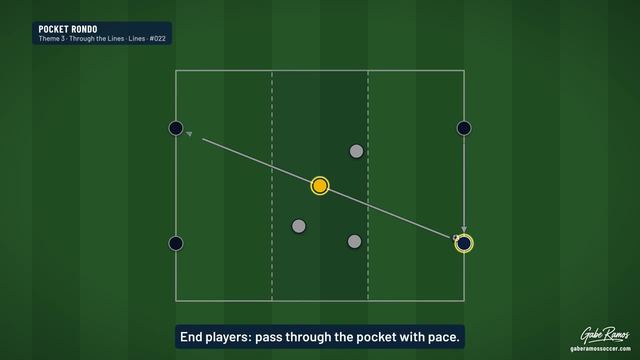 Ages 11+ · Possession and passingPocket Rondo
Three lines of cones split a 15x12 into thirds. Four attackers on the ends, one in the middle third with three defenders.
Open the activity ›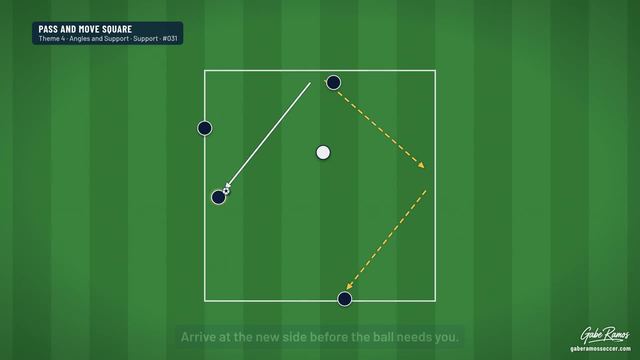 Ages 11+ · Possession and passingPass and Move Square
A 4v1 rondo with one rule that changes everything: after you pass, you must move to a different side of the square before you can receive again.
Open the activity ›All ten rungs of this theme, and nine more themes
100 Possession Activities is a 115-page PDF with 100 animated MP4 videos: rondos, playing out from the back, through the lines, support, switching, overloads, movement, timing, counter-pressing and counter-attacks. Print the page, watch the clip, run the session.