Coaching tools › Tools › Field sizes
Reference · for coaches, parents and registrarsSoccer field size, goal size and ball size
by age group
Every number a youth coach or club registrar gets asked for, on one page: field dimensions, goal and ball sizes, game length, keepers, offside, the build-out line and heading rules for 4v4, 7v7, 9v9 and 11v11, under U.S. Soccer’s Player Development Initiatives. Birth years are for the 2026-27 season.
Field, goal, ball and game length
| Format | Ages (2026-27) | Field, length × width | Goal | Ball | Game length |
|---|---|---|---|---|---|
| 4v4 | U6, U7, U8 Aug 2018 – Jul 2021 | 25–35 × 15–25 yd | 4 ft × 6 ft | 3 | 4 × 10 min quarters |
| 7v7 | U9, U10 Aug 2016 – Jul 2018 | 55–65 × 35–45 yd | 6.5 ft × 18.5 ft | 4 | 2 × 25 min halves |
| 9v9 | U11, U12 Aug 2014 – Jul 2016 | 70–80 × 45–55 yd | 7 ft × 21 ft | 4 | 2 × 30 min halves |
| 11v11 | U13 and up Jul 2014 and earlier | 100–130 × 50–100 yd | 8 ft × 24 ft | 5 | 2 × 35 (U13–14), 2 × 40 (U15–16), 2 × 45 (U17+) |
Sources: U.S. Soccer Player Development Initiatives small-sided standards (4v4, 7v7, 9v9); FIFA Laws of the Game and US Youth Soccer rules of play for 11v11. Leagues may vary inside the ranges, and some use 5v5 at the youngest ages.
Keepers, offside, build-out line and heading
| Format | Goalkeeper | Offside | Build-out line | Heading |
|---|---|---|---|---|
| 4v4 | No keeper | No | No | No heading |
| 7v7 | Keeper | Yes | Yes | No heading |
| 9v9 | Keeper | Yes | No | No heading at U11; limited at U12 |
| 11v11 | Keeper | Yes | No | Allowed from U14; limited at U13 |
What the sizes mean for how you coach
4v4: everything is close
A 30 by 20 field with no keeper means every player is never more than a few yards from the ball. That is the point. The format is built for touches, 1v1 moments and finding space, which is why the ages 4 to 6 activities are all dribbling games and the U6 practice plan ends with 3v3 to cone goals. Two or three small fields side by side beat one bigger one every time.
7v7: the first shape and the build-out line
At 55 by 35 a team can hold a shape, so U9 is where positions start: a keeper, two backs, three midfielders and a striker in a 2-3-1. The build-out line gives the keeper and backs room to play the first pass, and offside is judged from it rather than halfway. The U10 practice plan and the U12 plan are written for this field and the next one.
9v9: a plan, not just a shape
Seventy by forty-five yards and two more players is enough field to switch the play and enough players to press as a unit. The build-out line goes away, so playing out of the back has to be a habit by now, not a rule. The 2-3-3 for 9v9 explains what changes from 7v7 and what does not.
11v11: the full pitch
A 110 by 70 field needs a game model: a build shape, a block, triggers and rest defense, because no player can cover the distances alone. The 4-3-3 build-up guide and the pressing guide are where to start, and the U14 practice plan runs the first phase of play.
Questions coaches and parents ask
How big is a U8 soccer field?
Under U.S. Soccer's small-sided standards a U6, U7 or U8 field is 25 to 35 yards long and 15 to 25 yards wide, played 4v4 with no goalkeeper, 4 ft by 6 ft goals and a size 3 ball. Many clubs mark two or three of these fields across one half of a full pitch.
How big is a U10 soccer field?
U9 and U10 play 7v7 on a field 55 to 65 yards long and 35 to 45 yards wide, with 6.5 ft by 18.5 ft goals, a size 4 ball and a build-out line. A 7v7 field fits across half of a full-size pitch.
How big is a U12 soccer field?
U11 and U12 play 9v9 on a field 70 to 80 yards long and 45 to 55 yards wide, with 7 ft by 21 ft goals and a size 4 ball. It is the last step before the full pitch at U13.
What is the build-out line?
A line across each half, halfway between the penalty area and the halfway line, used only at 7v7. When the keeper has the ball in their hands, or on a goal kick, the other team must drop behind it until the ball is played. Offside at 7v7 is judged from the build-out line, not the halfway line. It exists so nine-year-olds learn to play out of the back without being swarmed.
When can players head the ball?
U.S. Soccer's concussion initiative bans heading in games and training for U11 and younger. At U12 and U13 heading is limited in training to a small number of repetitions per week. From U14 it is allowed, and taught.
What ball size does each age use?
Size 3 through U8, size 4 at U9 to U12, size 5 from U13. A size 4 ball on a 4v4 field is the most common equipment mistake in rec soccer; the heavier ball flattens the youngest players' technique.
Why are the field sizes a range and not one number?
The standards give a range so clubs can fit fields onto the space they have. A 7v7 field can be anything from 55 by 35 to 65 by 45. Smaller is usually better for development at the younger ages: more touches, more decisions, less running between them.
Keep reading
 CalculatorWhat age group is my child in?
Enter a date of birth and get the 2026-27 group, next season’s and the game format.
Open the calculator ›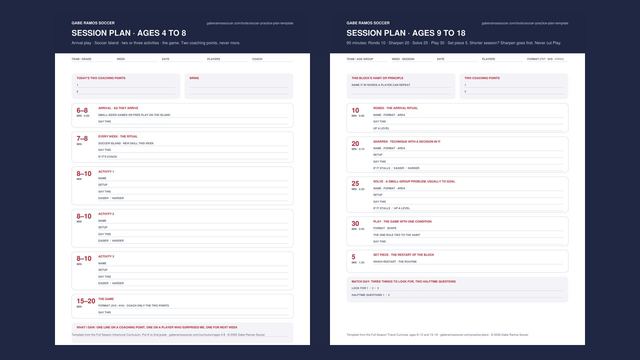 PrintablePractice plan template
A one-page session plan in the shape the books use, for ages 4 to 8 and 9 to 18.
Get the template › Free practice plansComplete sessions by age
U6 to U14, every minute accounted for, with a video of each activity.
See the plans ›