Coaching tools › Activities › Possession and passing
Free activity · 100 Possession ActivitiesBreak the Line
A 30x20 with a halfway line, 4v2 in the first half and 2v2 in the second. The first group keeps it until a pass breaks the line. The passer can follow it in, which turns 2v2 into 3v2. That is how a line-breaking pass really pays off.
Setup
A 30x20 with a halfway line. 4v2 in the first half, 2v2 in the second. The ball starts in the first half.
How it works
- The first-half team keeps it until a pass breaks the line into a second-half teammate.
- The passer may follow the ball in, making it 3v2.
- Defenders in the first half may not cross.
Scoring
A line-breaking pass and three more passes in the far half is a point.
- Second-half players: come to the ball as the pass is played.
- Break the line with a pass along the ground, not a chip.
- Follow your pass: numbers up on the far side.
Make it easier or harder
- Progression 1: Only one touch allowed for the second-half receiver.
- Progression 2: The far half shrinks: 30x12.
Coach’s notes
- If It Stalls: Line-breakers going astray? Let the receiver check to the line and take one touch back.
Why it works
A line-breaking pass on its own often gets a player surrounded. This teaches the part after it: the passer follows, and the team has more players in the new area than the defense.
Look at the timing of the second-half players. Coming to the ball too early brings a defender with them. Coming as the pass is played gives the passer a clean target.
Where it sits
This is activity 24 of 100 in 100 Possession Activities (Theme 3 · Through the Lines). The book is ten themes of ten rungs each, from a 3v1 square to a full 9v9 transition game, and every activity has its setup, rules, scoring, two progressions, three coaching points and an animated video like the one above.
All playing through the lines drills ›
More like this
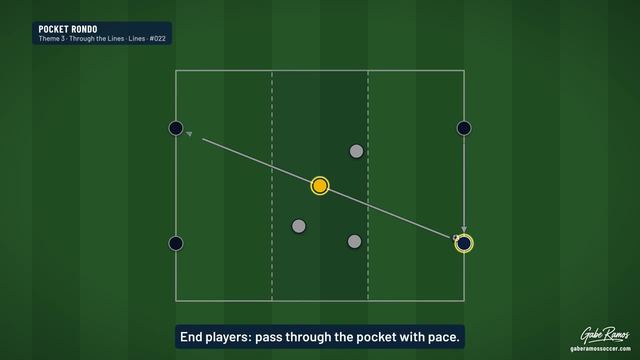 Ages 11+ · Possession and passingPocket Rondo
Three lines of cones split a 15x12 into thirds. Four attackers on the ends, one in the middle third with three defenders.
Open the activity ›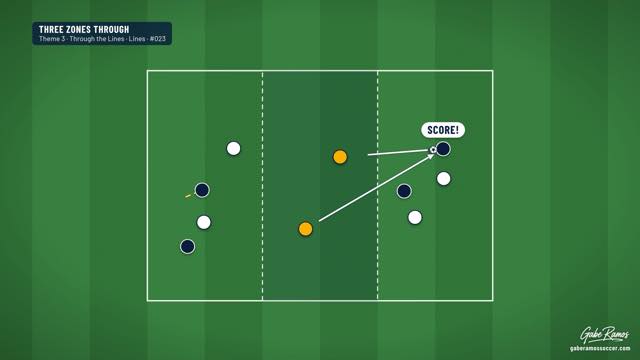 Ages 11+ · Possession and passingThree Zones Through
Three zones and two neutrals. You can only score by going through the middle.
Open the activity ›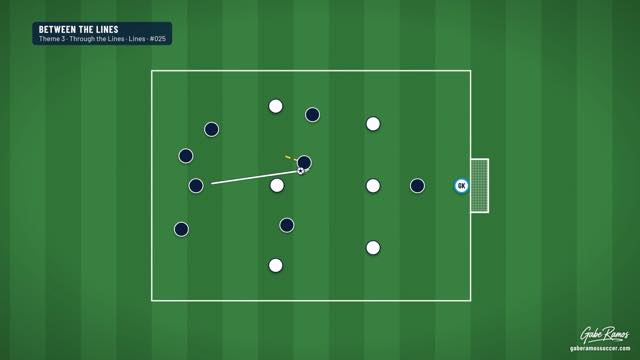 Ages 11+ · Possession and passingBetween the Lines
Score by receiving between two lines of defenders and turning.
Open the activity ›All ten rungs of this theme, and nine more themes
100 Possession Activities is a 115-page PDF with 100 animated MP4 videos: rondos, playing out from the back, through the lines, support, switching, overloads, movement, timing, counter-pressing and counter-attacks. Print the page, watch the clip, run the session.