Coaching tools › Activities › Playing out of the back
Free activity · 100 Possession ActivitiesKeeper and Two
The simplest build-up picture: a goal, a keeper and two backs on the edge of the box against one presser, with two gates on the far line. Every ball starts with the keeper and the backs split to the corners.
Setup
A goal, a keeper and two backs on the edge of the box against one presser. Two gates on the far line.
How it works
- Every ball starts with the keeper. Backs split to the corners of the box.
- Score by passing through either gate.
- If the presser wins it, they shoot.
Scoring
Ten balls; count the gates.
- Backs: split as wide as the box, open your body to the field.
- Keeper: play the back the presser is not going to.
- Play with the inside of the foot along the ground.
Make it easier or harder
- Progression 1: The presser starts on the penalty spot, live at once.
- Progression 2: A second presser. Now the keeper is the free player: use them.
Coach’s notes
- If It Stalls: Backs receiving square? Make them touch the corner cone of the box before the ball is played.
Why it works
Before any team can play out of the back it needs this picture to be automatic: keeper on the ball, backs as wide as the box, bodies open to the field. One presser is enough to make the keeper choose, and a wrong choice costs a shot.
Add the second presser only when the backs are splitting without being told. Then the keeper becomes the free player, and the pass back to the keeper stops looking like a retreat.
Where it sits
This is activity 11 of 100 in 100 Possession Activities (Theme 2 · Playing Out From the Back). The book is ten themes of ten rungs each, from a 3v1 square to a full 9v9 transition game, and every activity has its setup, rules, scoring, two progressions, three coaching points and an animated video like the one above.
More like this
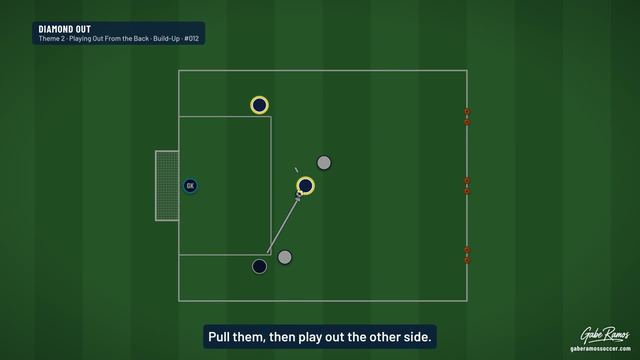 Ages 11+ · Playing out of the backDiamond Out
Keeper, two backs and a center mid in a diamond against two pressers, with three gates across the far line.
Open the activity ›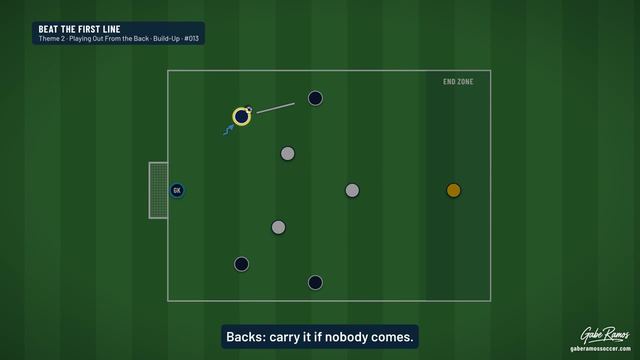 Ages 11+ · Playing out of the backBeat the First Line
Half a field. Keeper, two backs and two wide mids build against three pressers, and a striker waits in an end zone past halfway.
Open the activity ›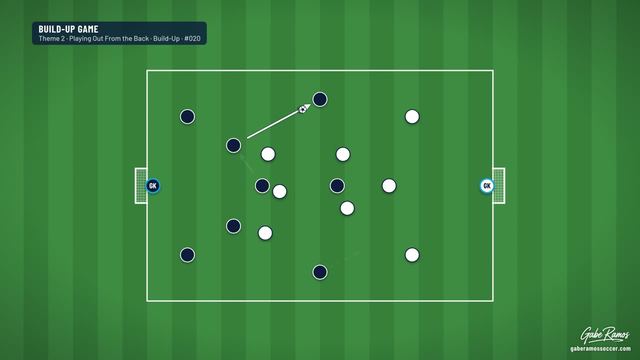 Ages 11+ · Playing out of the backBuild-Up Game
A full 9v9 where every restart is played short from the keeper and the opponents drop to halfway until the first pass is received.
Open the activity ›All ten rungs of this theme, and nine more themes
100 Possession Activities is a 115-page PDF with 100 animated MP4 videos: rondos, playing out from the back, through the lines, support, switching, overloads, movement, timing, counter-pressing and counter-attacks. Print the page, watch the clip, run the session.